

In like a lion…
The best of weather, the worst of weather... predicting conditions in March can be a dickens of a time
Advertisement
Read this article for free:
or
Already have an account? Log in here »
To continue reading, please subscribe:
Monthly Digital Subscription
$1 per week for 24 weeks*
- Enjoy unlimited reading on winnipegfreepress.com
- Read the E-Edition, our digital replica newspaper
- Access News Break, our award-winning app
- Play interactive puzzles
*Billed as $4.00 plus GST every four weeks. After 24 weeks, price increases to the regular rate of $19.95 plus GST every four weeks. Offer available to new and qualified returning subscribers only. Cancel any time.
Monthly Digital Subscription
$4.99/week*
- Enjoy unlimited reading on winnipegfreepress.com
- Read the E-Edition, our digital replica newspaper
- Access News Break, our award-winning app
- Play interactive puzzles
*Billed as $19.95 plus GST every four weeks. Cancel any time.
To continue reading, please subscribe:
Add Free Press access to your Brandon Sun subscription for only an additional
$1 for the first 4 weeks*
*Your next subscription payment will increase by $1.00 and you will be charged $16.99 plus GST for four weeks. After four weeks, your payment will increase to $23.99 plus GST every four weeks.
Read unlimited articles for free today:
or
Already have an account? Log in here »
Hey there, time traveller!
This article was published 01/03/2020 (2244 days ago), so information in it may no longer be current.
It’s March, that time when the Prairies are often the scene of an epic battle, between good and evil, spring and winter, warm American air masses and frigid arctic fronts. Glorious shorts weather, paralyzing blizzards: each is equally possible.
It’s the “big transition month between winter and spring on the Prairies,” and that can lead to crazy conditions, says Rob Paola, a retired Environment Canada meteorologist with more than 30 years of experience. His interest in weather has persisted after retirement, so much so he maintains a weather station in his Charleswood backyard.
“As that warmer air is building up over the U.S., where spring comes earlier, it’s trying to shift north, but winter is still hanging tough in Canada,” Paola explains. “That transition between those two competing air masses often results in quite a variable month across the Prairies.

“You’ll get occasions where spring is trying to move into southern Manitoba, but it will be battling against a still-frigid arctic air that’s well-established over the Prairies and northern Canada.”
Now that the calendar has turned from February, it’s the perfect time to revisit three of the most notable March weather events in our city’s history.
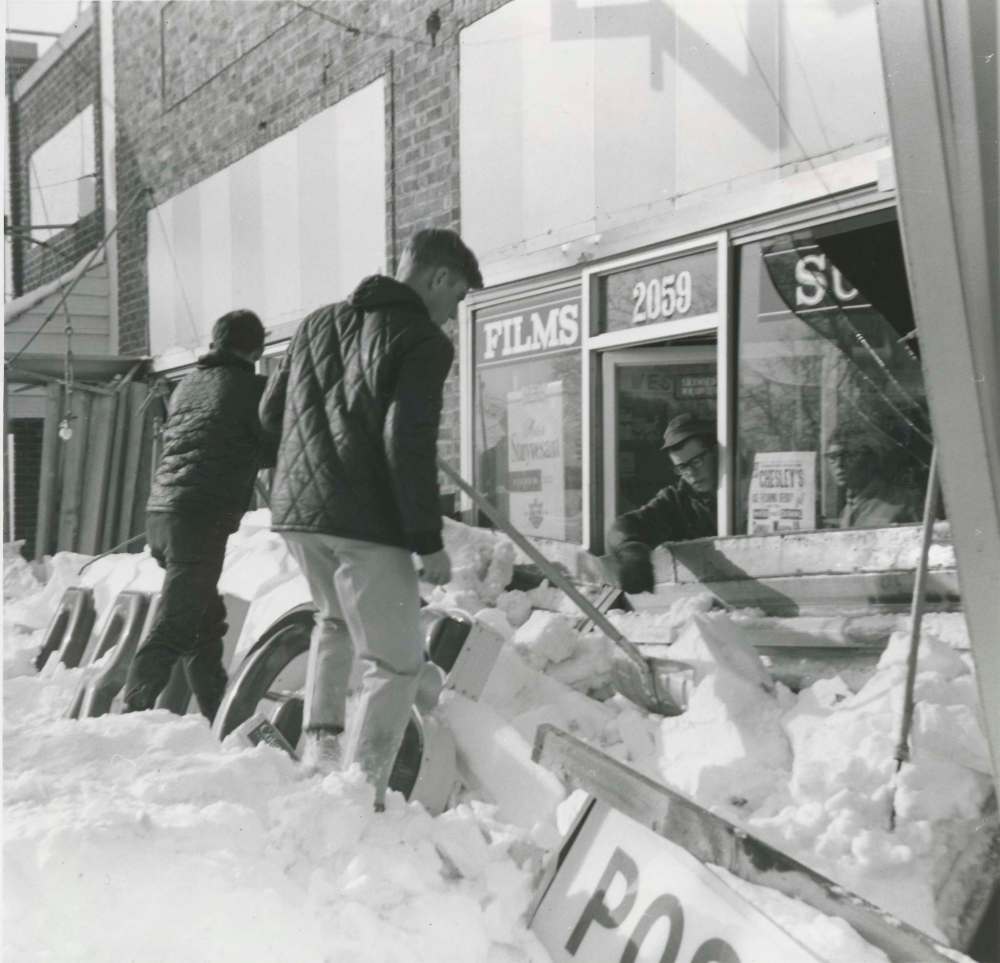
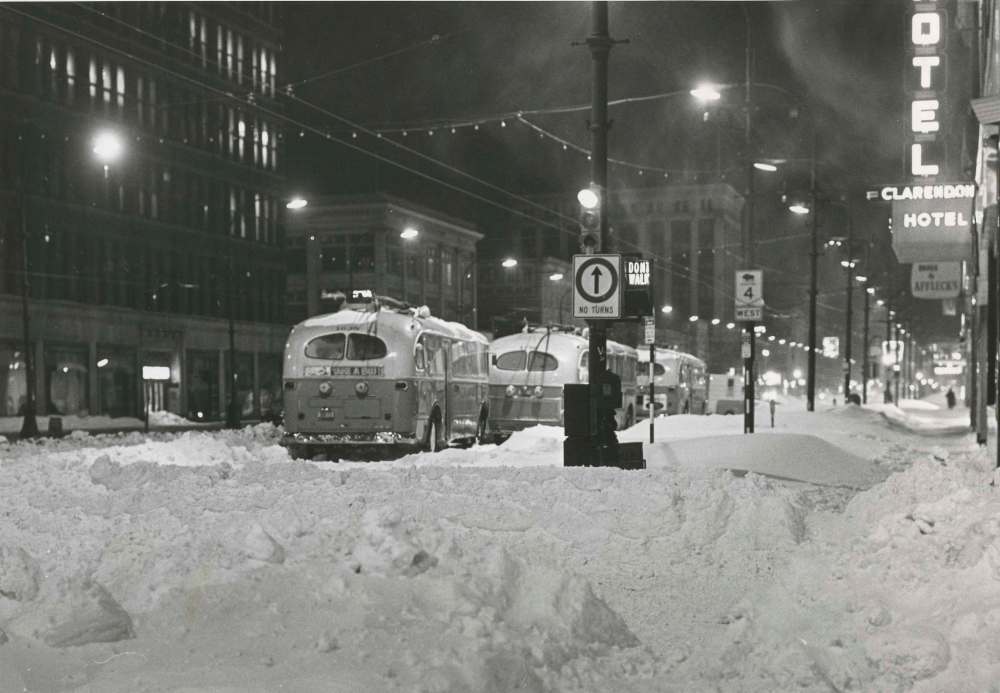
Cars completely buried under mountains of white. Buses abandoned, unable to move. Winnipeggers dwarfed by huge snow drifts whipped up by bitter, howling winds.
Those were some of the images that graced the Free Press in the wake of a massive Colorado Low that dumped more than 35 centimetres (reported in the paper as 14 inches, due to Canada not having adopted the metric system yet) on the city on March 4, 1966.
“The big story of that event was the winds,” Paola says. “The snowfall amounts were impressive… but the big thing about the blizzard of ’66 were the ferocious winds. Winds were (gusting to) 100 to 120 km/h, lasted all day.”
Those winds brought whiteout conditions to the airport for 14 straight hours as conditions deteriorated on a Friday afternoon. Just about everything ground to a halt as roads became impassable: 135 of Metro Winnipeg Transit’s 400 buses were stuck on the streets; by 11 a.m., the service ceased operations completely.

Mayor Stephen Juba called for everyone “to stay at home and keep their cars off the streets,” but it was too late for many to heed that advice.
“It caught people by surprise,” Paola says — the storm was not well forecast. “I believe they were thinking it was going to track just to the southeast of Winnipeg, and Winnipeg got hit a lot harder than they were expecting.”
“People tried to make it to school or go to work… and they became stranded wherever they were,” he says. More than 1,500 people were forced to sleep over in The Bay, Eaton’s, and other retail stores.
Downtown had eerie atmosphere, Raymond Sinclair wrote in a piece headlined “Nobody’s Downhearted Here.”
“The thunderous clatter of a jackhammer, a daily feature of normal, noisy downtown life, had ceased,” he wrote. “The wood and metal signs were toppled. A red mailbox laid on its side, parcel tray agape as if gasping for breath. And everywhere, crazily at odds with the established order of a metropolis, abandoned cars, noses up and down in deep snowdrifts.”
“The end of the world could well have been this day.”
The storm created everyday heroes. Policemen acted as midwives and delivered a baby in a North End home. A group of amateur radio operators delivered food, medicine, and other essentials using skidoos. A man named Alderman Leonard Claydon set up an impromptu bus service along Main Street using his panel truck. “You can get through anything with it,” he said. “We should have a hundred of them out by now.”
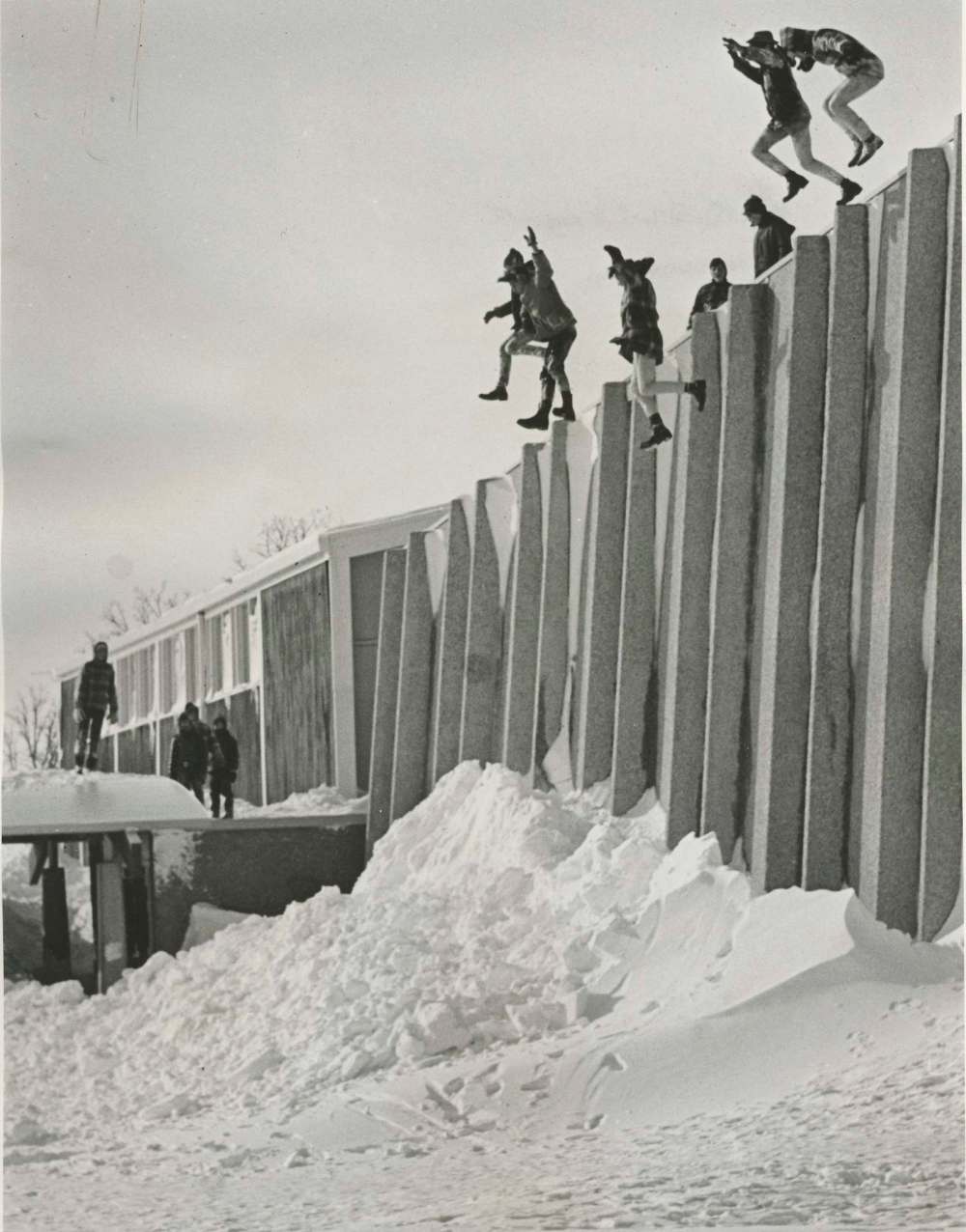
Teenagers, meanwhile scoffed at the conditions.
“At least half a dozen teen-age youths… wearing the ubiquitous blue-jeans, shirts and sweaters while scorning coats, scarves and gloves, will tell their grandchildren of ‘that blizzard of sixty-six,’” Sinclair predicted.
He was certainly right. It is an event well-known by Winnipeggers, by both those who lived through it and those who were simply regaled with tales, 54 years later.
Interestingly, the blizzard of 1966 is not the record for single-day snowfall, Paola says. The most snow to ever fall in Winnipeg in one day is 38 centimetres. That occurred in 1935, also on March 4.

The infamous April storm of 1997 — the three-day beast that led to the Flood of the Century — brought 48 centimetres.
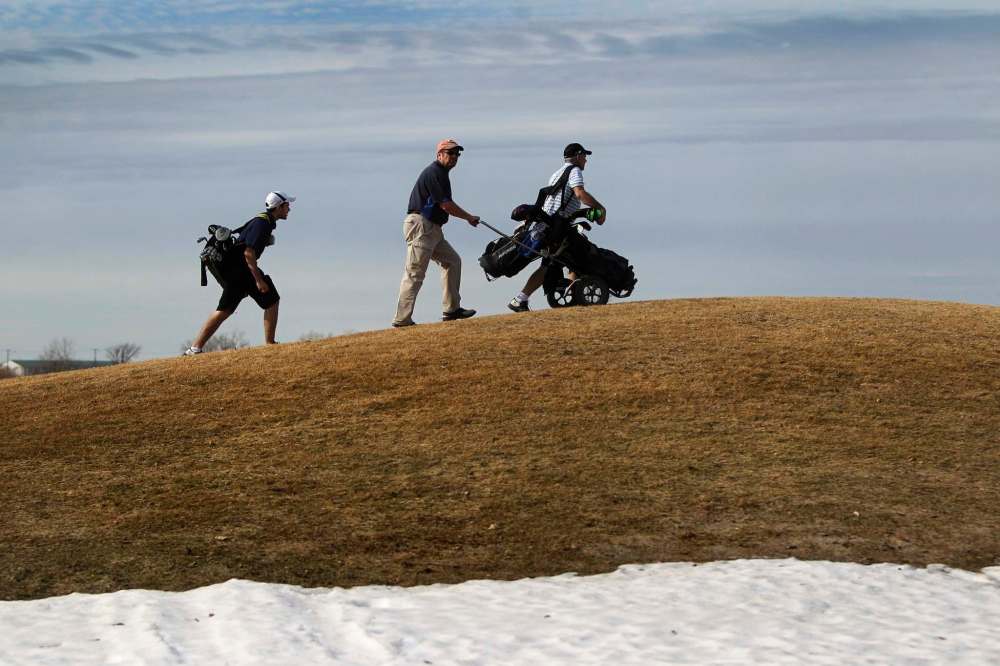
The year 2012 was an entirely different scene from 1966. Instead of bundling up and shovelling snowdrifts, Winnipeggers were soaking up the sunshine, sporting shorts, sitting on patios, and hitting the links.
That’s because the city recorded its warmest March in 140 years since records began in 1872.
There was “a huge upper ridge in the atmosphere which built up over North America and that allowed very warm, spring-like air over the U.S. and well into central Canada, including Manitoba,” Paola says.
Snow on the ground limits how warm highs can get, because sunlight reflects off the snow rather than absorbing into the ground, Paola explains.
“We had about 20 centimetres of snow on the ground by the 11th, but as that heat wave developed that snow vanished within two days,” Paola says. “With no snow and a persistent flow of warm air from the U.S., we just got unprecedented temperatures.”
At one point, Winnipeg recorded highs at least 15 degrees above normal for a week straight; the city saw its warmest March temperature of all time, too: the mercury soared to 23.7 C on March 19.
“Not only was it 20 degrees, it was a sunny 20 degrees,” Paola says. “It wasn’t like overcast with drizzle. It was truly beautiful weather with warm temperatures, no snow, and sunshine. You couldn’t ask for more in a Winnipeg March, for sure.”
The daily average for the month ended up being 2.2 C, an incredible 8.3 degrees above average.
The May-like weather led to unseasonable scenes. Golf season began on St. Patrick’s Day — nearly a month earlier than usual — Melissa Martin reported on March 18. One golfer at John Blumberg called the weather “a gift from god.” People biked and skateboarded on snow-free sidewalks and streets.
“’Tobans turned out in droves to cram parks and’ restaurant patios,” Martin wrote. “The Forks buzzed with activity, the bells of ice cream trucks tinkled down residential streets, and Sargent Sundae was thronged all afternoon by folks popping by for a cool treat.”

What The Forks couldn’t offer their visitors, understandably enough, were on-ice activities. The abnormal temps and consistent sunshine shuttered the skating trails on the Red and Assiniboine rivers by March 10, Kevin Rollason reported.
“It really did feel like May and it was such a novelty to experience… people just loved it,” Paola recalls. “Personally, I was hoping that this was the start of a new trend — that this is the way all Marches would be in southern Manitoba — but we haven’t seen anything like it since. That was a historic March heat wave that will stay in the record books for a while.”
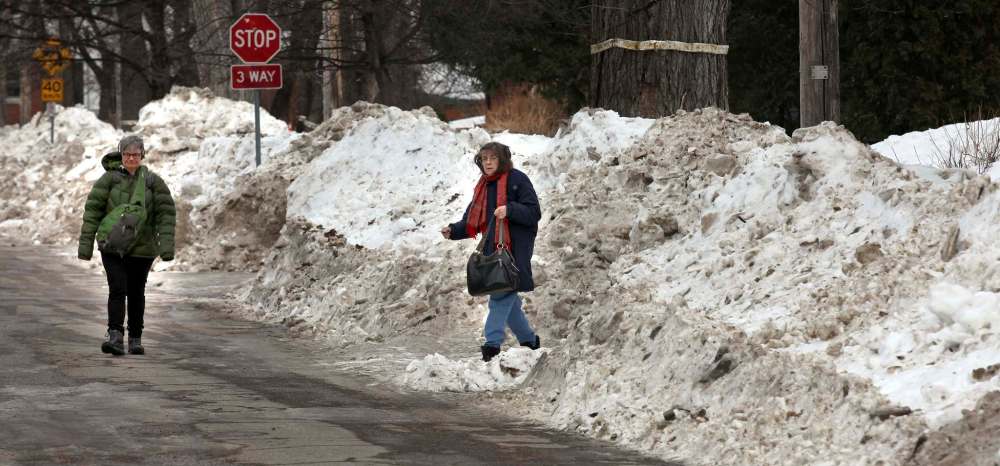
Two years later, however, there would be no short sleeves on St. Patrick’s Day. March of 2014 was simply “brutal,” Paola says.
The average temperature was -12.7 C, nearly seven degrees colder than average. The lowest temperature was -34.4, and only five days had a high above average.
That wouldn’t have been so bad if the preceding months had been anywhere close to decent, but they weren’t — December through January were also below average, temperature wise. Combined with well-above average snowfall, winter 2013-14 was classified as Winnipeg’s worst since 1898.
“That’s right, 1898, when the Spanish-American War was raging and the Montreal Victorias won their fourth-straight Stanley Cup. The year of the first recorded motor-vehicle fatality and the year Marie and Pierre Curie discovered radium,” the illustrious Randy Turner wrote on April 5.
“Nobody alive can say they’ve had it colder in Winnipeg,” Environment Canada’s David Phillips remarked in the same article. “The story about this winter was the relentlessness of it. There was really no break. It was from the get-go…
“So if we award the prize for citizens who’ve endured the toughest winter, I think (Winnipeggers) would win gold. I’m not sure you want to brag about misery, but…”
The relentless cold caused all kinds of problems. While many were undoubtedly cursing their ancestors for settling in a place so unfit for human inhabitation, most likely didn’t have to work outside. City crews, however, responding to an unprecedented surge in frozen pipes, weren’t so lucky.
By late March, there were nearly 2,000 cases of frozen pipes in the city and more than 6,300 properties at risk, due to unusually deep frost in the soil. While a usual winter would see a frost depth of between 1 and 1.5 metres, crews using specialized thawing machines to get water flowing again were regularly encountering depths of 2.1 metres or deeper, water distribution engineer Tim Shanks told the Free Press in late February. They couldn’t keep up with demand.
Some enterprising Winnipeggers took it as an opportunity. Contractor Jared Horbatiuk, for example, jerry-rigged a pipe-thawing machine for about $600 and restored water for some residents… for a fee.
“Today was our last day doing favours,” he told Aldo Santin on March 25. “Tuesday, we’re doing this as a business.”
Things got so dire then-mayor Sam Katz appealed to the provincial government for disaster financial assistance; the crisis ended up costing the city $8 million, the CBC reported in November.

After the miserable March, Winnipeggers were “treated” to an awful April that was once again, colder than average.
“It just felt like it would never end,” Paola says. “We didn’t lose the snow cover until the mid or end of April.
“Once we get to April it’s like ‘all right, we’ve done our penance. Give us warm weather, please.’”
Winter did eventually end, of course, but not until late May when temps hit plus 34 on the 24th. That was a boon to beloved ice cream vendor Bridge Drive-In, as the Elm Park Bridge turned 100 that day.
City councillors Brian Mayes and Jenny Gerbasi unveiled an official plaque that afternoon commemorating the occasion before treating about 40 onlookers to ice cream, Alexandra Paul reported, a fitting way to celebrate surviving the worst Mother Nature had to offer.