

Indigenous woman to lead reconciliation centre

Advertisement
Read this article for free:
or
Already have an account? Log in here »
To continue reading, please subscribe:

Digital Subscription
One year of digital access for only $205*
- Enjoy unlimited reading on winnipegfreepress.com
- Read the E-Edition, our digital replica newspaper
- Access News Break, our award-winning app
- Play interactive puzzles
*First annual payment billed as $205.00 + GST for one year. This annual subscription will automatically renew at $233.00 + GST every 52 weeks (10% off the regular annual price of $259.35). Offer available to new and qualified returning subscribers only. Cancel any time.
To continue reading, please subscribe:
Add Free Press access to your Brandon Sun subscription for only an additional
$1 for the first 4 weeks*
- Enjoy unlimited reading on winnipegfreepress.com
- Read the E-Edition, our digital replica newspaper
- Access News Break, our award-winning app
- Play interactive puzzles
*Your next Brandon Sun subscription payment will increase by $1.00 and you will be charged $17.95 plus GST for four weeks. After four weeks, your payment will increase to $24.95 plus GST every four weeks.
Read unlimited articles for free today:
or
Already have an account? Log in here »
Hey there, time traveller!
This article was published 11/03/2021 (1993 days ago), so information in it may no longer be current.
AMPLIFYING the voices of Indigenous women will be a priority for the new executive director of the National Centre for Truth and Reconciliation.
For the first time, the centre named an Indigenous woman to the top post.
Stephanie Scott, who was director of operations and has been involved with the Winnipeg-based centre since 2010, called the promotion a “gift.”
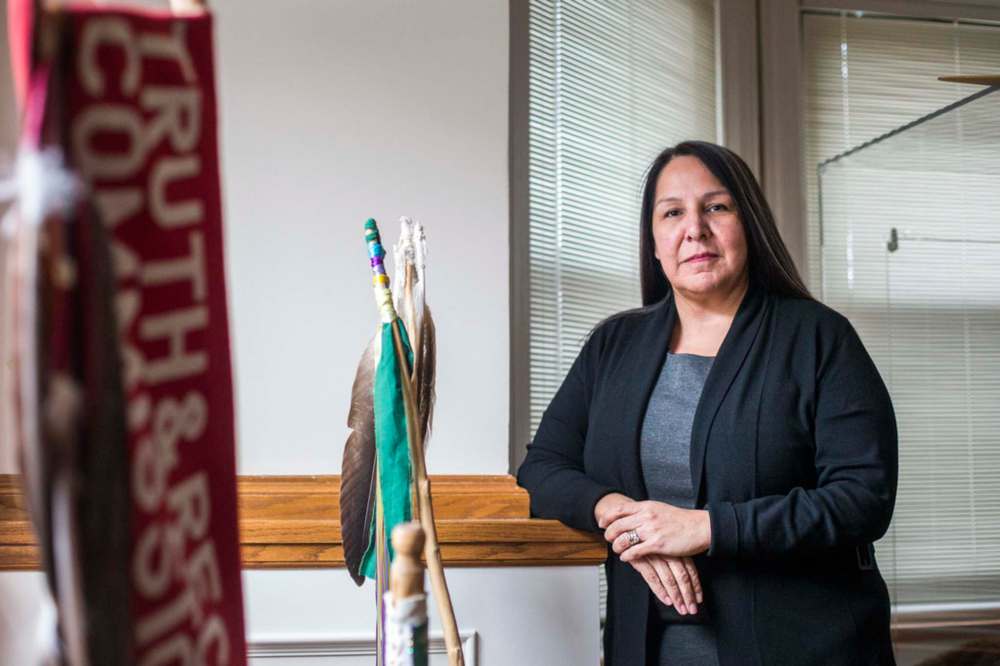
“It’s a lot of very important work, and we need to do it on behalf of survivors, and I don’t do this work alone,” she said.
Scott said she hopes to highlight the voices of Indigenous women.
“Women are taking back some power as matriarchs in the community, as knowledge-keepers, providing wisdom,” she said. “Being an Indigenous woman, I’ve worked very, very hard over the past 20, 30 years.”
The centre is on the University of Manitoba campus, which has faced its own hurdles in advancing Indigenous leadership — two Indigenous administrators at the university have left since 2018, both citing systemic racism. Scott said working on behalf of students entering the institution is one of her priorities. She credited the work of vice-president (Indigenous) Catherine Cook.
“I’m a brown-skinned Indigenous woman, you know. I still go into stores and get followed, it doesn’t matter what I’ve achieved in this society… I think the university has made great strides,” Scott said.
“Not a perfect world, but with Dr. Cook as vice-president, I think we’re absolutely going to go places and make changes for the students.”
Scott has worn many hats throughout her career, including working at CBC, the Aboriginal People’s Television Network, the National Film Board and doing community outreach work. She was born and raised in Winnipeg, but her family is from Roseau River First Nation. She was adopted by a non-Indigenous family during the Sixties Scoop and said she was surrounded by racism as she grew up away from her culture.
She said she gained perspective on her “tumultuous” upbringing when she had twin daughters.
“It really, really made me wake up. The lifestyle I was engaging in changed because it was no longer just me, I had two little children to raise. (It) was super important to give them a good life and make change,” she said.
She credits the love of her daughters and four grandchildren as the driving force behind her work. In her new job, Scott said she will work on a review of the records the NCTR has on missing Indigenous children who didn’t return home from residential schools.

The centre recently received funding from the Canada Foundation for Innovation to develop a database to make its archives more accessible to the public.
For other Indigenous women in Winnipeg who may look to her as an inspiration, Scott said hard work and collaboration are key.
“Learn from others, look for mentors. There are so many gifted elders, survivors, knowledge-keepers,” she said. “We have professors, teachers, judges, lawyers. There’s a movement happening right now.”
malak.abas@freepress.mb.ca
Twitter: malakabas_
Malak Abas is a city reporter at the Free Press. Born and raised in Winnipeg’s North End, she led the campus paper at the University of Manitoba before joining the Free Press in 2020. Read more about Malak.
Every piece of reporting Malak produces is reviewed by an editing team before it is posted online or published in print — part of the Free Press‘s tradition, since 1872, of producing reliable independent journalism. Read more about Free Press’s history and mandate, and learn how our newsroom operates.
Our newsroom depends on a growing audience of readers to power our journalism. If you are not a paid reader, please consider becoming a subscriber.
Our newsroom depends on its audience of readers to power our journalism. Thank you for your support.
Malak Abas is a city reporter at the Free Press. Born and raised in Winnipeg’s North End, she led the campus paper at the University of Manitoba before joining the Free Press in 2020. Read more about Malak.
Every piece of reporting Malak produces is reviewed by an editing team before it is posted online or published in print — part of the Free Press‘s tradition, since 1872, of producing reliable independent journalism. Read more about Free Press’s history and mandate, and learn how our newsroom operates.
Our newsroom depends on a growing audience of readers to power our journalism. If you are not a paid reader, please consider becoming a subscriber.
Our newsroom depends on its audience of readers to power our journalism. Thank you for your support.
Advertisement Advertise With Us
Advertisement Advertise With Us