

Internal election reform should be high on Tories’ priority list for 2022

Advertisement
Read this article for free:
or
Already have an account? Log in here »
To continue reading, please subscribe:
Monthly Digital Subscription
$1 per week for 24 weeks*
- Enjoy unlimited reading on winnipegfreepress.com
- Read the E-Edition, our digital replica newspaper
- Access News Break, our award-winning app
- Play interactive puzzles
*Billed as $4.00 plus GST every four weeks. After 24 weeks, price increases to the regular rate of $19.95 plus GST every four weeks. Offer available to new and qualified returning subscribers only. Cancel any time.
Monthly Digital Subscription
$4.99/week*
- Enjoy unlimited reading on winnipegfreepress.com
- Read the E-Edition, our digital replica newspaper
- Access News Break, our award-winning app
- Play interactive puzzles
*Billed as $19.95 plus GST every four weeks. Cancel any time.
To continue reading, please subscribe:
Add Free Press access to your Brandon Sun subscription for only an additional
$1 for the first 4 weeks*
*Your next subscription payment will increase by $1.00 and you will be charged $16.99 plus GST for four weeks. After four weeks, your payment will increase to $23.99 plus GST every four weeks.
Read unlimited articles for free today:
or
Already have an account? Log in here »
Hey there, time traveller!
This article was published 30/12/2021 (1570 days ago), so information in it may no longer be current.
Manitoba’s Progressive Conservative party has a challenge in the new year: how to change its leadership election process without alienating grassroots members, while also avoiding the kind of debacle it experienced in the fall.
After coming within a whisker of electing a leader who ran on an anti-vaccine mandate platform before the Oct. 30 vote, the party will almost certainly revise its voter eligibility rules in 2022.
Former Conservative MP Shelly Glover, who ran for the leadership to replace outgoing party boss Brian Pallister, signed up thousands of new members during the race. She did so largely by appealing to opponents of vaccine mandates and other measures taken by the province to fight COVID-19.
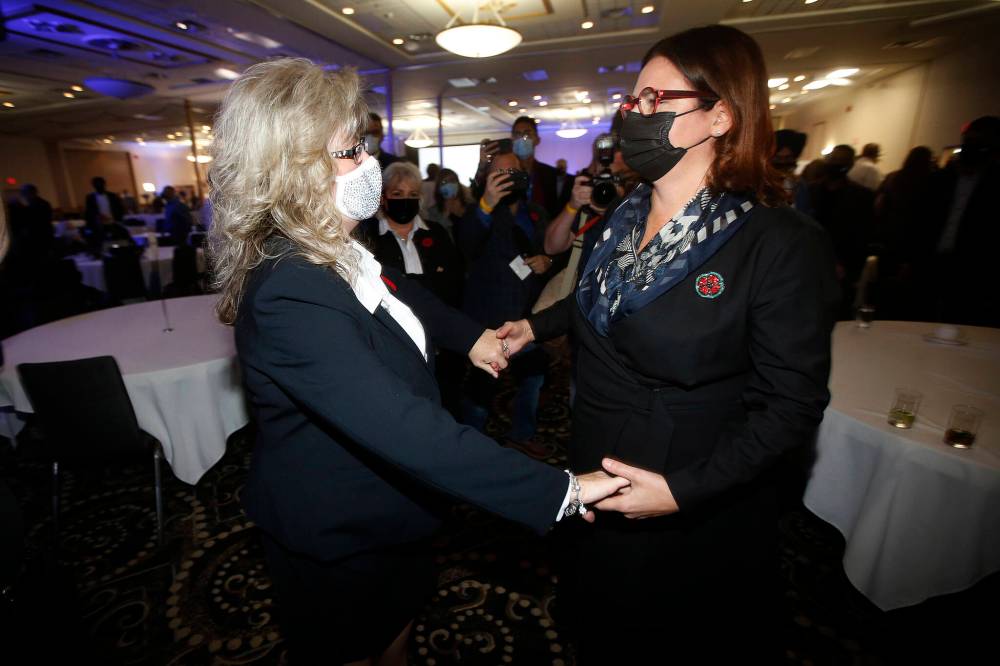
Under the current rules, candidates were allowed to sign up new members until a month before voting day. Last-minute signups allow candidates to attract new blood to the party. However, under the Tories’ one member, one vote system, it also leaves the party open to a hostile takeover.
Glover’s strategy was to flood ballot boxes with new members opposed to vaccine mandates and public-health restrictions. She exploited the polarization around vaccines, particularly in parts of rural Manitoba where anti-vaccine sentiment is strong. It worked remarkably well: she won 49 per cent of the vote. Heather Stefanson, now premier, garnered 51 per cent support.
Glover is a conspiracy theorist’s dream. She has the knack for raising suspicions about issues without providing supporting evidence, like suggesting nurses could be fired for not getting vaccinated (they can undergo testing instead), or that available treatment for COVID-19 was being suppressed (it wasn’t). There’s little doubt it helped Glover attract a fringe element to her campaign.
When she lost the leadership race, Glover took her conspiracy theories to the courtroom. She alleged, without evidence, that ballots may have been tampered with when the votes were counted. That could have altered the results of the election and deprived her of victory, she claimed. The former Winnipeg Police Service officer wanted the results of the election declared invalid by the court. However, she provided no evidence to support her accusations.
In addition to bogus claims that unsealed ballot boxes could have been tampered with, Glover said a spreadsheet that contained the number of party members who voted in the election (sent out by the party on the eve of the leadership convention) didn’t match the final count on election day. It was the central argument of her legal challenge. However, she refused to produce the spreadsheet. She didn’t even file it as an exhibit in court. There was no way of verifying the veracity of her claims. Glover wanted the court — and the public — to just take her word for it.
Court of Queen’s Bench Justice James Edmond didn’t buy any of the arguments. While he found there was one (“arguably” two) “irregularities” in the voting process — which the Supreme Court of Canada has ruled can be expected in any election — the party’s rules and procedures were followed. He said there was no evidence of ballot tampering.

In fact, the party went above and beyond its duty by hiring a “respected” accounting firm and a security company to supervise the ballots “to preserve the integrity of the election process,” Edmond wrote in his 46-page decision.
With the legitimacy of the election confirmed by the court, the party now has to address the question of how to select leaders in the future.
It has a few options, including a minimum membership period to vote for a leader, such as six months or a year. The party could also give weighted preference to certain members, such as party executives and MLAs (the NDP has similar provisions in its delegate system for choosing leaders, including guaranteed voting rights for organized labour).
The Tories aren’t expected to hold a leadership race any time soon, but they have to be prepared for one; who knows what could happen if they lose the 2023 general election? Which means they will likely begin the process of revising their election rules in 2022. The last thing they want is another Shelly Glover hijack attempt.
tom.brodbeck@freepress.mb.ca
Tom Brodbeck is an award-winning author and columnist with over 30 years experience in print media. He joined the Free Press in 2019. Born and raised in Montreal, Tom graduated from the University of Manitoba in 1993 with a Bachelor of Arts degree in economics and commerce. Read more about Tom.
Tom provides commentary and analysis on political and related issues at the municipal, provincial and federal level. His columns are built on research and coverage of local events. The Free Press’s editing team reviews Tom’s columns before they are posted online or published in print – part of the Free Press’s tradition, since 1872, of producing reliable independent journalism. Read more about Free Press’s history and mandate, and learn how our newsroom operates.
Our newsroom depends on a growing audience of readers to power our journalism. If you are not a paid reader, please consider becoming a subscriber.
Our newsroom depends on its audience of readers to power our journalism. Thank you for your support.
Tom Brodbeck is an award-winning author and columnist with over 30 years experience in print media. He joined the Free Press in 2019. Born and raised in Montreal, Tom graduated from the University of Manitoba in 1993 with a Bachelor of Arts degree in economics and commerce. Read more about Tom.
Tom provides commentary and analysis on political and related issues at the municipal, provincial and federal level. His columns are built on research and coverage of local events. The Free Press’s editing team reviews Tom’s columns before they are posted online or published in print – part of the Free Press’s tradition, since 1872, of producing reliable independent journalism. Read more about Free Press’s history and mandate, and learn how our newsroom operates.
Our newsroom depends on a growing audience of readers to power our journalism. If you are not a paid reader, please consider becoming a subscriber.
Our newsroom depends on its audience of readers to power our journalism. Thank you for your support.
Advertisement Advertise With Us
Advertisement Advertise With Us