

July was smokiest on record in city
Advertisement
Read this article for free:
or
Already have an account? Log in here »
To continue reading, please subscribe:
Monthly Digital Subscription
$1 per week for 24 weeks*
- Enjoy unlimited reading on winnipegfreepress.com
- Read the E-Edition, our digital replica newspaper
- Access News Break, our award-winning app
- Play interactive puzzles
*Billed as $4.00 plus GST every four weeks. After 24 weeks, price increases to the regular rate of $19.95 plus GST every four weeks. Offer available to new and qualified returning subscribers only. Cancel any time.
Monthly Digital Subscription
$4.99/week*
- Enjoy unlimited reading on winnipegfreepress.com
- Read the E-Edition, our digital replica newspaper
- Access News Break, our award-winning app
- Play interactive puzzles
*Billed as $19.95 plus GST every four weeks. Cancel any time.
To continue reading, please subscribe:
Add Free Press access to your Brandon Sun subscription for only an additional
$1 for the first 4 weeks*
- Enjoy unlimited reading on winnipegfreepress.com
- Read the E-Edition, our digital replica newspaper
- Access News Break, our award-winning app
- Play interactive puzzles
*Your next Brandon Sun subscription payment will increase by $1.00 and you will be charged $17.95 plus GST for four weeks. After four weeks, your payment will increase to $24.95 plus GST every four weeks.
Read unlimited articles for free today:
or
Already have an account? Log in here »
Hey there, time traveller!
This article was published 03/08/2021 (1741 days ago), so information in it may no longer be current.
Winnipeggers endured the smokiest July in recorded history: 137 hours of hazy conditions as wildfires raged across the province.
It was the second smokiest month on record; only August 1961 had more smoke — 163 hours — since smoky conditions began being recorded in 1953.
Rob Paolo, a retired Environment Canada meteorologist and volunteer climate observer, said both years were marked by exceptionally dry seasons that sparked many wildfires.
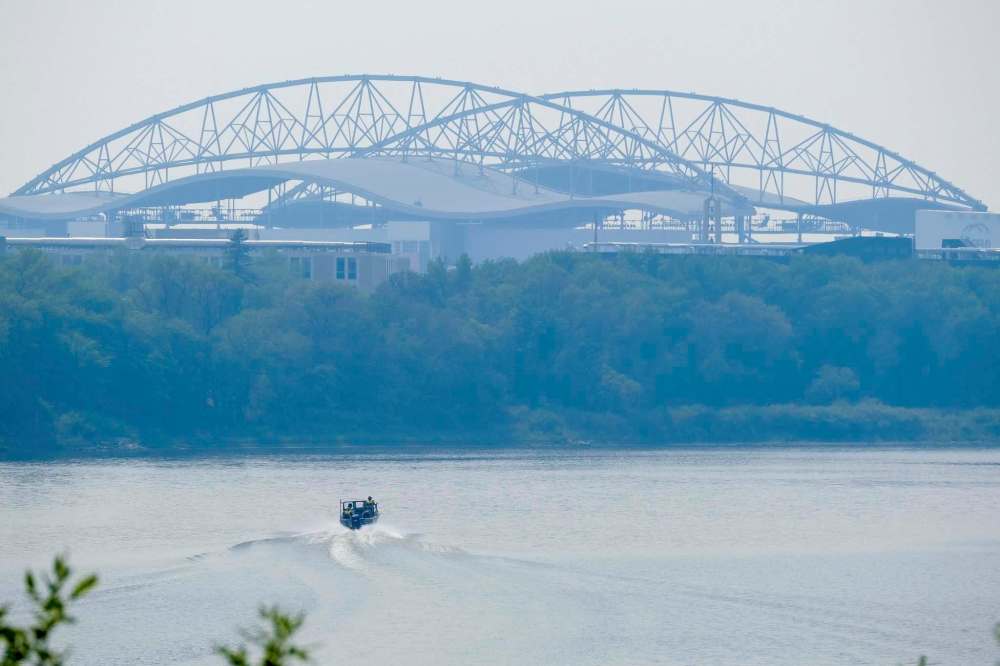
In Winnipeg, the wind tends to come either from the north or south through the Red River Valley, said Paola. This year, the wind patterns have shifted slightly, with the airstream from the northeast pushing down into the south.
Massive fires have been burning in eastern Manitoba, including two close together that have consumed more than 400,000 hectares combined, and dozens in northwest Ontario. The wind has blown that smoke over Winnipeg.
“If we have any sort of northeast or east wind direction, we’re getting smoked directly from there and that can be the thickest. (It) causes the poorest air quality,” said Paolo.
Smoke can also drift in from much farther away, but it tends to be much higher in the atmosphere, he said. Smoke from nearby fires settles lower to the ground.
As of Tuesday, 159 fires were burning in Manitoba, said Don Hallett, assistant director of the Manitoba Wildfire Service.

That doesn’t include a fire in northwestern Ontario that threatens to cross the border. On Sunday, it forced the evacuation of Davidson Lake cottagers in Nopiming Provincial Park. Evacuation notices were also issued to cottagers in the Flanders Lake, Booster Lake and Bird Lake areas, said Hallett.
While the fire hasn’t yet reached the area, Hallett said crews set up sprinklers to douse properties as a precaution.
“If and when this fire does breach the border of Ontario and Manitoba, we’re prepared to do our best to protect those structures,” he said.
Reinforcement personnel has been enlisted from Nova Scotia, New Brunswick and Quebec, said Hallett. Quebec has also lent the province extra water bombers.
cody.sellar@freepress.mb.ca