

Lake Winnipeg rescue prompts ice warning
Advertisement
Read this article for free:
or
Already have an account? Log in here »
To continue reading, please subscribe:
Monthly Digital Subscription
$1 per week for 24 weeks*
- Enjoy unlimited reading on winnipegfreepress.com
- Read the E-Edition, our digital replica newspaper
- Access News Break, our award-winning app
- Play interactive puzzles
*Billed as $4.00 plus GST every four weeks. After 24 weeks, price increases to the regular rate of $19.95 plus GST every four weeks. Offer available to new and qualified returning subscribers only. Cancel any time.
Monthly Digital Subscription
$4.99/week*
- Enjoy unlimited reading on winnipegfreepress.com
- Read the E-Edition, our digital replica newspaper
- Access News Break, our award-winning app
- Play interactive puzzles
*Billed as $19.95 plus GST every four weeks. Cancel any time.
To continue reading, please subscribe:
Add Free Press access to your Brandon Sun subscription for only an additional
$1 for the first 4 weeks*
*Your next subscription payment will increase by $1.00 and you will be charged $16.99 plus GST for four weeks. After four weeks, your payment will increase to $23.99 plus GST every four weeks.
Read unlimited articles for free today:
or
Already have an account? Log in here »
Hey there, time traveller!
This article was published 21/12/2020 (1909 days ago), so information in it may no longer be current.
In the wake of rescuing two fishers stranded on Lake Winnipeg, the RCMP are reminding Manitobans to be careful and smart when it comes to outdoor activities on ice.
On Saturday, Selkirk RCMP worked with Prairie Helicopters Inc. to rescue the pair, while Mounties also responded to a report of a vehicle falling through the ice near Oak Lake. The incidents follow three snowmobiles being completely submerged in the Louise River at Lac du Bonnet on Dec. 13.
“The message has to be clear that winter has just begun, and it has actually been a very mild winter, with maybe a couple of cold days,” RCMP spokesman Paul Manaigre said Monday.
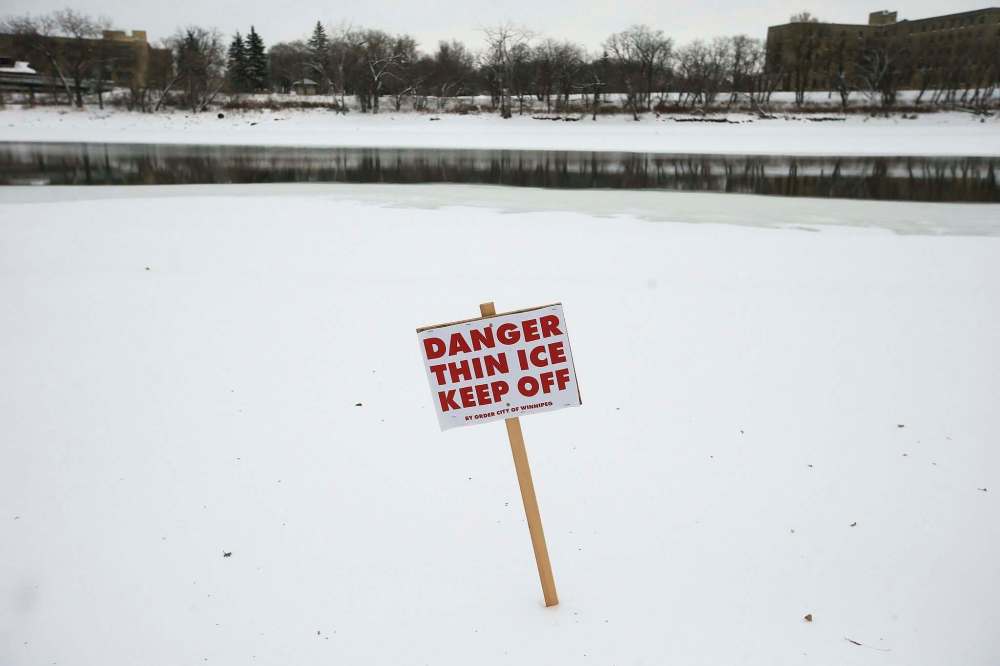
“The ice hasn’t had the time to freeze to a thickness that would be safe, especially for vehicles… People just need to be patient. I understand they want to get out there and fish. You’ve got to have the right equipment and, if you know the area, make sure you understand the ice thickness before you head out.”
At 1:20 p.m. Saturday, a man called the police, saying he and another male on an ice fishing outing were stranded on Lake Winnipeg.
“They went to return to shore, and they noticed there was water between them and shore not realizing a large chunk of ice had broken away and was pushed out by the wind,” said Manaigre.
The local fire department tried to use a Zodiac boat to reach the men, but the waves were around 1.2 metres high, and it was too dangerous, he added. RCMP called in a charter and training helicopter company, who airlifted the two men shortly before 5 p.m. The Mounties are urging Manitobans to know the thickness of the ice before going fishing or sledding on open water this winter.
“Tragedy could happen really quickly, and with the water temperatures as cold as they are, you don’t have a lot of time to get yourself out of that water before hypothermia kicks in,” Manaigre said.
Meanwhile, in Winnipeg, Clare MacKay, vice-president of strategic initiatives at The Forks, said the warm December weather won’t change its plans for the annual downtown river skating path.

“We don’t normally open (the river trail) until January, anyways,” said MacKay. “We have however put in the upper trails and rinks in Arctic Glacier Winter Park and those will be ready this week for skaters.”
The City of Winnipeg said its firefighters and paramedics have responded to 249 water or ice rescue calls this year, compared to 152 in 2019 — 36 of this year’s calls have been at retention ponds, a 50 per cent increase from 2019.
“Retention ponds are never safe to use for winter recreation activities, as ice conditions can change quickly without warning,” said a city spokesperson.
“Water from snowmelt or nearby water main breaks can drain into retention ponds. This water is often mixed with street salts, which can cause ice to melt and thin unevenly. This water enters retention ponds from underneath the ice, resulting in thinning of ice that can’t be seen from the surface.”
kellen.taniguchi@freepress.mb.ca