

Manitoba seeks help with zebra mussels
Document reveals provincial push for federal assistance
Advertisement
Read this article for free:
or
Already have an account? Log in here »
To continue reading, please subscribe:

Digital Subscription
One year of digital access for only $205*
- Enjoy unlimited reading on winnipegfreepress.com
- Read the E-Edition, our digital replica newspaper
- Access News Break, our award-winning app
- Play interactive puzzles
*First annual payment billed as $205.00 + GST for one year. This annual subscription will automatically renew at $233.00 + GST every 52 weeks (10% off the regular annual price of $259.35). Offer available to new and qualified returning subscribers only. Cancel any time.
To continue reading, please subscribe:
Add Free Press access to your Brandon Sun subscription for only an additional
$1 for the first 4 weeks*
- Enjoy unlimited reading on winnipegfreepress.com
- Read the E-Edition, our digital replica newspaper
- Access News Break, our award-winning app
- Play interactive puzzles
*Your next Brandon Sun subscription payment will increase by $1.00 and you will be charged $17.95 plus GST for four weeks. After four weeks, your payment will increase to $24.95 plus GST every four weeks.
Read unlimited articles for free today:
or
Already have an account? Log in here »
Hey there, time traveller!
This article was published 17/02/2020 (2407 days ago), so information in it may no longer be current.
OTTAWA — The Pallister government pushed the federal government to beef up boat inspections at the U.S. border, as zebra mussels wreaked havoc on Manitoba.
“Manitoba is concerned with the (Department of Fisheries and Oceans’) capacity to implement the aquatic invasive species regulations,” reads a briefing note the Free Press obtained through access-to-information laws.
“In particular, they would like increased federal assistance to control for (such species) at the Manitoba-U.S. border,” reads the document, prepared for the top DFO bureaucrat, for a Feb. 15, 2019, call with her counterpart in the Manitoba government.
The document notes that instead of spending more on border checks, the federal government would try to “better leverage our existing resources.”
The department says it has since launched an unspecified pilot project with the Canada Border Services Agency at Manitoba crossings.
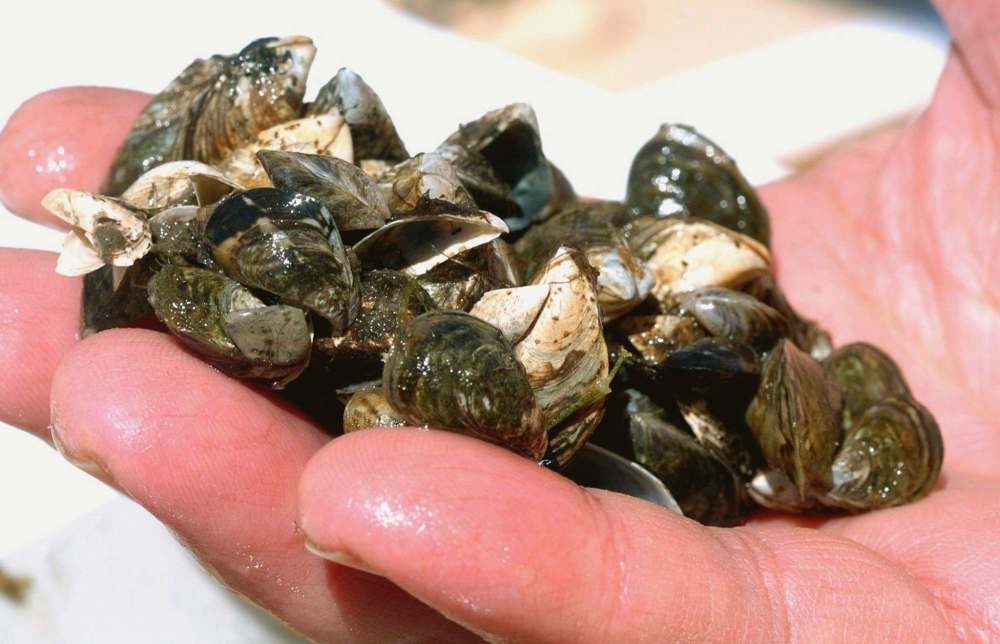
The zebra mussel, which has spread across the Great Lakes since the 1980s, is an invasive species that breeds rapidly and latches onto metal surfaces.
“They can get incredibly high densities, and they clog intake screens and a variety of infrastructures,” said Scott Higgins, a research scientist at the International Institute for Sustainable Development.
He said zebra mussels are “the poster child for aquatic invasive species” because they throw off fish ecosystems and jam up Manitoba Hydro infrastructure.
Zebra mussels were found in Lake Winnipeg in 2013, while larva were found last August near a generating station in the Nelson River, as well as in Shoal Lake last spring.
In an email, DFO said in the past 12 months, it has helped Manitoba craft response plans and research the issue.
The department has also collaborated with border guards on a pilot project to stop overland spread of the species in Manitoba, and has two invasive-species experts in Winnipeg.
“DFO has prioritized a number of key projects to support Manitoba,” wrote spokeswoman Holly Foerter.
Zebra mussels can spread on boats that aren’t sufficiently decontaminated with hot, high-pressure water, because their embryos aren’t always visible to the human eye.
However, Higgins said the mussels most likely arrived in Lake Winnipeg on driftwood floating up the Red River from the United States, rather than on boats driven into Manitoba.
“There’s no evidence to suggest that they came across the land border,” said Higgins, who used to work for DFO before the institute took over the Experimental Lakes Area in northwestern Ontario.
He said officials should be more worried about mussels already in Lake Winnipeg spreading north and west, because there’s sufficient calcium in Prairie waters for the species to thrive.
“It’s really hard to find these things; it’s like finding a needle in a haystack — but if that needle gets into your lake, it can wreak havoc,” Higgins said. “They’re extremely hard to eradicate, if not impossible.”

Manitoba Hydro has monitored for zebra mussels since the 1990s, and hasn’t yet found them in generating stations. This year, the Crown corporation will install traps and design equipment to treat stations for the mussels.
The province would not make a minister available for an interview to explain whether Ottawa’s response is enough to address its concerns.
A spokesman for the agriculture department noted collaboration with border services on enhanced aquatic invasive species protection at the Canada-United States border.
He added the province expanded operations at six key watercraft-inspection stations last year.
dylan.robertson@freepress.mb.ca
Memo on fisheries deputy-ministers' call regarding zebra mussels