

Manitoba students still not making the grade
National test results show province has high number of struggling learners

Advertisement
Read this article for free:
or
Already have an account? Log in here »
To continue reading, please subscribe:
Monthly Digital Subscription
$1 per week for 24 weeks*
- Enjoy unlimited reading on winnipegfreepress.com
- Read the E-Edition, our digital replica newspaper
- Access News Break, our award-winning app
- Play interactive puzzles
*Billed as $4.00 plus GST every four weeks. After 24 weeks, price increases to the regular rate of $19.95 plus GST every four weeks. Offer available to new and qualified returning subscribers only. Cancel any time.
Monthly Digital Subscription
$4.99/week*
- Enjoy unlimited reading on winnipegfreepress.com
- Read the E-Edition, our digital replica newspaper
- Access News Break, our award-winning app
- Play interactive puzzles
*Billed as $19.95 plus GST every four weeks. Cancel any time.
To continue reading, please subscribe:
Add Free Press access to your Brandon Sun subscription for only an additional
$1 for the first 4 weeks*
*Your next subscription payment will increase by $1.00 and you will be charged $16.99 plus GST for four weeks. After four weeks, your payment will increase to $23.99 plus GST every four weeks.
Read unlimited articles for free today:
or
Already have an account? Log in here »
Hey there, time traveller!
This article was published 30/04/2018 (2915 days ago), so information in it may no longer be current.
Manitoba’s education system has once again produced the highest percentage of under-performing children anywhere in Canada on a major international or national test — and once again, we’ve produced the smallest group of high achievers anywhere in the country.
That combination once again places Manitoba students dead last among Canadian children in reading, math and science.
The news came at 4 a.m. today with the release of 2016 testing results of 30,000 Canadian Grade 8 students by the Council of Ministers of Education, Canada (CMEC).
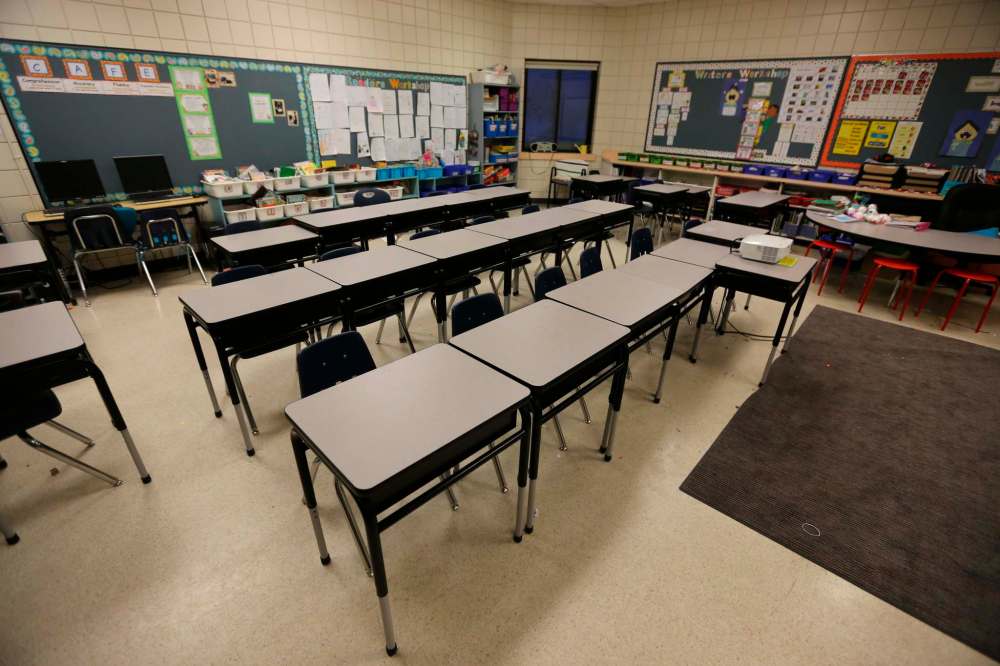
Our kids were last in reading and math, far behind the Canadian average, and tied for Saskatchewan for last in science, again way behind the Canadian average.
Nevertheless, the data say three out of four Manitoba children are doing very well in school in reading, learning and succeeding at the same rate as their peers across Canada.
“It gives us a target group” for improvement, Education Minister Ian Wishart said this weekend in an interview. “We also want to shift the three-quarters into the higher group.
“We have to adjust our education system, really, kid by kid — there’s some really innovative programs out there,” said Wishart, who emphasized that teachers know their students better than anyone and are best placed to come up with solutions.
What dooms the results every time in national and international testing is that a higher percentage of Manitoba children is in the lowest category of performance than in other provinces, while a lower percentage of Manitoba children is in the highest category of performance than children in other provinces.
The CMEC says 74 per cent of Manitoba children read at acceptable levels, the same as Canadian children overall; however, 17 per cent of Manitoba children read at the lowest level, compared to 12 per cent in all of Canada. Nine per cent of Manitoba kids read at the highest level, compared to 14 per cent of Canadian children.
The CMEC testing focused on analysis of reading results and did not break out the levels of performance in each province for math and science.
It’s become the norm for Manitoba children to be at or near the bottom among Canadian provinces in testing in the three core subjects, be it the CMEC’s Pan-Canadian Assessment Program of Grade 8s every three years released earlier this morning, or the Organization of Economic Development and Co-ordination’s similar testing of 15 year olds from industrialized nations.
A series of anguished education ministers — the NDP’s Peter Bjornson, Nancy Allan, James Allum, now Conservative Wishart — has heard the gnashing of parents’ teeth and struggled to figure out what’s wrong with our schools and our education system.
Indeed, Manitoba children performed better overall than kids in most industrialized countries in the last OECD testing released in December of 2016, but it’s at the bottom and top of the performance scale that Manitoba’s numbers within Canadian provinces come crashing down.
Wishart said too many people get hung up on how other provinces are doing. The CMEC data show Manitoba children have made progress in the past six years, even if the relative standing hasn’t changed.
It will take time to turn the results around and figure out what’s working, Wishart said.
CMEC analysts don’t provide breakdowns of the data within the 190 Manitoba schools tested, but have reported that while most provinces get consistent results across their systems, Manitoba is one of three provinces in which the results are inconsistent.
“They don’t get into the why,” Wishart lamented.
Officials in Manitoba’s education system are determined to figure out what’s happening, and to change it, Wishart said.
There are no plans to bring back the type of intensive standardized testing of grades 3 and 12 in the 1990s that would have expanded into grades 6 and 9 and more core subjects had the Filmon Conservatives won the 1999 election.
“I look at long-term trends. We really do compare well on a world scale,” the education minister said.
“I’m happy progress is being made from the original baseline years,” said Jennifer Maw, the department’s assistant co-ordinator for the assessment unit in the instruction, curriculum and assessment branch.
Girls have performed far better than boys in reading throughout Canada, which is consistent with previous testing.
Within Manitoba, girls and boys are pretty much equal in math, but girls are way ahead in reading and well ahead in science.
Results within the English-language system are generally better than results in French-language schools.
Both the NDP and Conservatives have focused on improving early-years numeracy and literacy, and most of the kids that have been targeted by those strategies are young enough that they may have to wait for the next round of testing or the one beyond that to see if any of those plans worked.
Allan restored basic 1950s arithmetic for very young children: adding and subtracting, simple multiplying and dividing, and memorizing times tables. Then the NDP invested heavily in small class sizes, primarily capping classes at 20 children in kindergarten to Grade 3.

The Tories are emphasizing early-years math and reading.
The latest report noted Manitoba’s overall reading scores are up since 2010, but so are the results from across Canada.
“In Manitoba, both girls and boys achieved mathematics scores below the respective Canadian means by gender. There was no gender gap in mathematics achievement in Manitoba, which is consistent with the pattern in Canada overall,” the CMEC found.
Students completing the reading test also filled in a questionnaire, which researchers say showed there was a correlation between the results and parental level of education, language spoken in the home and number of books in the home.
nick.martin@freepress.mb.ca
Nick Martin
Former Free Press reporter Nick Martin, who wrote the monthly suspense column in the books section and was prolific in his standalone reviews of mystery/thriller novels, died Oct. 15 at age 77 while on holiday in Edinburgh, Scotland.
Our newsroom depends on a growing audience of readers to power our journalism. If you are not a paid reader, please consider becoming a subscriber.
Our newsroom depends on its audience of readers to power our journalism. Thank you for your support.
The Council of Ministers of Education, Canada set 90-minute tests in 2016 for 30,000 randomly-selected Grade 8 students. Here are the results, with the Canadian average, and each province’s points above or below the average.
Reading:
Canada 507
British Columbia 509 +2
Alberta 510 +3
Saskatchewan 491 -16
Manitoba 487 -20
Ontario 512 +5
Quebec 503 -4
New Brunswick 489 -18
Nova Scotia 498 -9
Prince Edward Island 513 +6
Newfoundland and Labrador 491 -16
Mathematics:
Canada 511
British Columbia 494 -17
Alberta 505 -6
Saskatchewan 483 -28
Manitoba 479 -32
Ontario 508 -3
Quebec 541 +30
New Brunswick 498 -13
Nova Scotia 497 -14
Prince Edward Island 503 -8
Newfoundland and Labrador 490 -21
Science:
Canada 508
British Columbia 505 -3
Alberta 518 +10
Saskatchewan 491 -17
Manitoba 491 -17
Ontario 510 +2
Quebec 507 -1
New Brunswick 500 -8
Nova Scotia 499 -9
Prince Edward Island 516 +8
Newfoundland and Labrador 501 -7
When the Canadian Ministers of Education, Canada tested 13-year-old Canadian kids in 2008, Manitoba students ranked sixth in reading, fifth in math, and eighth in science.
Three years later, we were ahead of only PEI in math and ahead of only Yukon in science and reading. In 2014, our children were dead last in everything.
In this latest round, the children tested were all in Grade 8 — there was no age specified — and only the 10 provinces were tested.
Meanwhile, the Organization for Economic Co-operation and Development testing has seen Manitoba children drop from the middle of the pack 15 years ago to near-bottom.
Conducted every three years, the OECD most recently tested 540,000 randomly selected 15 year olds in 72 industrialized countries and city-states in science, reading and math. In the most recent results released in December of 2016, Manitoba’s children ranked eighth in math in Canada, and ninth in both reading and science, rankings that were near identical to 2013 and 2010 results. Manitoba, however, is above the OECD average in reading and science and just below in math, while remaining ahead of many major countries.
Two things have been clear throughout the history of both OECD and CMEC testing: Manitoba has a higher proportion of kids performing at the lowest level than the rest of Canada, and a smaller percentage achieving at the highest level.
Nick Martin
Former Free Press reporter Nick Martin, who wrote the monthly suspense column in the books section and was prolific in his standalone reviews of mystery/thriller novels, died Oct. 15 at age 77 while on holiday in Edinburgh, Scotland.
Our newsroom depends on a growing audience of readers to power our journalism. If you are not a paid reader, please consider becoming a subscriber.
Our newsroom depends on its audience of readers to power our journalism. Thank you for your support.
Advertisement Advertise With Us
Advertisement Advertise With Us
History
Updated on Monday, April 30, 2018 12:19 PM CDT: Adds photo