

More treatment key to battling meth problem

Advertisement
Read this article for free:
or
Already have an account? Log in here »
To continue reading, please subscribe:
Monthly Digital Subscription
$1 per week for 24 weeks*
- Enjoy unlimited reading on winnipegfreepress.com
- Read the E-Edition, our digital replica newspaper
- Access News Break, our award-winning app
- Play interactive puzzles
*Billed as $4.00 plus GST every four weeks. After 24 weeks, price increases to the regular rate of $19.95 plus GST every four weeks. Offer available to new and qualified returning subscribers only. Cancel any time.
Monthly Digital Subscription
$4.99/week*
- Enjoy unlimited reading on winnipegfreepress.com
- Read the E-Edition, our digital replica newspaper
- Access News Break, our award-winning app
- Play interactive puzzles
*Billed as $19.95 plus GST every four weeks. Cancel any time.
To continue reading, please subscribe:
Add Free Press access to your Brandon Sun subscription for only an additional
$1 for the first 4 weeks*
*Your next subscription payment will increase by $1.00 and you will be charged $16.99 plus GST for four weeks. After four weeks, your payment will increase to $23.99 plus GST every four weeks.
Read unlimited articles for free today:
or
Already have an account? Log in here »
Hey there, time traveller!
This article was published 10/12/2018 (2691 days ago), so information in it may no longer be current.
Never before have the federal and provincial governments done such a good job of living up to the adage of “too little, too late.”
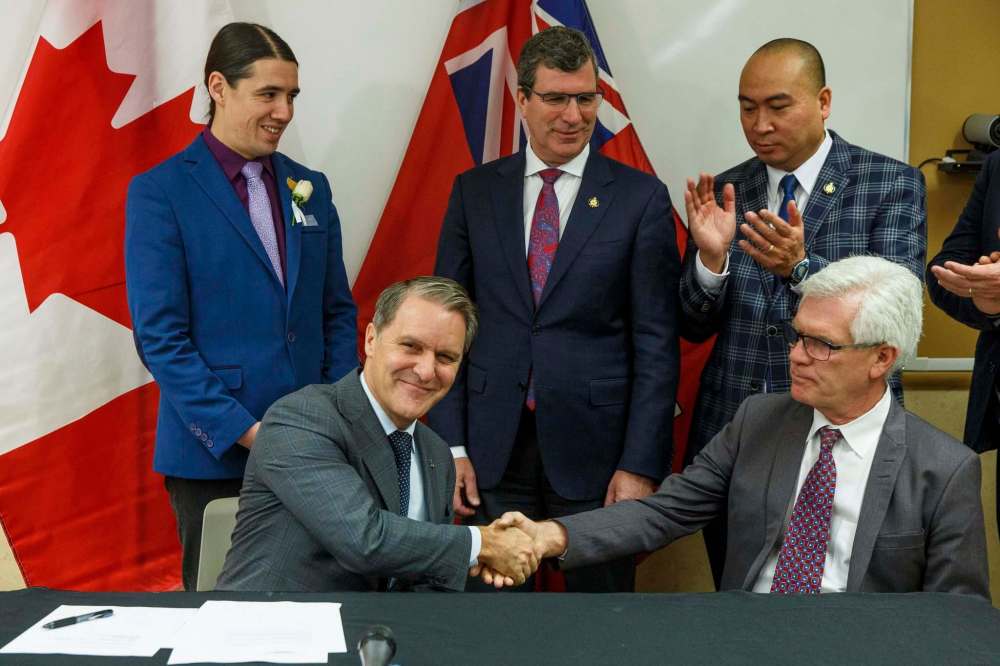
Last week, the federal and provincial governments announced an additional $8.4 million to help battle methamphetamine addiction. It’s a one-time injection of government funding that should be able to provide treatment to an additional 130 meth addicts.
It was a good news announcement that had two major flaws.
First, it was dramatically underwhelming given the size of the problem. Winnipeg hospitals have seen a 1,200 per cent increase in the number of people suffering from meth addiction from 2012 to 2018. These days, more than 200 people per month show up in various stages of physical and psychological distress from having developed a dependence on this virulent drug.
Second, it was more than a bit late.
This is the kind of announcement that should have been made during National Addictions Awareness Week, which ran from Nov. 26 to Dec, 2. Unfortunately, the two levels of government couldn’t get their acts together to make an announcement until Dec. 7. That’s a big missed opportunity to make the announcement when the nation was focused on the underlying issues.
Despite the fact that the word “meth” is always accompanied by the word “crisis,” our collective response has been decidedly leisurely.
The situation gets worse, the body count rises, and it seems that governments find ways of slowing down their response. We convene panels of experts, hold committee meetings to confirm that our response is insufficient, and study the underling issues in exhaustive fashion.
However, while all this is going on, we do nothing. Or, as we saw with last week’s announcement, next to nothing.
Neither the province nor the federal government can claim to be unaware of both the magnitude of the problem and the inadequacy of the responses to date.
In Manitoba, the so-called Virgo report on improving mental health and addictions services was delivered to the Progressive Conservative government last March.
The Virgo report noted that while most provinces spend just over seven per cent of their health budgets on mental health and addictions, Manitoba only spends about five per cent. When you consider that Manitoba’s health care budget is $6.7 billion, that is a $135-million annual shortfall.
The province did introduce a plan to establish five Rapid Access to Addictions Medicine clinics, which will help addicts avoid overdoses and give them access to some treatment options. Those clinics are open now.
The failure to address the gaping need in mental health and addictions is something that can be shared by the former and current provincial governments. The NDP never did find enough money to address these needs, and the PC government has followed in more or less the same tradition.
So, what’s the answer? If you look at jurisdictions that have made progress in addressing addictions crises, you’ll find out that it’s a lot simpler than lawmakers and policy wonks in this country would have you think.
It involves more treatment — way more treatment.
The New York Times recently published an extensive profile about the battle against opioid addiction in Dayton, Ohio, which had one of the highest rates of drug overdose deaths in the U.S. In 2017, 548 people died in Montgomery County, in which Dayton is the hub.
However, a concerted effort that ultimately involved federal, state and local governments has turned that equation on its head. In just one year, public health officials have reported a 54 per cent decline in overdose deaths.
How did they do it? Again, it was treatment.
The progress started in 2015, when Republican Gov. John Kasich massively expanded federal Medicaid coverage for his state, an opportunity created when former president Barack Obama introduced the Affordable Care Act. While other Republican state leaders were eschewing the Medicaid offer in a spiteful bid to undermine Obamacare, Kasich accepted the additional money with open arms.
That decision became the turning point in the addictions battle. Today, more than 700,000 low-income adults in Ohio have free access to addictions and mental health treatment. That has spawned the establishment of more than a dozen new private treatment agencies, and new multi-disciplinary response teams that involve medical professionals, social workers and law enforcement officials.
The result is that just about everyone in Dayton and across Ohio who needs treatment for mental health and addictions, and cannot afford it, gets treatment. Kasich even ensured that anyone sentenced to prison would not have to give up access to treatment, as was the case before the Medicaid expansion.
Dayton Mayor Nan Whaley told the Times that the influx of federal money was the key. “If you’re a state that does not have Medicaid expansion, you can’t build a system for addressing this disease.”

Canada can learn a lot from the Dayton experience. Provinces and municipalities don’t have the fiscal resources to make a massive investment in mental health and addictions treatment. They need help from the federal government to make a meaningful dent in this pressing public health crisis.
But it’s also a call to arms for the lower levels of government to reorganize service delivery and put more emphasis on treatment. Right now, whether it’s a pressing opioid addiction or alcoholism, Manitobans are forced to wait in line to get treatment. It’s time to speed up the response.
The solution — more treatment — may seem simple, but it’s not easy. A massive expansion of treatment options will be expensive and complex and difficult to administer.
But it’s also effective. Political leaders should consider that whenever they schedule their next news conference to deliver a too-little, too-late solution.
dan.lett@freepress.mb.ca
Dan Lett is a columnist for the Free Press, providing opinion and commentary on politics in Winnipeg and beyond. Born and raised in Toronto, Dan joined the Free Press in 1986. Read more about Dan.
Dan’s columns are built on facts and reactions, but offer his personal views through arguments and analysis. The Free Press’ editing team reviews Dan’s columns before they are posted online or published in print — part of the our tradition, since 1872, of producing reliable independent journalism. Read more about Free Press’s history and mandate, and learn how our newsroom operates.
Our newsroom depends on a growing audience of readers to power our journalism. If you are not a paid reader, please consider becoming a subscriber.
Our newsroom depends on its audience of readers to power our journalism. Thank you for your support.
Dan Lett is a columnist for the Free Press, providing opinion and commentary on politics in Winnipeg and beyond. Born and raised in Toronto, Dan joined the Free Press in 1986. Read more about Dan.
Dan’s columns are built on facts and reactions, but offer his personal views through arguments and analysis. The Free Press’ editing team reviews Dan’s columns before they are posted online or published in print — part of the our tradition, since 1872, of producing reliable independent journalism. Read more about Free Press’s history and mandate, and learn how our newsroom operates.
Our newsroom depends on a growing audience of readers to power our journalism. If you are not a paid reader, please consider becoming a subscriber.
Our newsroom depends on its audience of readers to power our journalism. Thank you for your support.
Advertisement Advertise With Us
Advertisement Advertise With Us
History
Updated on Monday, December 10, 2018 10:21 AM CST: Corrects that Rapid Access to Addictions Medicine clinics are open now.