

New provincial health organization looking for creative thinkers
Advertisement
Read this article for free:
or
Already have an account? Log in here »
To continue reading, please subscribe:

Digital Subscription
One year of digital access for only $205*
- Enjoy unlimited reading on winnipegfreepress.com
- Read the E-Edition, our digital replica newspaper
- Access News Break, our award-winning app
- Play interactive puzzles
*First annual payment billed as $205.00 + GST for one year. This annual subscription will automatically renew at $233.00 + GST every 52 weeks (10% off the regular annual price of $259.35). Offer available to new and qualified returning subscribers only. Cancel any time.
To continue reading, please subscribe:
Add Free Press access to your Brandon Sun subscription for only an additional
$1 for the first 4 weeks*
- Enjoy unlimited reading on winnipegfreepress.com
- Read the E-Edition, our digital replica newspaper
- Access News Break, our award-winning app
- Play interactive puzzles
*Your next Brandon Sun subscription payment will increase by $1.00 and you will be charged $17.95 plus GST for four weeks. After four weeks, your payment will increase to $24.95 plus GST every four weeks.
Read unlimited articles for free today:
or
Already have an account? Log in here »
Hey there, time traveller!
This article was published 05/01/2018 (3175 days ago), so information in it may no longer be current.
The head of clinical and preventative planning for Shared Health says it is hunting down the most creative thinkers in health care to build the teams that will centralize ambulance and other services across Manitoba.
It’s still very much a work in progress, says Lanette Siragusa, as is much of the new provincial organization that’s launch is now only months away.
“We’re working on getting the resources in place,” she said. “Once we can identify that, we’ll have more certainty as to what the timelines will be.”
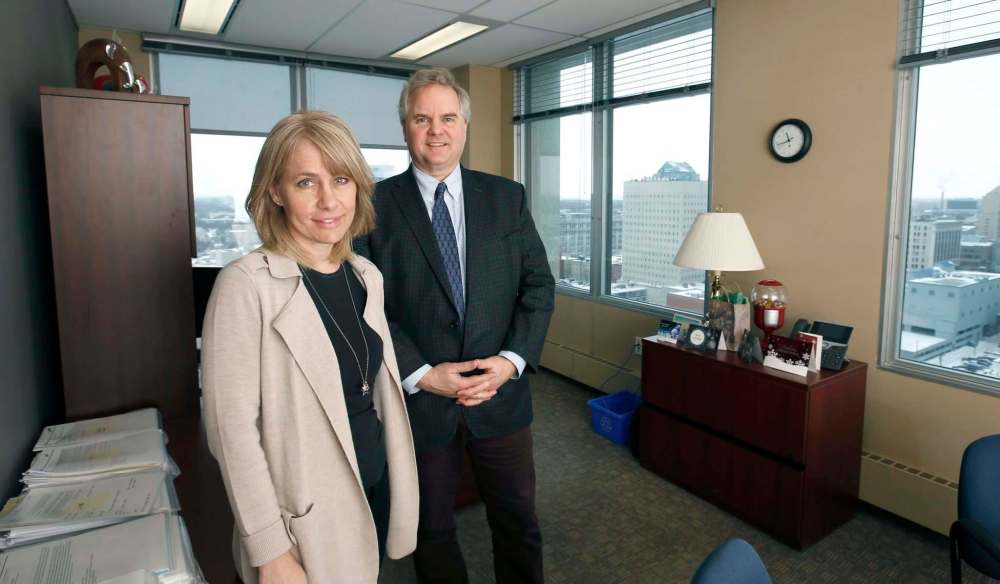
Siragusa and Shared Health’s chief executive officer, Dr. Brock Wright, recently sat down with the Free Press, shortly after moving into their new offices. Shared Health joins Diagnostic Services Manitoba on Carlton Street in Winnipeg, where it will essentially replace DSM, using its corporate shell to become a legal entity in time for its planned April launch.
It’s part of the provincial government’s commitment to building the entirely new organization out of existing resources, Wright says — one with an expansive mandate.
Ever since the health minister announced Shared Health’s creation last June, it has been the go-to for the evaluation of many health initiatives with province-wide implications, including rural and remote health authorities’ proposed clinical cuts to meet the government’s savings targets.
In addition to its clinical assignments, Shared Health will eventually take over provincial lab services, handle health human resource issues — including negotiating with doctors, other health-care providers and unions — and be in charge of capital planning and supply chain processes.
To do it, Shared Health has been plucking from the Winnipeg Regional Health Authority’s talent pool.
Siragusa was surgical director with the WRHA before moving to the provincial side. Several of her regional colleagues — including the chief financial officer, the vice-president of population and Aboriginal health, the chief operating officer of emergency response and patient transport, as well as the regional director of primary health care and chronic disease — have also all moved to Shared Health.
With the exception of the chief medical officer position Wright vacated (it’s since been filled by Dr. Bruce Roe), their funding moves with them.
That’s fine for the region, Wright says in a joint statement with the WRHA’s interim president and CEO, Réal Cloutier. Siragusa’s role has been handed over to someone else who will receive extra administrative support, while the regional director of primary health care and chronic disease role has been divided amongst two existing employees.
The other portfolios, including the vice-president of population and Aboriginal health and chief operating officer of emergency response and patient transport, will now be under Shared Health’s purview.
That’s ideal, Wright says.
“Part of what I think was influencing the government to make this decision to create Shared Health was to create an opportunity to take some of the special expertise that resides in the Winnipeg Regional Health Authority, in particular, and bring that provincially,” he said.
“The WRHA has a lot of expertise in capital planning, for example. Why is that only available to the WRHA? Why shouldn’t that be leveraged and be there as a resource or all of the RHAs?”
When it comes to what expertise Shared Health plans to have ready to leverage by its start date, Wright couldn’t say. The plan is to stagger the launch of each clinical planning team, but the order is still uncertain. It is, as yet, unclear what Shared Health will actually be doing right off the start.
“Obviously, you can assume that emergency-related services will be some of the early teams that are established,” Wright said. “We’ll stage them in a way that gives priority to those issues that are priority issues.”

The reaction so far has been fairly positive from the regional health authorities, Siragusa says.
In asking for their most creative thinkers, she says she’s hoping to build non-traditional clinical teams from a mixed group of professionals who won’t limit themselves to thinking only of their role in the system.
The goal is to free up resources that are being underused in some areas and redeploy them to areas that do need it.
“There is capacity and there is opportunity too,” Siragusa said. “We just have to figure out how to span and spread and sustain it.”
jane.gerster@freepress.mb.ca