

Not enough border officials able to spot invasive zebra mussels: audit
Advertisement
Read this article for free:
or
Already have an account? Log in here »
To continue reading, please subscribe:
Digital Subscription
One year of digital access for only $1.44 a week*
- Enjoy unlimited reading on winnipegfreepress.com
- Read the E-Edition, our digital replica newspaper
- Access News Break, our award-winning app
- Play interactive puzzles
*Billed as $5.77 plus GST every four weeks. After 52 weeks, price increases to the regular rate of $19.95 plus GST every four weeks. Offer available to new and qualified returning subscribers only. Cancel any time.
To continue reading, please subscribe:
Add Free Press access to your Brandon Sun subscription for only an additional
$1 for the first 4 weeks*
- Enjoy unlimited reading on winnipegfreepress.com
- Read the E-Edition, our digital replica newspaper
- Access News Break, our award-winning app
- Play interactive puzzles
*Your next Brandon Sun subscription payment will increase by $1.00 and you will be charged $17.95 plus GST for four weeks. After four weeks, your payment will increase to $24.95 plus GST every four weeks.
Read unlimited articles for free today:
or
Already have an account? Log in here »
Hey there, time traveller!
This article was published 02/04/2019 (2757 days ago), so information in it may no longer be current.
OTTAWA — Canada’s main line of defence against an invasive species plaguing Lake Winnipeg has little actual muscle, according to a federal audit released Tuesday.
Boats at risk of transmitting zebra mussels have crossed into Manitoba without making waves, because not enough border officials know how to spot those containing invasive species, nor how to respond when they do.
“I was kind of surprised at the breadth of the lack of information and knowledge that the government has, in order to manage this file,” environment commissioner Julie Gelfand said in an interview.
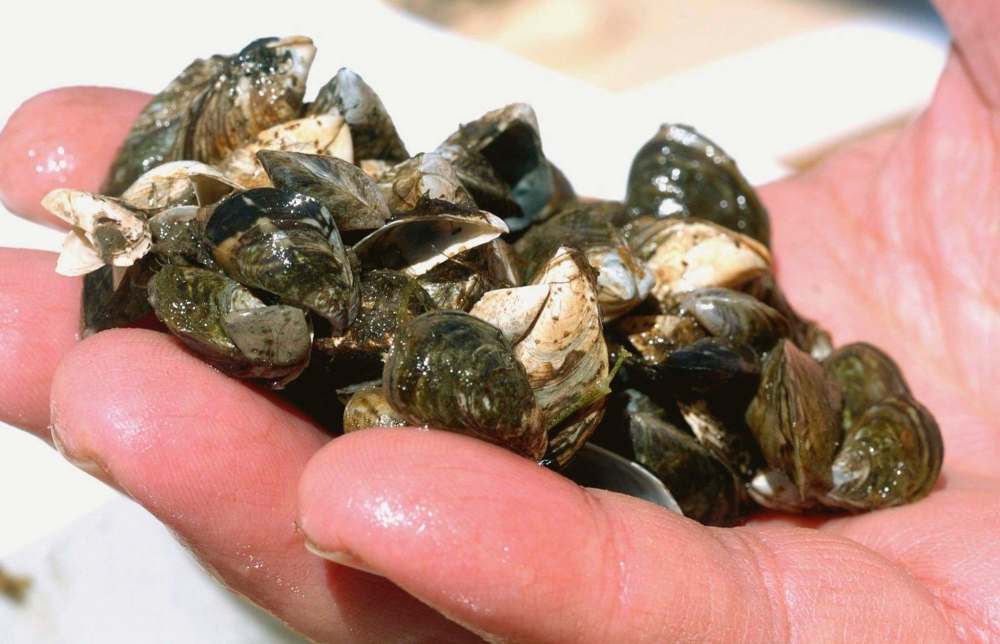
Since 2013, zebra mussels have been found along the southern basin of Lake Winnipeg.
In infant form, the mussels are undetectable to the human eye, and they feed off particles in the water other species rely on, while releasing nitrogen and phosphorus.
In adult form, the mussels can be the shape of a fingernail, and form clusters consisting of tens of thousands, clogging drinking-water infrastructure and even hydroelectric dams.
Ottawa and Manitoba have both made it a top priority to contain the spread. Yet officials with the Canada Border Services Agency at Emerson told auditors “they sometimes sent uncleaned boats back to American car washes before allowing the boats to re-enter Canada. But car washes are not an effective way to decontaminate boats, since the water temperatures are often not hot enough to kill the mussel.”
Gelfand’s audit found border guards weren’t clearly told they had to refer suspected cases of aquatic invasive species to conservation officials, nor how to react when they come a cross a high-risk boat and don’t have a conservation official available.
The training Ottawa does provide isn’t targeted to border guards working at crossings that are most likely to encounter these issues.
Her report also found Fisheries and Oceans Canada “had not distinguished its responsibilities from those of” Manitoba, and thus “did not intervene to prevent potentially contaminated boats from entering Canada” at the Emerson crossing.
Scott Higgins, a research scientist with the Winnipeg-based International Institute for Sustainable Development, said that speaks to a broader confusion over jurisdiction. Over time, federal governments have given provincial counterparts authority over fishery regulations, such as the ability to issue fines.
“They haven’t followed through on providing the provinces with additional resources to deal with this,” said Higgins, adding the issue seems particularly acute in Manitoba, Saskatchewan and the Maritimes.
“The federal government has a leadership role here.”

Neepawa-area MP Robert Sopuck agreed, saying he was concerned Ottawa wasn’t doing enough to ward off “a chain reaction” that could imperil the supply of pickerel.
“It’s extremely difficult” to control the spread of zebra mussels, said Sopuck, a former marine biologist.
Fisheries Minister Jonathan Wilkinson accepted the report’s recommendations, but noted his government put up $43.8 million over five years in the 2017 budget to combat aquatic invasive species.
“We are working actively to align the work we’re doing federally with the provinces,” he told reporters.
dylan.robertson@freepress.mb.ca
History
Updated on Tuesday, April 2, 2019 8:00 PM CDT: Fixes photo caption.