

Oil crisis, possible Ford walkout, set to hijack first ministers meeting
Advertisement
Read this article for free:
or
Already have an account? Log in here »
To continue reading, please subscribe:
Monthly Digital Subscription
$1 per week for 24 weeks*
- Enjoy unlimited reading on winnipegfreepress.com
- Read the E-Edition, our digital replica newspaper
- Access News Break, our award-winning app
- Play interactive puzzles
*Billed as $4.00 plus GST every four weeks. After 24 weeks, price increases to the regular rate of $19.95 plus GST every four weeks. Offer available to new and qualified returning subscribers only. Cancel any time.
Monthly Digital Subscription
$4.99/week*
- Enjoy unlimited reading on winnipegfreepress.com
- Read the E-Edition, our digital replica newspaper
- Access News Break, our award-winning app
- Play interactive puzzles
*Billed as $19.95 plus GST every four weeks. Cancel any time.
To continue reading, please subscribe:
Add Free Press access to your Brandon Sun subscription for only an additional
$1 for the first 4 weeks*
*Your next subscription payment will increase by $1.00 and you will be charged $16.99 plus GST for four weeks. After four weeks, your payment will increase to $23.99 plus GST every four weeks.
Read unlimited articles for free today:
or
Already have an account? Log in here »
Hey there, time traveller!
This article was published 06/12/2018 (2686 days ago), so information in it may no longer be current.
MONTREAL — While tanking oil prices and the federal carbon tax are not on the official agenda as Prime Minister Justin Trudeau meets with premiers and territorial leaders here Friday, both issues are bound to garner a lot of attention.
The meeting is supposed to tackle interprovincial trade barriers, but the historically low price of oil, due to a glut on the market, appears set to derail that topic. Economists have warned the problem is having negative effects across the country, not just in Alberta, whose economy depends on oil.
Some of the premiers had pushed Trudeau to put it on the agenda, during a teleconference on Wednesday.
The Liberal government has wanted to focus on business-tax competitiveness, its environmental goals and improving trade between the provinces, an issue Manitoba Premier Brian Pallister has advocated for nationally.
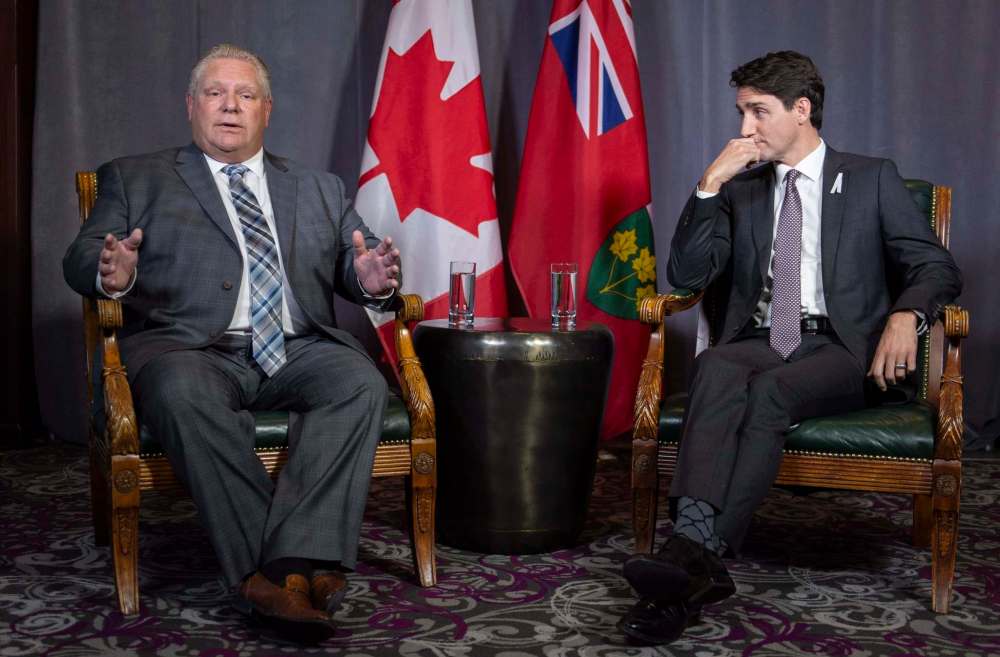
On Thursday, Alberta Premier Rachel Notley urged Ottawa to “cut the fluff” and focus on the oil crisis. Ontario Premier Doug Ford threatened to walk out of the meeting if it doesn’t include discussions on the “job-killing carbon tax,” though he later met with with Trudeau, and apeared somewhat appeased.
Dominic LeBlanc, the federal minister for intergovernmental affairs, dismissed the threat of a walkout by Ford, characterizing carbon-tax opponents as environmental laggards.
“Premiers can practise whatever partisan politics they want on the eve of a first ministers meeting,” he told reporters. “Canadians I think will judge harshly people who don’t want to constructively engage.”
Ford, along with the premiers of Saskatchewan and New Brunswick, held a news conference Thursday to repeat their criticism of the federal carbon tax, which Ottawa will impose on their provinces next year. Manitoba will also be forced to adopt the federal carbon tax, but Pallister didn’t attend the news conference because he was travelling to Montreal from Winnipeg.
On Wednesday, Pallister said the agenda should focus on the oil crisis, and he didn’t raise the carbon tax issue.
“Clearly, when some of your family are suffering, you should be concerned about that, and right now we have some real, real problems affecting the oilpatch and that affects the GDP of our country,” Pallister had said.
The premier noted the meeting only includes about four hours of open discussion, after briefings from officials and ministers.
“The meeting time is very brief, and I think we really need to focus on a couple of key economic issues right now,” he said, citing interprovincial trade barriers.
Pallister raised the issue at the premiers meeting in July. Since then, jurisdictions have standardized some regulations, including construction codes.
The premier believes trade barriers cost each family in Canada about $1,500 a year – or the equivalent of a seven per cent tariff on all the goods and services that are traded within the country.
LeBlanc highlighted the “patchwork quilt” of provincial regulations in a speech to the Montreal Chamber of Commerce Thursday.

He cited progress on harmonizing the definition of “vodka,” which prompted some in the audience to laugh. LeBlanc said that federal rules used to mean vodka could only be sold in another province when derived solely from wheat or potatoes. He said that only allowed two Manitoba firms to market the drink abroad and within the province. The rules changed recently.
LeBlanc said success at Friday’s meeting would mean “substantial progress” on removing internal trade barriers “on a much more accelerated scale.”
Pallister said he would discuss Manitoba’s meth crisis in private conversations with fellow premiers.
— With files from Larry Kusch
dylan.robertson@freepress.mb.ca