

Opiates making deadly comeback
Drug abuse linked to nearly 200 per cent rise in paramedic calls

Advertisement
Read this article for free:
or
Already have an account? Log in here »
To continue reading, please subscribe:
Monthly Digital Subscription
$1 per week for 24 weeks*
- Enjoy unlimited reading on winnipegfreepress.com
- Read the E-Edition, our digital replica newspaper
- Access News Break, our award-winning app
- Play interactive puzzles
*Billed as $4.00 plus GST every four weeks. After 24 weeks, price increases to the regular rate of $19.95 plus GST every four weeks. Offer available to new and qualified returning subscribers only. Cancel any time.
Monthly Digital Subscription
$4.99/week*
- Enjoy unlimited reading on winnipegfreepress.com
- Read the E-Edition, our digital replica newspaper
- Access News Break, our award-winning app
- Play interactive puzzles
*Billed as $19.95 plus GST every four weeks. Cancel any time.
To continue reading, please subscribe:
Add Free Press access to your Brandon Sun subscription for only an additional
$1 for the first 4 weeks*
*Your next subscription payment will increase by $1.00 and you will be charged $16.99 plus GST for four weeks. After four weeks, your payment will increase to $23.99 plus GST every four weeks.
Read unlimited articles for free today:
or
Already have an account? Log in here »
Hey there, time traveller!
This article was published 07/12/2020 (1963 days ago), so information in it may no longer be current.
Winnipeg is suffering from a surge in opiate abuse that has led to an unprecedented number of overdose deaths and threatened to overwhelm emergency medical services and addictions treatment.
After three years in which methamphetamine was the single biggest illicit drug threat in Winnipeg and other major cities, opiates have returned with a vengeance that has shocked health professionals who work on the front lines of emergency medicine.
Dr. Rob Grierson, medical director of the Winnipeg Fire Paramedic Services, said there has been a profound and alarming shift away from methamphetamine to opiates — fentanyl and a range of prescription medications — and to hybrid formulas that mix meth and opiates.
That is a major concern for public health officials because while meth is addictive and can cause violent psychotic episodes, the risk of overdose is much higher with opiates.
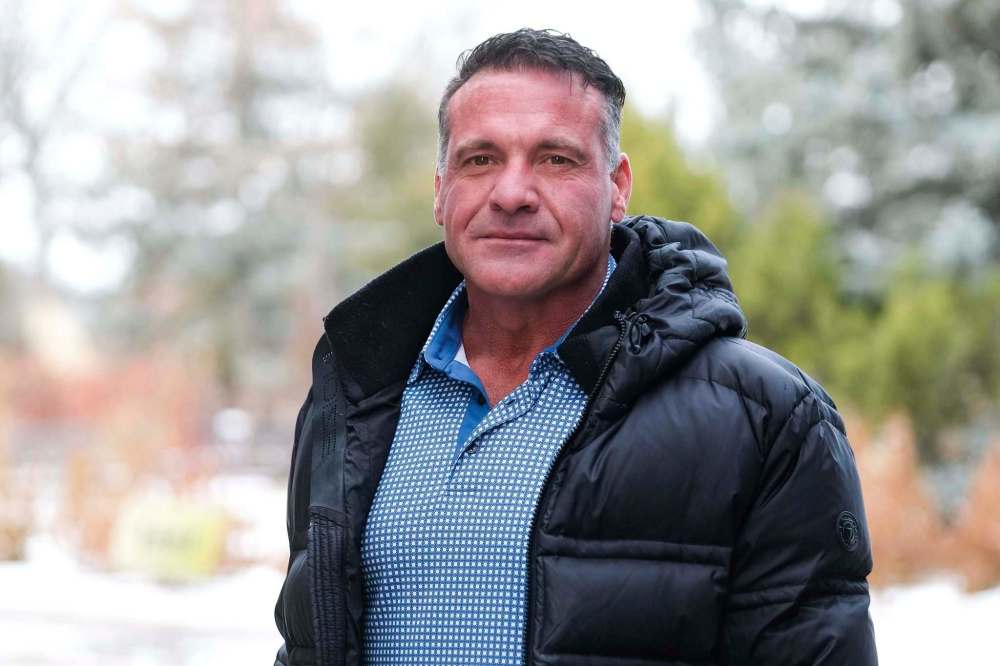
“What we’re seeing through this pandemic is that there has been a shift from one to another,” Grierson said. “(The shift is) to something that can be very deadly, something that if you abuse it, you can be dead in 15 minutes.”
Those concerns are backed up by data from the Office of the Chief Medical Examiner, which shows that in the first six months of 2020, there were 137 opiate-related deaths. At this pace, Manitoba could have as many or more opiate-related deaths in 2020 than in the previous three years combined.
Grierson said the increase in the number of overdose deaths is particularly worrisome because the WFPS has been very aggressive in the use of naloxone, a powerful drug used to counter the effects of an opiate overdose.
In the first nine months of the year, WFPS administered 2,018 doses of naloxone to prevent opiate overdoses. In 2016, just over 1,500 doses were given.
“The drug supply has clearly been impacted by the pandemic.” – Dr. Murray Hoy
Those numbers do not include the number of naloxone doses administered by addicts or people close to them, who can obtain kits and training for the administration of the drug from various public health offices, Grierson noted.
The sheer number of opiate cases is starting to put a strain on paramedics.
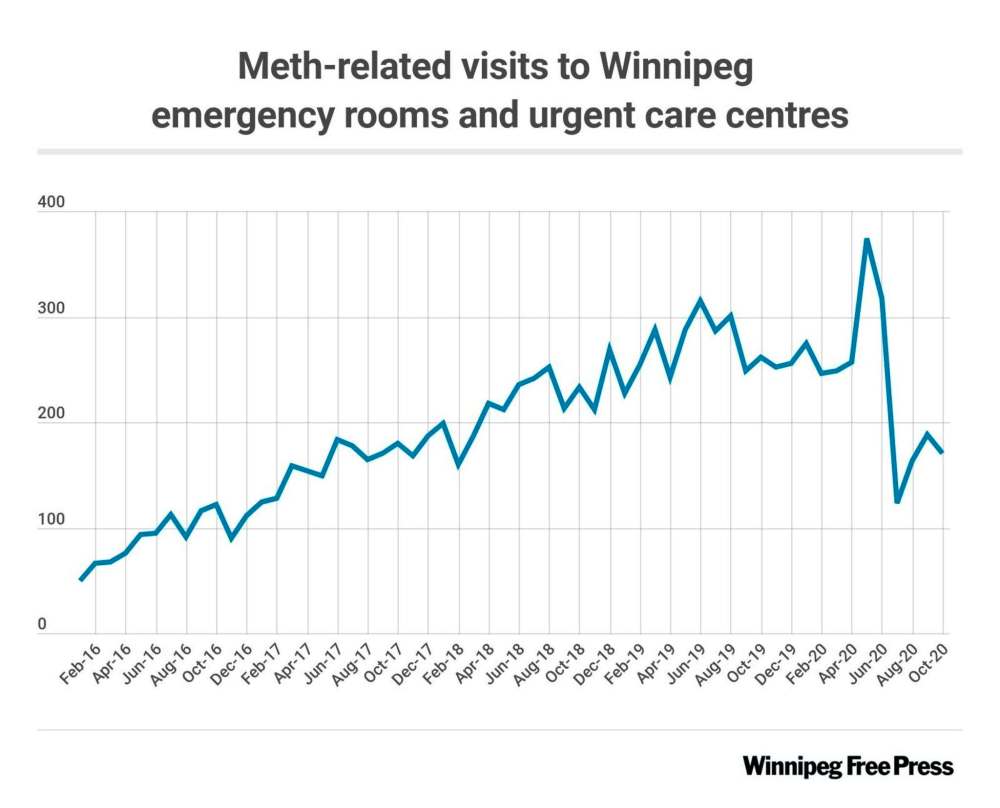
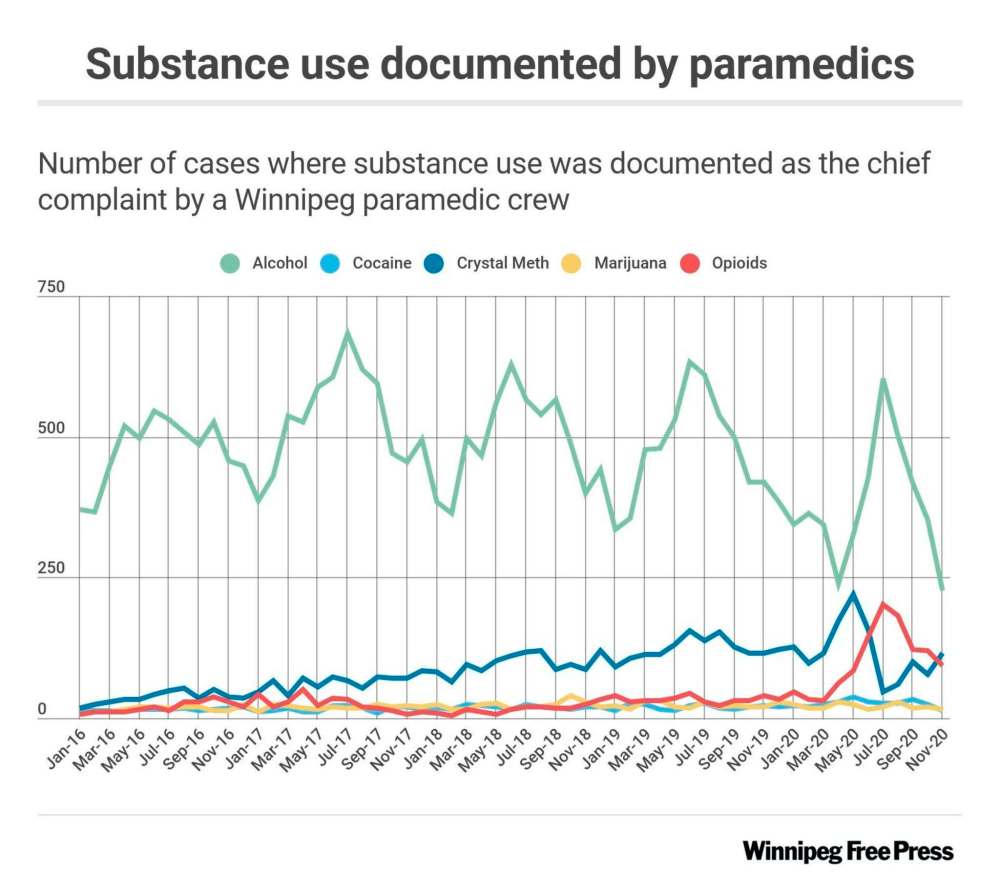
WFPS data paint a graphic picture of just how big the opiate problem has become in the city, especially starting in June when users reported a major reduction in the street-level supply of meth.
In all of 2019, there were 398 opiate-related calls to the WFPS. From Jan. 1 to Nov. 30, the WFPS responded to 1,121 opiate-related calls, a 181 per cent increase in less than a full year. Grierson said all anecdotal evidence suggests the WFPS is on pace to reach record levels by the end of the year not only for opiates calls, but for all illicit drugs.
When you combine the increased opiate numbers with meth usage, which is on pace to equal totals from 2019, it could become the worst year on record for drug-related calls to paramedical services in Winnipeg.
“I’m concerned because, if you look toward the end of the year, the total number… of people using illicit drugs will be much higher,” Grierson said. “Then we have the added concern about the sudden death associated with opiates.”
It will come as little comfort to people on the front lines of the battle against illicit drug abuse here that the breathtaking resurgence of opiate use is a truly North American phenomenon. In almost every jurisdiction, the pandemic is believed to be a major factor behind that.
Some have theorized that the social and economic restrictions which have forced many people to shelter at home has driven an increase in mental health problems, which can manifest in drug abuse.
As well, the pandemic has served as a major disruption to the supply of illicit drugs. Many law enforcement officials believe that pandemic restrictions on travel within and between Canada, the United States and other nations is driving down the supply of meth and ingredients needed to manufacture it.
On the other side of the equation, opiates are always available through prescriptions that eventually make their way to the black market. It is widely believed it is much easier to manufacture fentanyl, an incredibly powerful opiate, than it is to cook meth from scratch.
The result is a seismic shift in the type of illicit drugs being abused.
“The increasing prices have actually driven a lot more people to seek treatment. Unfortunately, we just don’t have the resources to meet that new demand.” – Dr. Murray Hoy
“The drug supply has clearly been impacted by the pandemic,” said Dr. Murray Hoy, who operates two private opiate treatment clinics in Winnipeg. “Even with opiates, the supply does not seem to be able to keep up with demand. The prices are skyrocketing.”
Hoy said that just last year, a single tablet of Percocet, a prescription painkiller that always seems to be available in abundance through illegal sources, cost about $5 on the street; today that same pill will cost $20 or more.
Given that one person who abuses Percocet can require 20 to 30 tablets a day to feed their habit, the price is out of reach of many addicts, Hoy noted. That has driven the huge spike in demand for treatment and counselling.
Hoy’s two clinics have never had a waiting list until this year. Now, his treatment program is full and it could take up to two months for a spot to open up. At the Addictions Foundation of Manitoba, another major source of opiate treatment and counselling, Hoy said he was told the wait was six to eight months.
“The increasing prices have actually driven a lot more people to seek treatment,” Hoy said. “Unfortunately, we just don’t have the resources to meet that new demand.”
dan.lett@freepress.mb.ca
Dan Lett is a columnist for the Free Press, providing opinion and commentary on politics in Winnipeg and beyond. Born and raised in Toronto, Dan joined the Free Press in 1986. Read more about Dan.
Dan’s columns are built on facts and reactions, but offer his personal views through arguments and analysis. The Free Press’ editing team reviews Dan’s columns before they are posted online or published in print — part of the our tradition, since 1872, of producing reliable independent journalism. Read more about Free Press’s history and mandate, and learn how our newsroom operates.
Our newsroom depends on a growing audience of readers to power our journalism. If you are not a paid reader, please consider becoming a subscriber.
Our newsroom depends on its audience of readers to power our journalism. Thank you for your support.
Dan Lett is a columnist for the Free Press, providing opinion and commentary on politics in Winnipeg and beyond. Born and raised in Toronto, Dan joined the Free Press in 1986. Read more about Dan.
Dan’s columns are built on facts and reactions, but offer his personal views through arguments and analysis. The Free Press’ editing team reviews Dan’s columns before they are posted online or published in print — part of the our tradition, since 1872, of producing reliable independent journalism. Read more about Free Press’s history and mandate, and learn how our newsroom operates.
Our newsroom depends on a growing audience of readers to power our journalism. If you are not a paid reader, please consider becoming a subscriber.
Our newsroom depends on its audience of readers to power our journalism. Thank you for your support.
Advertisement Advertise With Us
Advertisement Advertise With Us
History
Updated on Monday, December 7, 2020 6:13 AM CST: Corrects headline to say opiates.