

Pallister transfers post-secondary schooling to economic development
Advertisement
Read this article for free:
or
Already have an account? Log in here »
To continue reading, please subscribe:
Digital Subscription
One year of digital access for only $1.44 a week*
- Enjoy unlimited reading on winnipegfreepress.com
- Read the E-Edition, our digital replica newspaper
- Access News Break, our award-winning app
- Play interactive puzzles
*Billed as $5.77 plus GST every four weeks. After 52 weeks, price increases to the regular rate of $19.95 plus GST every four weeks. Offer available to new and qualified returning subscribers only. Cancel any time.
To continue reading, please subscribe:
Add Free Press access to your Brandon Sun subscription for only an additional
$1 for the first 4 weeks*
- Enjoy unlimited reading on winnipegfreepress.com
- Read the E-Edition, our digital replica newspaper
- Access News Break, our award-winning app
- Play interactive puzzles
*Your next Brandon Sun subscription payment will increase by $1.00 and you will be charged $17.95 plus GST for four weeks. After four weeks, your payment will increase to $24.95 plus GST every four weeks.
Read unlimited articles for free today:
or
Already have an account? Log in here »
Hey there, time traveller!
This article was published 28/10/2019 (2556 days ago), so information in it may no longer be current.
While Premier Brian Pallister made many small changes to his cabinet last week, one of his major adjustments was to remove the responsibility for post-secondary education from the education minister.
Ralph Eichler, the new minister of economic development and training, will look after post-secondary schooling and immigration: tasks previously handled by Education Minister Kelvin Goertzen, who is now focused solely on kindergarten-to-Grade-12 learning.
Pallister said the change better aligns the province’s education and economic needs.
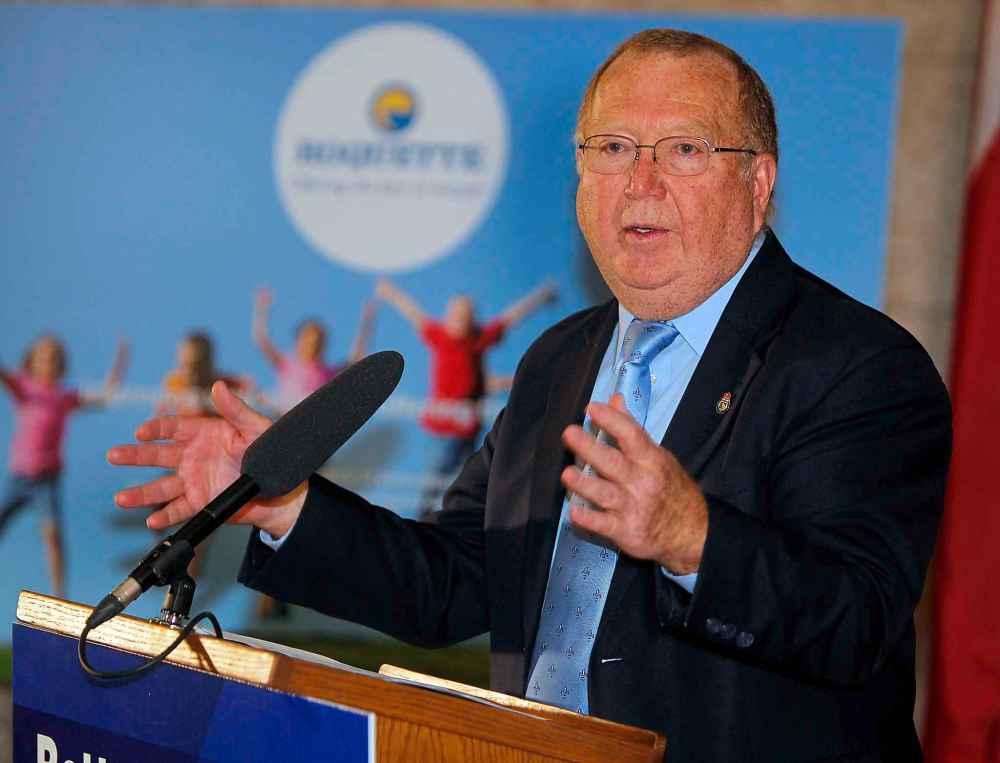
“As we move forward with our economic development strategies, we can’t do it in isolation from the imperatives of doing a great job of preparing our high school graduates for careers,” he said Wednesday.
“And that linkage has been, according to many I’ve talked to in academia and in the business world, something that we haven’t done as well as we need to. So linking training and skill development with our economic growth strategies is… good synergy.”
It’s not clear how the government plans to ask schools to develop better “synergy” with the job market.
Weeks ago, Pallister promised new mandate letters for post-secondary institutions would be delivered within his re-elected government’s first 100 days in office. A government spokesperson said Friday the letters are still being worked on.
NDP Leader Wab Kinew said he worries Pallister’s education priorities aren’t where they should be. He noted more focus should be placed on pushing students toward jobs in the “caring economy.” That would include nurses, teachers and health care aides; jobs that can’t be replaced by technology or artificial intelligence.
Kinew is concerned the emphasis will be taken away from teaching humanities and arts courses, and placed solely on developing technical, skills-based training.
“When we look at his vision for advanced education, for higher learning, for colleges and universities, Mr. Pallister wants your kid to be a cog in the machine. But what we really need your kid to be is that person who’s going to rethink our approach to health care, re-think our approach to the climate crisis, re-think our economy,” he said.
“So, I want the emphasis to continue, or actually to even be more… on people who are going to think differently. And part of the way that we do that is by having humanities courses, along with technical and skill-based education and training.”
Manitoba Chambers of Commerce president Chuck Davidson applauded the government’s new approach and said he hears often from business owners who lacked skilled workers, especially in the tech sector.
“Make no mistake, I think the post-secondaries are doing a good job and have been pretty responsive in regards to that. But the work dynamic is changing on almost a daily basis in terms of what businesses are looking for. So we need post-secondaries that can be agile to be able to make those changes to address some of those needs,” Davidson said.
The Free Press requested interviews with executive members from the University of Manitoba, University of Winnipeg and Red River College to discuss the province’s new strategy. No one from any of the institutions was made available, though all three sent similar statements by email saying they look forward to working with Eichler.
U of W president Annette Trimbee said her school understands the move to shuffle post-secondary education to a new department, while Red River spokesman Conor Lloyd said the college welcomes the new approach.

U of M president David Barnard echoed that sentiment and emphasized that the province needs to invest in post-secondary.
“Investment in this institution and the entire post-secondary sector remains critical to this province’s competitiveness nationally and globally,” he said. “We welcome our ongoing engagement with government and hope they continue to prioritize higher education.”
jessica.botelho@freepress.mb.ca
Twitter: @_jessbu