

Parks popular but roads less so, report states
Advertisement
Read this article for free:
or
Already have an account? Log in here »
To continue reading, please subscribe:
Monthly Digital Subscription
$1 per week for 24 weeks*
- Enjoy unlimited reading on winnipegfreepress.com
- Read the E-Edition, our digital replica newspaper
- Access News Break, our award-winning app
- Play interactive puzzles
*Billed as $4.00 plus GST every four weeks. After 24 weeks, price increases to the regular rate of $19.95 plus GST every four weeks. Offer available to new and qualified returning subscribers only. Cancel any time.
Monthly Digital Subscription
$4.99/week*
- Enjoy unlimited reading on winnipegfreepress.com
- Read the E-Edition, our digital replica newspaper
- Access News Break, our award-winning app
- Play interactive puzzles
*Billed as $19.95 plus GST every four weeks. Cancel any time.
To continue reading, please subscribe:
Add Free Press access to your Brandon Sun subscription for only an additional
$1 for the first 4 weeks*
*Your next subscription payment will increase by $1.00 and you will be charged $16.99 plus GST for four weeks. After four weeks, your payment will increase to $23.99 plus GST every four weeks.
Read unlimited articles for free today:
or
Already have an account? Log in here »
Hey there, time traveller!
This article was published 31/07/2017 (3146 days ago), so information in it may no longer be current.
A background report compiled in preparation for city hall’s 2018 budget deliberations has found that Winnipeggers love their firefighters, commute times from the Perimeter to downtown have increased over the past four years and the city has more transit buses but fewer trees and flower pots on boulevards and parks.
The annual Community Trends and Performance Report is a snapshot of the hundreds of services provided by city hall, their cost, comparisons to other municipalities and the public’s perception of the quality of the service.
A foreword to the report states the data are compiled and released at this time to “provide context and timely information for the City of Winnipeg Council and the Public in support of the upcoming budget decision-making process.”
The report provides a look at how the city’s population has grown, while also detailing its housing trends, economic conditions, how its municipal property taxes compare to other municipalities and the process followed by council to arrive at a budget.
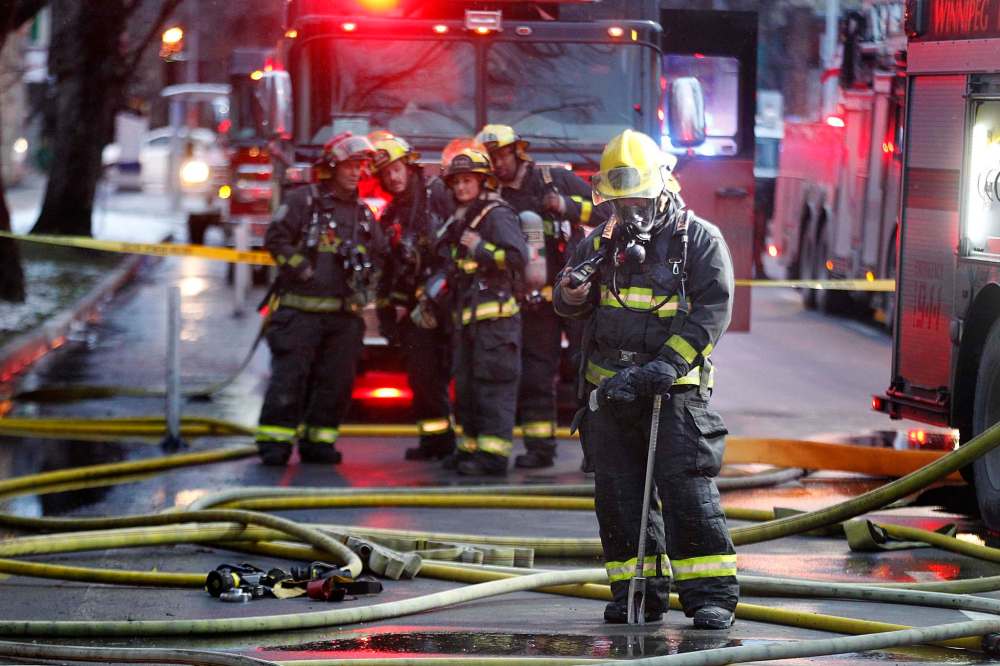
The report shows Winnipeggers have a positive perception of most civic services, none more favourably than their satisfaction with the response of firefighters in dealing with fires. Residents surveyed for the report gave a 98.9 per cent satisfaction for the city’s response to fires — 62.7 per cent very satisfied and 36.2 per cent somewhat satisfied — an increase from the 97.8 per cent in 2015.
One of the lowest satisfaction ratings was found in the condition of the city’s roadways: 48.3 per cent of those surveyed said they were satisfied with the condition of Winnipeg’s major streets. The rating was only marginally better for residential streets, at 48.6 per cent.
The report also comments on morning commute times to the downtown. The only corridor where the travel time has been reduced has been along Henderson Highway, where the commute (measured from the Perimeter Highway) is eight minutes shorter than it had been in 2013 (12.2 minutes in 2016 vs 20.5 minutes in 2013).
The commute along St. Mary’s Road is almost 4 minutes longer (21.1 minutes in 2016 vs 17.5 minutes in 2013).
The times along Portage Avenue, Main Street and Pembina Highway have essentially remained the same since 2013.
Winnipeggers’ appreciation of city parks was also high, with a 96.9 per cent satisfaction rating (59.9 per cent very satisfied; 37 per cent somewhat satisfied).

Despite citizens’ appreciation for the parks, the report found that the city has fewer trees on its boulevards and parks and fewer flower planters than in previous years. The report also notes that city hall is pruning fewer trees than it has in the past. The city pruned 4.5 per cent of its trees in 2016, compared to 6 per cent in 2015 and 8 per cent in 2014. The report notes that the industry standard is 14 per cent and Edmonton pruned 16 per cent of its urban forest in 2016.
The complete report can be found at the City of Winnipeg’s website: wfp.to/trendsreport.
aldo.santin@freepress.mb.ca