Health authority put patients in danger by diverting paramedics from Winnipeg hospitals: union
Advertisement
Read this article for free:
or
Already have an account? Log in here »
To continue reading, please subscribe:
Monthly Digital Subscription
$1 per week for 24 weeks*
- Enjoy unlimited reading on winnipegfreepress.com
- Read the E-Edition, our digital replica newspaper
- Access News Break, our award-winning app
- Play interactive puzzles
*Billed as $4.00 plus GST every four weeks. After 24 weeks, price increases to the regular rate of $19.95 plus GST every four weeks. Offer available to new and qualified returning subscribers only. Cancel any time.
Monthly Digital Subscription
$4.99/week*
- Enjoy unlimited reading on winnipegfreepress.com
- Read the E-Edition, our digital replica newspaper
- Access News Break, our award-winning app
- Play interactive puzzles
*Billed as $19.95 plus GST every four weeks. Cancel any time.
To continue reading, please subscribe:
Add Free Press access to your Brandon Sun subscription for only an additional
$1 for the first 4 weeks*
*Your next subscription payment will increase by $1.00 and you will be charged $16.99 plus GST for four weeks. After four weeks, your payment will increase to $23.99 plus GST every four weeks.
Read unlimited articles for free today:
or
Already have an account? Log in here »
Hey there, time traveller!
This article was published 28/07/2017 (3192 days ago), so information in it may no longer be current.
The Interlake-Eastern Regional Health Authority is being accused of threatening the safety of patients after temporarily directing its paramedics to avoid Winnipeg hospitals.
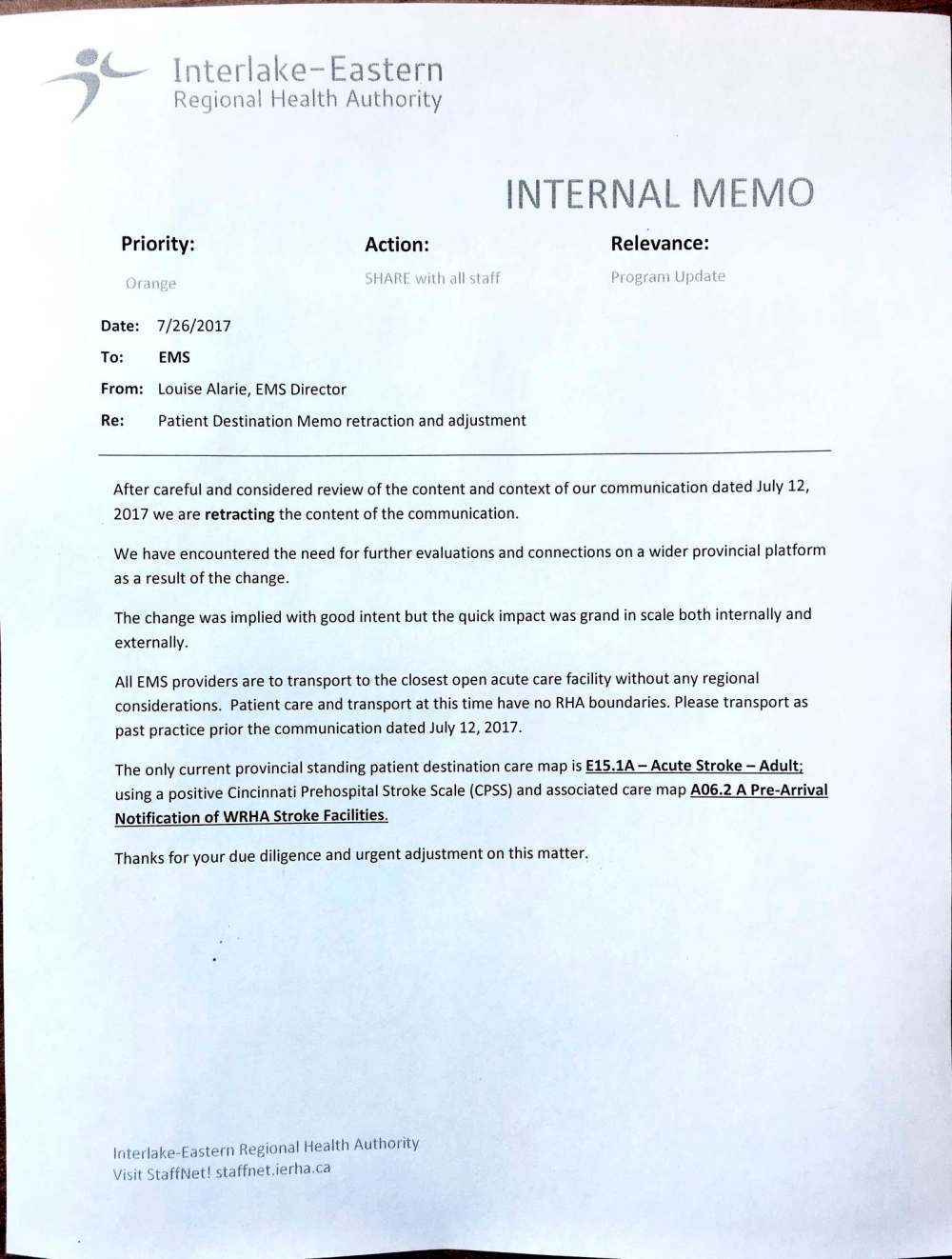
On July 13, the authority’s emergency medical services director, Louise Alarie, wrote a memo ordering patients within the region — apart from apparent stroke victims — be first transported to and treated at the nearest regional hospital.
It meant someone requiring emergency assistance just north of the Perimeter Highway, for instance, would be taken to Selkirk or Stonewall when, in the paramedics’ judgment, it would have been best for them to go to Concordia Hospital, Seven Oaks General Hospital or Health Sciences Centre, all in Winnipeg.
The authority rescinded the order Wednesday after strong pushback from paramedics — and, also likely, from patients, although the health authority wouldn’t say that Thursday.
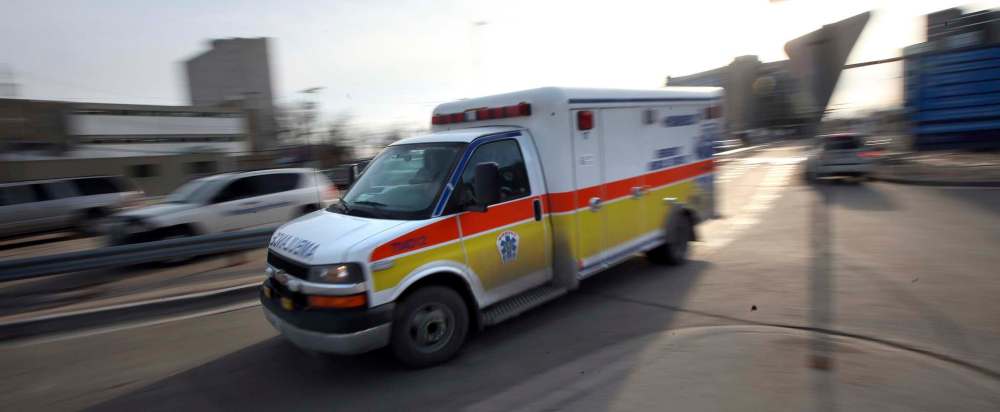
An authority source, who spoke on condition of anonymity, said paramedics were “pretty hot” about the directive, which prevented them from using their judgment on where to transport patients.
The protocol was issued in the wake of the Manitoba government’s announcement it will eventually close the emergency rooms at Concordia and Seven Oaks hospitals in north Winnipeg, sparking speculation the two decisions were linked. However, there is no evidence of that yet.
During the two weeks the directive remained in effect, some 911 callers, including those with heart conditions, balked at the idea of being taken to a local hospital and arranged their own transportation to Winnipeg after signing a waiver form, sources said.
Some paramedic crews defied the directive, the Free Press was told, transporting patients to Winnipeg. They said city hospitals appeared unaware of the Interlake authority’s edict — something the Winnipeg Regional Health Authority confirmed Thursday.
The Interlake-Eastern region has had a severe doctor shortage for several years, necessitating temporary ER closures at various hospitals. A Gimli baby who fell and injured her head while the edict was in effect was transported to Selkirk instead of Children’s Hospital in Winnipeg. (The Gimli hospital was diverting patients at the time, reportedly because either no doctor was available or it was short of beds.)
Sources said paramedics would normally have taken the child directly to Children’s. And, about a half-hour after the child arrived at hospital in Selkirk, staff there arranged for the baby to be taken to Winnipeg.
“Why would an RHA suggest that you don’t take a patient to the hospital that can look after them the best? It is ludicrous,” said Michelle Gawronsky, president of the Manitoba Government and General Employees’ Union, which represents paramedics.
The temporary policy could have had serious implications for victims of vehicular crashes, especially those occurring just north of the Perimeter, Gawronsky fumed. Any serious collision would normally result in patients transported directly to the province’s main trauma centre — Health Sciences Centre, she said.
“Why are we putting patients at risk to drive further away from where the patients are going to get the best care?” Gawronsky said.
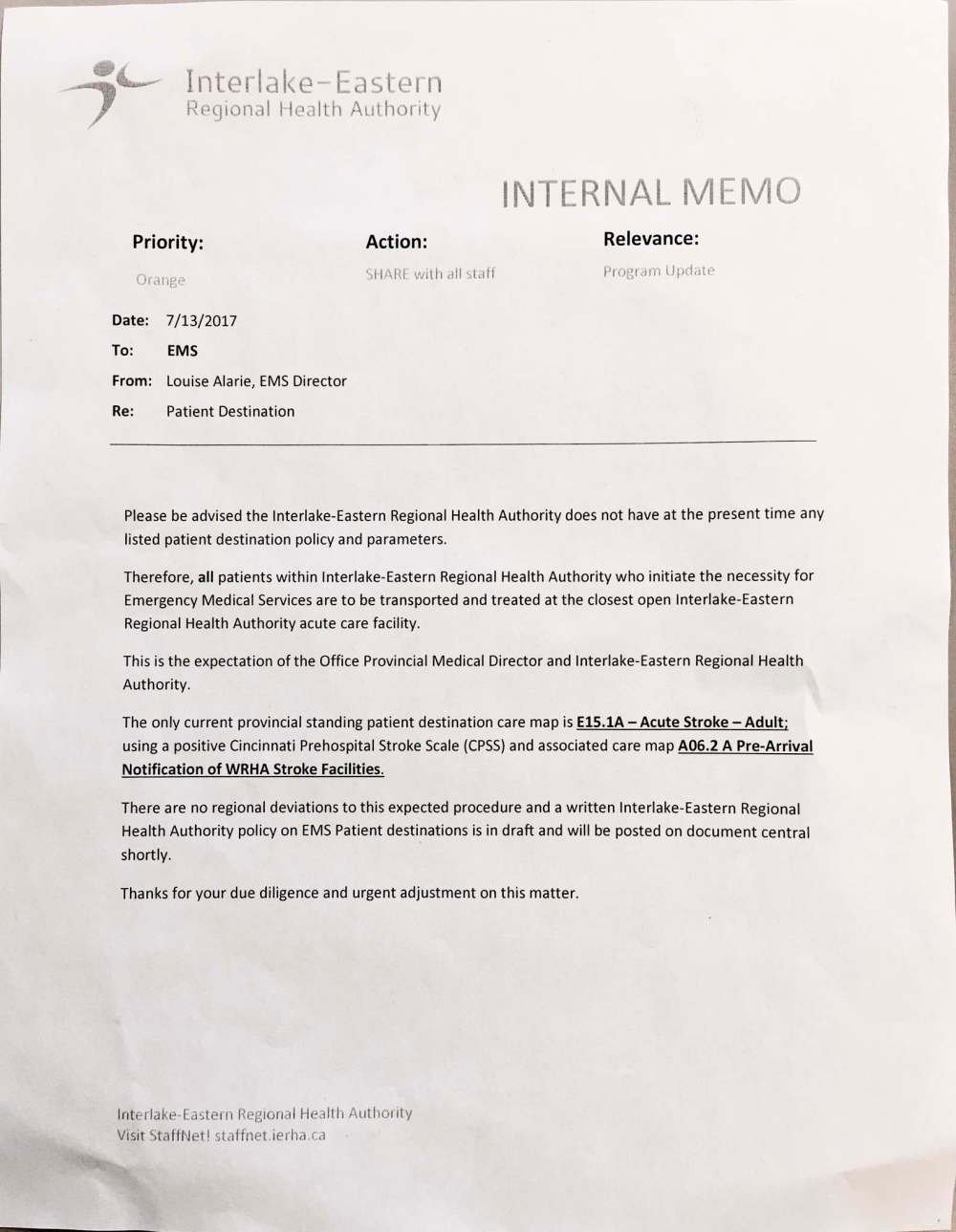
The Interlake authority would not agree to an interview about the memo Thursday. In an email to the Free Press, a spokeswoman portrayed the original directive as being poorly worded, creating a misunderstanding among staff.
“The original memo was misleading — all patients should be transferred to the nearest facility that can offer the most appropriate care. The memo attempted to ensure services are being provided in the most appropriate manner for our residents, but that does not always mean taking patients to an (Interlake-Eastern) facility. Sometimes, appropriate care is located in Winnipeg (depending on the case),” communications associate Lita Savage-Murray said.
“Because the memo dated July 13 gave a different impression, it was retracted in the second memo dated July 26. The second memo should have clarified the intent is for EMS staff to transport to appropriate service delivery in the shortest amount of time as possible given the circumstances,” she said. “We always strive to deliver health-care services closer to home for our residents and not rely on facilities in Winnipeg unnecessarily.”
However, the union strongly disputes the region’s explanation. More than a dozen paramedics immediately raised their concerns to management, including Alarie, who penned both memos, Gawronsky said.
“If senior staff at (Interlake-Eastern) knew about the error and consequences but didn’t take corrective action, that’s a very serious breach of ethical standards,” she said.
The Free Press left messages requesting an interview with provincial EMS medical director, Anthony Herd, who was said to be in support of the original memo. Herd didn’t respond.
According to its website, the authority covers 61,000 square kilometres and more than 124,000 people, with its borders extending east to the Ontario border, north to the 53rd parallel, west to the eastern shores of Lake Manitoba and south to Winnipeg’s north Perimeter.
larry.kusch@freepress.mb.ca