

Pencilling in the details of a case
Winnipeg police officer one of the few composite sketch artists in the field

Advertisement
Read this article for free:
or
Already have an account? Log in here »
To continue reading, please subscribe:
Monthly Digital Subscription
$1 per week for 24 weeks*
- Enjoy unlimited reading on winnipegfreepress.com
- Read the E-Edition, our digital replica newspaper
- Access News Break, our award-winning app
- Play interactive puzzles
*Billed as $4.00 plus GST every four weeks. After 24 weeks, price increases to the regular rate of $19.95 plus GST every four weeks. Offer available to new and qualified returning subscribers only. Cancel any time.
Monthly Digital Subscription
$4.99/week*
- Enjoy unlimited reading on winnipegfreepress.com
- Read the E-Edition, our digital replica newspaper
- Access News Break, our award-winning app
- Play interactive puzzles
*Billed as $19.95 plus GST every four weeks. Cancel any time.
To continue reading, please subscribe:
Add Free Press access to your Brandon Sun subscription for only an additional
$1 for the first 4 weeks*
*Your next subscription payment will increase by $1.00 and you will be charged $16.99 plus GST for four weeks. After four weeks, your payment will increase to $23.99 plus GST every four weeks.
Read unlimited articles for free today:
or
Already have an account? Log in here »
Hey there, time traveller!
This article was published 28/09/2017 (3094 days ago), so information in it may no longer be current.
A briefcase stocked with paper and pencils — the regular HB kind — is close at hand for Patrol Sgt. Kevyn Bourgeois.
At a moment’s notice, he may need to grab it and go. Called away from his post taking fingerprints and processing inmates, he could wind up at a hospital bedside, in someone’s living room, or sitting at a table in a windowless, (distraction-less) space at the Winnipeg Police Service headquarters, where he’d pull out his paper and pencil and get to work.
Such is the call of duty for a police sketch artist and Bourgeois is one of a select group of officers across the country who is still practising the craft.
“It’s a very weird craft. It’s not entirely just art. There’s a lot more to it. There’s a lot of interview, a lot of speaking, a lot of listening, a lot of paying attention and a lot of interacting with someone. That is a huge portion of it,” says Bourgeois, a 22-year WPS officer who has spent most of his career juggling part-time forensic sketch work on top of other duties.
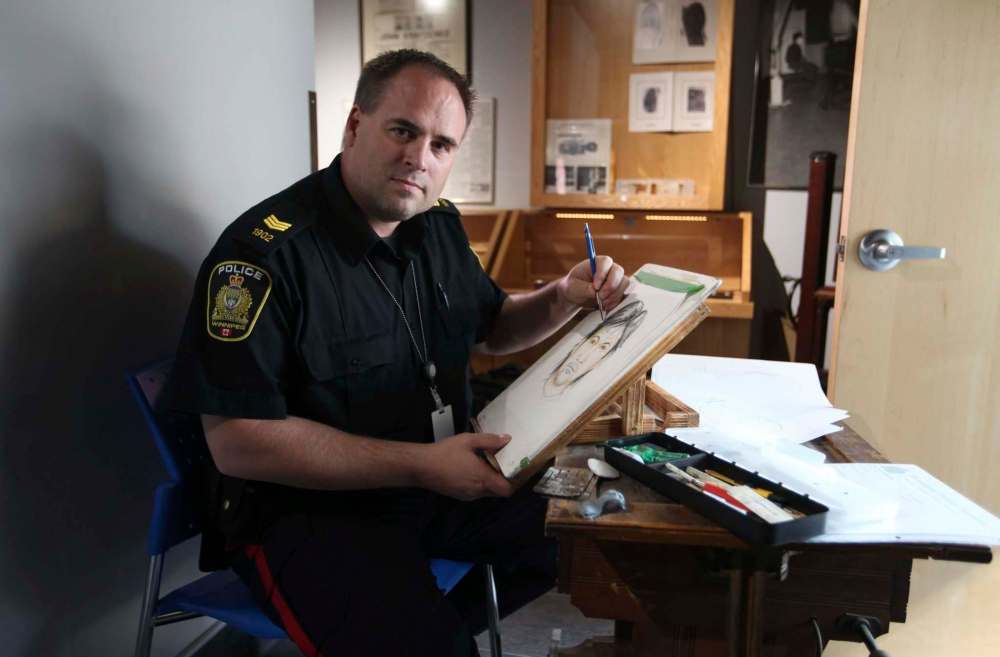
There are few full-time forensic sketch artists employed by police forces across Canada. The RCMP has only two, at opposite ends of the country — one in British Columbia, the other in the Maritimes. RCMP employees in other parts of the country take up sketch work only occasionally.
In Manitoba, the RCMP has only one officer who draws composite sketches for detachments throughout the province. There used to be two positions, but after a recent retirement, Thompson-based forensic identification specialist Cpl. Dean Martin now stands alone.
Meanwhile, Bourgeois is one of two part-time forensic sketch artists with the Winnipeg Police Service, and the duo is training two apprentices, out of a pool of eight applicants, who may eventually take over.
They’re part of a small, select group of forensic artists in North America trained at the FBI academy in Quantico, Va. Before they even get to the training stage, they must have already shown artistic ability.
Just as important, says Bourgeois, who started with the WPS in 1995, is the officer’s interviewing style. Police too green in their careers won’t make the cut as sketch artists, he says. They need to know how to allow people to tell their stories and get the necessary information — an understanding that comes with years of conducting police interviews.
Pencil-and-paper technique
Bourgeois has been drawing since he was three and has “dabbled” in digital art, three-dimensional models and painting — he completed a mural for the West District station last year and is working on a new project for the WPS headquarters building.
Bourgeois says he was never interested in becoming a sketch artist. In recruit class, he got caught doodling.
“I had my head down and I was drawing my instructor. And then I had a big shadow come over me, and I looked up and I saw my instructor, not looking at me but looking at himself on my page,” he says.
“So I kinda got known as being ‘that guy.’”
His reputation made its way up the ranks, and when the police service’s longtime sketch artist was preparing to retire in 2001, he called Bourgeois even though he didn’t know him personally.
Bourgeois had not applied for the job.
“He said, ‘Just bring me a portfolio.’ And I said, ‘Sure. What’s a portfolio?’”
Sixteen years later, despite ever-changing technologies and the inflated expectations raised in a glut of fictional forensic-focused entertainment, Bourgeois doesn’t go for fancy electronic tablets or special software when he is creating a likeness of a potential suspect.
“I am very much the pencil-and-paper drawing guy, so that’s sort of my specialty and where I focus,” he says. While computerized sketches may or may not be the future, he says, “If you add up all the composite artists in the world, there’s not a lot of us. So there really isn’t a lot of great software.”
Together, the two WPS artists complete about 30 sketches a year, often for random sexual assault cases or stranger-to-stranger attacks.
‘You have to trust the process’
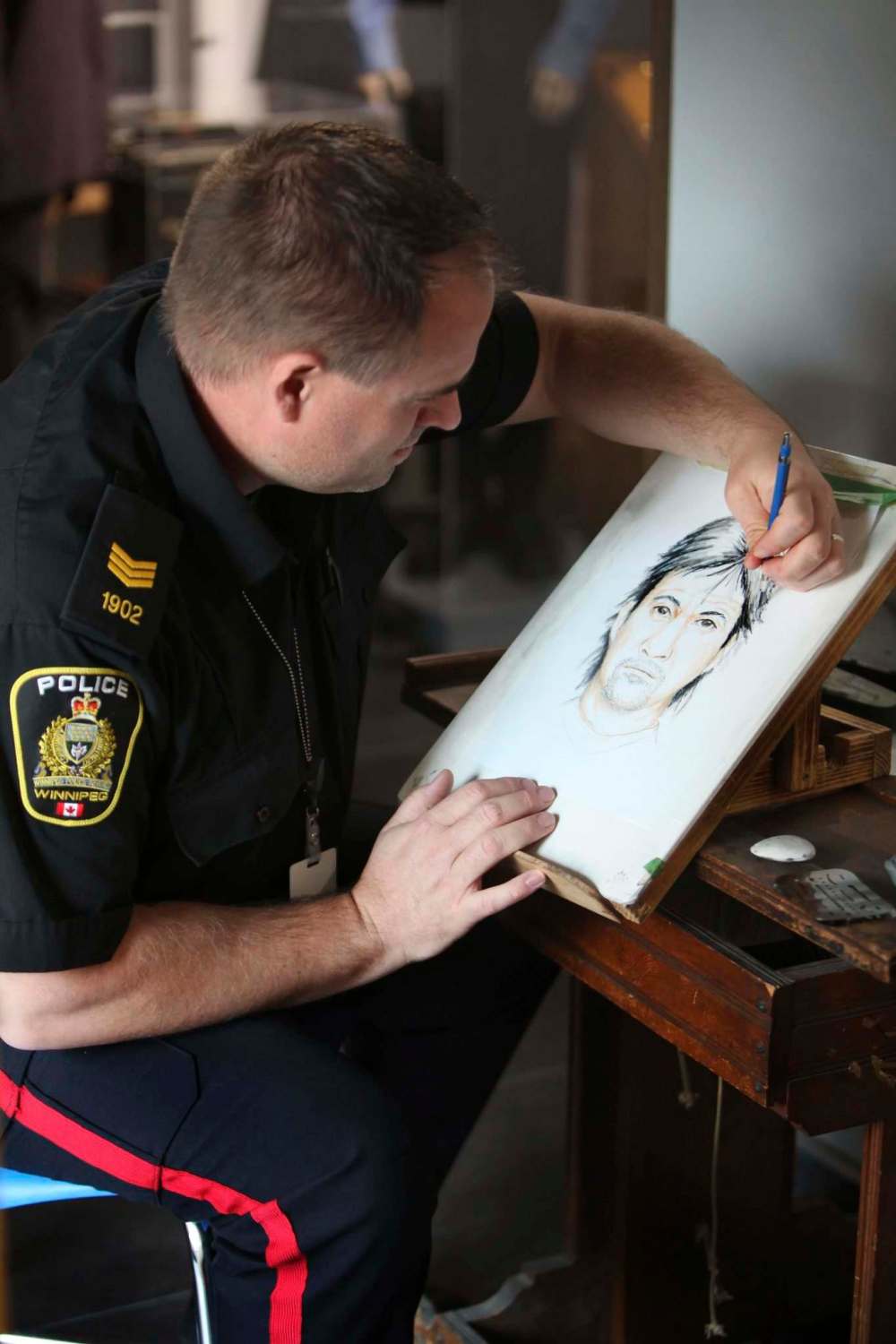
Each sketch Bourgeois does is by hand, but the process begins long before he puts pencil to paper. He’ll sit down with someone — typically the victim of a crime — and ask what they remember about their attacker.
The victim can flip through a photo book of categorized facial feature examples and after an hour or two of careful questioning designed to piece together the memories, they’ll see the perpetrator’s face on Bourgeois’ page. And because it’s only pencil, he reminds them, it’s easy to adjust along the way.
“It’s weird because you’re told how it works. We talk about memory and we talk about human experience, like, short people see everybody as tall, tall people see everybody as short. And it’s very interesting. You have to be very careful in how you do it,” he says.“I’ll have some sketches where I know the witness had a remarkable (memory of the) image. I know that, but we never find out who it is. And I’m dying to find out. I’d love to see who the suspect was because I can tell that person gave a really fantastic description.”–Kevyn Bourgeois
“You have to trust the process. You truly have to trust it, because somebody’s telling you something and that’s what the image should be.”
It’s complex work and he doesn’t always have a good witness account to go on. Sometimes people really can’t offer a decent description of a face they saw for a few seconds in the dark. And Bourgeois is always alert for the signs of a liar. But often, he says, “you’d probably be very surprised how much you can remember.”
“More often than not, the person may say, ‘Oh, I can only remember one thing.’ OK, what is that? It’s the eyes. OK, let’s draw the eyes. And then we draw the eyes and now literally that person has taken those off of their memory,” he says. With the hard part out of the way, the victim often relaxes and can refocus.
Tell me a little about the cheeks, Bourgeois will continue. The nose? The neck?
“We can still create a very viable drawing. I mean, sometimes we can’t, but lots of times we can,” he says.
“We just work it in until it works.”
‘I’m not here to solve the case’
Cpl. Martin, meanwhile, has been drawing since he can remember, and while he once dreamed of launching his own career as an artist, he trained in composite sketching to marry his artistic ability with his skills in law enforcement, using his creative side as an investigative tool.
“I’m not here to solve the case,” he says. “If they’re running out of ideas or they’re running into dead ends on their investigation, this becomes another avenue to kind of lead them in the proper direction.”
For the past five years, he’s been drawing sketches as they’re needed, in addition to his other work, which includes crime scene photography, fingerprinting and analyzing footwear and tire impressions.
Rural police forces in the province call upon Martin if they need a sketch done, so he’s often driving or flying to meet victims who can visualize potential suspects. He currently draws about one sketch per month — whether it’s of a face, a tattoo or distinctive clothing.
“For Manitoba, it is not as widely used as, say, in Winnipeg. Especially up here in the north, the victim and the suspect may know each other, more often than not. So there’s no need for me to come in and do a sketch. Quite often, most of the sketches I do are down south as opposed to up north,” Martin says when reached by phone in Thompson.
Not all police sketches are publicly released, but they’re given to investigators to help them solve cases. Sometimes, years go by before Bourgeois can match one of his sketches to an arrested suspect.
In many investigations, he’s still waiting to find out how accurate his depiction may have been as the cases remain unsolved.
“It’s frustrating for me, too, because I’ll have some sketches where I know the witness had a remarkable (memory of the) image. I know that, but we never find out who it is. And I’m dying to find out. I’d love to see who the suspect was because I can tell that person gave a really fantastic description,” Bourgeois says.
Martin, too, said it can be difficult to find out how his sketch fared in an investigation.
“Often, I will get an email from the investigator telling me how successful it was or how helpful it was, but most of the time, I don’t hear anything.”
‘It’s not your drawing, it’s the witness’s’
As artists, Bourgeois and Martin say they can be their own worst critics. But they see themselves mainly as conduits for witnesses’ memories, trying to get the truth of the image onto the page.
Martin recalled a recent missing person case in which he showed his sketch to all of the officers in a particular detachment.
“They immediately said, that looks like X person, and they solved it right off the hop. So that’s a good feeling when that happens. Then when they showed me (the photo of the person), I’m like — I don’t see it,” Martin says.“As long as there’s laws, there’s going to be crime. As long as there’s crime, we’re going to need someone to be identified.”–Dean Martin
“But you’ve got to remember that it’s not your drawing; it’s the witness’s or the victim’s drawing.”
The two sketch artists both hold their paper and pencils in high regard and they can’t see the job changing too much.
“As long as there’s laws, there’s going to be crime. As long as there’s crime, we’re going to need someone to be identified,” Martin says. “These crimes happen so quickly, and in places where someone’s not going to have a camera to take a picture; they’re too concerned for their well-being. So a composite sketch is your best bet for that kind of situation.”
Bourgeois agrees.
“If you talk to some traditionalists, they’ll say it’ll never change, ever. And part of me says that too, like, it doesn’t actually ever need to change.
“Pencil and paper is extremely effective in the hands of a qualified artist,” he says.
katie.may@freepress.mb.ca Twitter: @thatkatiemay
Katie May is a multimedia producer for the Free Press.
Our newsroom depends on a growing audience of readers to power our journalism. If you are not a paid reader, please consider becoming a subscriber.
Our newsroom depends on its audience of readers to power our journalism. Thank you for your support.
Katie May is a multimedia producer for the Free Press.
Our newsroom depends on a growing audience of readers to power our journalism. If you are not a paid reader, please consider becoming a subscriber.
Our newsroom depends on its audience of readers to power our journalism. Thank you for your support.
Advertisement Advertise With Us
Advertisement Advertise With Us