

Powering up innovation
Advertisement
Read this article for free:
or
Already have an account? Log in here »
To continue reading, please subscribe:
Digital Subscription
One year of digital access for only $1.44 a week*
- Enjoy unlimited reading on winnipegfreepress.com
- Read the E-Edition, our digital replica newspaper
- Access News Break, our award-winning app
- Play interactive puzzles
*Billed as $5.77 plus GST every four weeks. After 52 weeks, price increases to the regular rate of $19.95 plus GST every four weeks. Offer available to new and qualified returning subscribers only. Cancel any time.
To continue reading, please subscribe:
Add Free Press access to your Brandon Sun subscription for only an additional
$1 for the first 4 weeks*
- Enjoy unlimited reading on winnipegfreepress.com
- Read the E-Edition, our digital replica newspaper
- Access News Break, our award-winning app
- Play interactive puzzles
*Your next Brandon Sun subscription payment will increase by $1.00 and you will be charged $17.95 plus GST for four weeks. After four weeks, your payment will increase to $24.95 plus GST every four weeks.
Read unlimited articles for free today:
or
Already have an account? Log in here »
Hey there, time traveller!
This article was published 23/04/2021 (2011 days ago), so information in it may no longer be current.
The Innovation Centre is living up to its name.
Next week, electrical and construction crews will begin to install 400 energy-conducting solar panels — the first of their kind in North America — on its exterior.
The centre, which is the latest addition to Red River College’s Exchange District campus, will foster collaboration between businesses and students on concept and product development, testing and promotion.
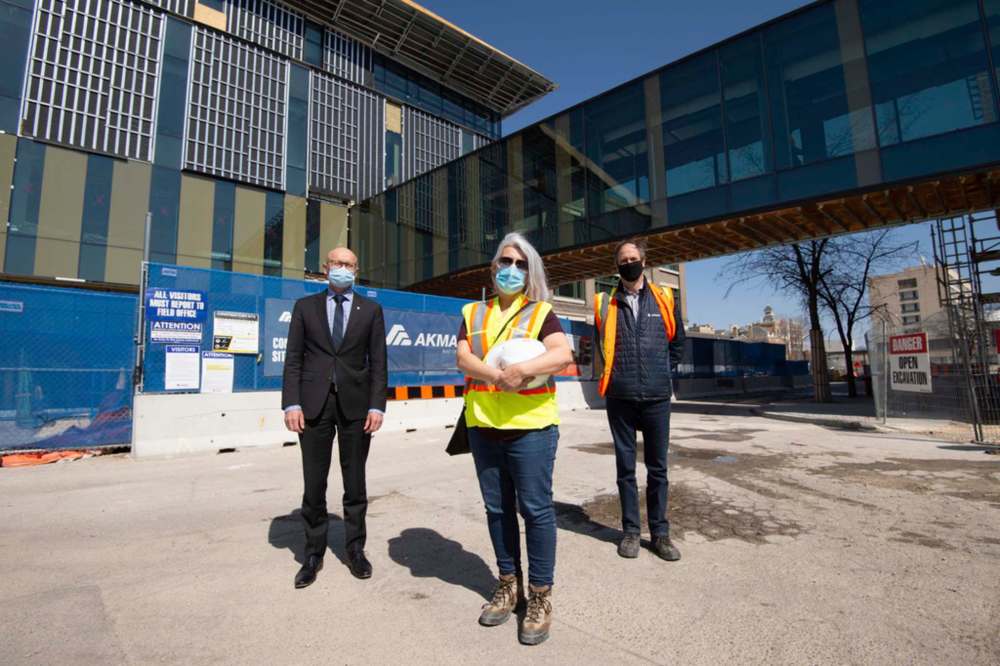
The glass panels, called Kromatix building-integrated photovoltaics, are made by layering solar, thermal and electronic components.
Together with 138 rooftop panels, the college expects to offset its energy consumption by enough energy to power 18.5 average-sized houses.
With global markets for building-integrated photovoltaics expected to more than double by 2026, according to a recent report, the installation offers students a peek at technology on the cusp of widespread growth.
The solar panels’ inverters, which convert the energy for use in the building, also serve a second purpose.
“They collect information about how much power it’s producing and when,” said Joe Carey, chair of electrical engineering technology at Red River College.
That data will end up in a digital storage point accessible to students.
“They can actually see the real-world application and what it’s doing and how it’s doing it,” he said.
Carey and his department asked for sensors on the panels to collect environmental data, such as wind shear and ice cover. Understanding how conditions affect energy production will provide students with invaluable insight, he said.
“This is a tremendous opportunity to learn about the latest technology in sustainable energy,” he said.
This applies to the architectural engineering and construction management students too, he said, who will also get exposure to the technology.
A crucial benefit of the solar panels is they function as cladding, the outer layer covering a building. Unlike older solar panels, there’s no need to buy cladding separately.
Of course, the new tech costs more upfront than most traditional cladding. But brick and vinyl siding don’t funnel energy into their buildings. Solar panels do, reducing energy costs.
“It pays for itself over a period of time,” said Carey.
There’s another, more visceral, factor: the panels are beautiful.
Quite apart from the image of dull black squares plastered atop buildings like single-player chess boards, the panels come in a range of colour. The colour is the result not of paint or tint but of “atomic deposition” — a thin film of ingrained atoms that reflect light to create colour.
So the golden panels facing Adelaide Street should have an iridescent effect, changing hues as you walk around it.
“It makes you feel good,” said Maria Mendes, who heads the Innovation Centre project. “Sustainability is more than just energy efficiency and so on. You still want your environment to be a place you want to be.”
She said she thinks good esthetics can help encourage more builders to use green technology. That would result in greater overall efficiency, which, for Mendes, is the goal.
“One of the targets was to try to get to as near net zero as possible,” she said.

The panels’ high energy-transmission rates will help do that, she said. They’re also installing Power over Ethernet lighting, which can transmit both power and data through a single low-voltage cable, and a number of smaller energy-saving elements.
It took a team of architects, engineers, builders and electricians to get the project to this point, said Mendes.
Besides that, the European panels had to be inspected and improved by the Canadian Standards Association, the City of Winnipeg and Manitoba Hydro.
Lauren Parsons, a spokeswoman for Red River, said the college hopes to hold classes at the centre after it opens in the fall.
fpcity@freepress.mb.ca
History
Updated on Friday, April 23, 2021 8:14 AM CDT: Fixes spelling of names in photo caption.
Updated on Friday, April 23, 2021 8:31 AM CDT: updates cutline for style
Updated on Friday, April 23, 2021 8:38 AM CDT: Removes "left to right" in photo caption