

Province seeks to boost women in trades, tech

Advertisement
Read this article for free:
or
Already have an account? Log in here »
To continue reading, please subscribe:
Monthly Digital Subscription
$1 per week for 24 weeks*
- Enjoy unlimited reading on winnipegfreepress.com
- Read the E-Edition, our digital replica newspaper
- Access News Break, our award-winning app
- Play interactive puzzles
*Billed as $4.00 plus GST every four weeks. After 24 weeks, price increases to the regular rate of $19.95 plus GST every four weeks. Offer available to new and qualified returning subscribers only. Cancel any time.
Monthly Digital Subscription
$4.99/week*
- Enjoy unlimited reading on winnipegfreepress.com
- Read the E-Edition, our digital replica newspaper
- Access News Break, our award-winning app
- Play interactive puzzles
*Billed as $19.95 plus GST every four weeks. Cancel any time.
To continue reading, please subscribe:
Add Free Press access to your Brandon Sun subscription for only an additional
$1 for the first 4 weeks*
*Your next subscription payment will increase by $1.00 and you will be charged $16.99 plus GST for four weeks. After four weeks, your payment will increase to $23.99 plus GST every four weeks.
Read unlimited articles for free today:
or
Already have an account? Log in here »
Hey there, time traveller!
This article was published 08/03/2021 (1884 days ago), so information in it may no longer be current.
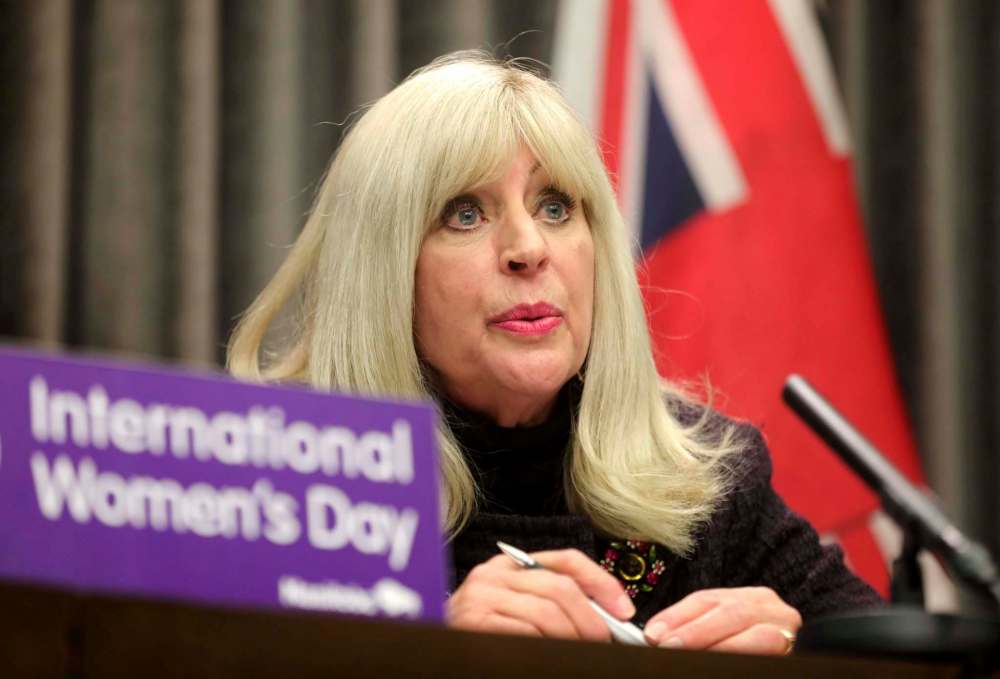
On International Women’s Day, Manitoba announced it is spending $50,000 to try and rectify a so-called “she-cession.”
With Manitoba women facing the second-highest loss of jobs of any province, and with Manitoba facing a major skills shortage, the province is seeking to get more women working in male-dominated sectors.
The Empower program at the Manitoba Institute of Trades and Technology is receiving $25,000 to help women training in information and communications technology.
Another $25,000 has been tabbed for the Manitoba Construction Sector Council to promote careers in heavy construction, partnering with the River East Transcona School Division.
Women in Grade 12 and adults will receive career awareness, certificates and networking opportunities with job opportunities this spring.
“Jobs in trades and technology are often better-paying and have job security that minimum-wage jobs do not,” Cathy Cox, minister responsible for the status of women, said at a news conference Monday, joined virtually by two advocates for women in trades and technology.
The sector is made up of just over three per cent women, and experiencing a skills shortage of more than 8,000 jobs, said Colleen Munro, chairwoman of the Manitoba Construction Sector Council.
“The challenge for us to attract women in trades and technology is fear of the unknown,” said Beverlie Stuart, acting vice-president at MITT. “You have to see yourself in that career to have the confidence to pursue it.”
Manitoba women have borne the career brunt of the COVID-19 pandemic, and lost the second-highest percentage of jobs of any province, according to a report released Monday by the Manitoba office of the Canadian Centre for Policy Alternatives.
Most of the jobs were lost in retail, services and accommodations, social services and health. Manitoba’s unemployment rate was 7.1 per cent for women, compared to 5.1 per cent for men.
Before the pandemic (January 2020), women’s unemployment rate was slightly lower (4.4 per cent) than men’s (five per cent), the report says. Women’s part-time employment was down dramatically from more than a year ago, with 36,500 working part-time, compared to 41,600 a year ago,citing Statistics Canada Labour Force Survey data.
Women working part-time, racialized women, and women earning less than $17 an hour were hardest hit, the anti-poverty think tank report says.
Manitoba’s Progressive Conservative government isn’t doing enough to respond to the needs of women, says the NDP status of women critic.
“Right now, we know this has been an asymmetrical recession. Most of the people that have been hardest hit by this recession are women, specifically mothers, young people, newcomers and racialized people,” MLA Malaya Marcelino said at a news conference.
The province needs to invest more in affordable and accessible child care, she said.
“They have actually frozen child care operating grants across the province for the past four years. And they’ve also cut inclusion supports for children with additional needs.”
Improved child care will enable mothers to retrain and get back to work, boosting the economy, Marcelino said. Government can help address employment inequities by offering subsidies to industry to hire from under-represented groups, she said.

Meanwhile, in honouring International Women’s Day, the City of Winnipeg unveiled a photo display celebrating a century of women on council.
This year marks the 100th anniversary of the inauguration of Jessie Kirk, the first woman elected to council. Winnipeg elected its first female mayor, Susan Thompson, in 1992, and its first female speaker of council, Devi Sharma, in 2013.
The display will be installed in the Susan A. Thompson Building at a later date.
— with files from Larry Kusch
carol.sanders@freepress.mb.ca
Feminist%20COVID%20recovery%20MB
Carol Sanders
Legislature reporter
Carol Sanders is a reporter at the Free Press legislature bureau. The former general assignment reporter and copy editor joined the paper in 1997. Read more about Carol.
Every piece of reporting Carol produces is reviewed by an editing team before it is posted online or published in print — part of the Free Press‘s tradition, since 1872, of producing reliable independent journalism. Read more about Free Press’s history and mandate, and learn how our newsroom operates.
Our newsroom depends on a growing audience of readers to power our journalism. If you are not a paid reader, please consider becoming a subscriber.
Our newsroom depends on its audience of readers to power our journalism. Thank you for your support.
Carol Sanders
Legislature reporter
Carol Sanders is a reporter at the Free Press legislature bureau. The former general assignment reporter and copy editor joined the paper in 1997. Read more about Carol.
Every piece of reporting Carol produces is reviewed by an editing team before it is posted online or published in print — part of the Free Press‘s tradition, since 1872, of producing reliable independent journalism. Read more about Free Press’s history and mandate, and learn how our newsroom operates.
Our newsroom depends on a growing audience of readers to power our journalism. If you are not a paid reader, please consider becoming a subscriber.
Our newsroom depends on its audience of readers to power our journalism. Thank you for your support.
Advertisement Advertise With Us
Advertisement Advertise With Us