

Putting safety on the map

Advertisement
Read this article for free:
or
Already have an account? Log in here »
To continue reading, please subscribe:
Monthly Digital Subscription
$1 per week for 24 weeks*
- Enjoy unlimited reading on winnipegfreepress.com
- Read the E-Edition, our digital replica newspaper
- Access News Break, our award-winning app
- Play interactive puzzles
*Billed as $4.00 plus GST every four weeks. After 24 weeks, price increases to the regular rate of $19.95 plus GST every four weeks. Offer available to new and qualified returning subscribers only. Cancel any time.
Monthly Digital Subscription
$4.99/week*
- Enjoy unlimited reading on winnipegfreepress.com
- Read the E-Edition, our digital replica newspaper
- Access News Break, our award-winning app
- Play interactive puzzles
*Billed as $19.95 plus GST every four weeks. Cancel any time.
To continue reading, please subscribe:
Add Free Press access to your Brandon Sun subscription for only an additional
$1 for the first 4 weeks*
*Your next subscription payment will increase by $1.00 and you will be charged $16.99 plus GST for four weeks. After four weeks, your payment will increase to $23.99 plus GST every four weeks.
Read unlimited articles for free today:
or
Already have an account? Log in here »
Hey there, time traveller!
This article was published 08/04/2021 (1841 days ago), so information in it may no longer be current.
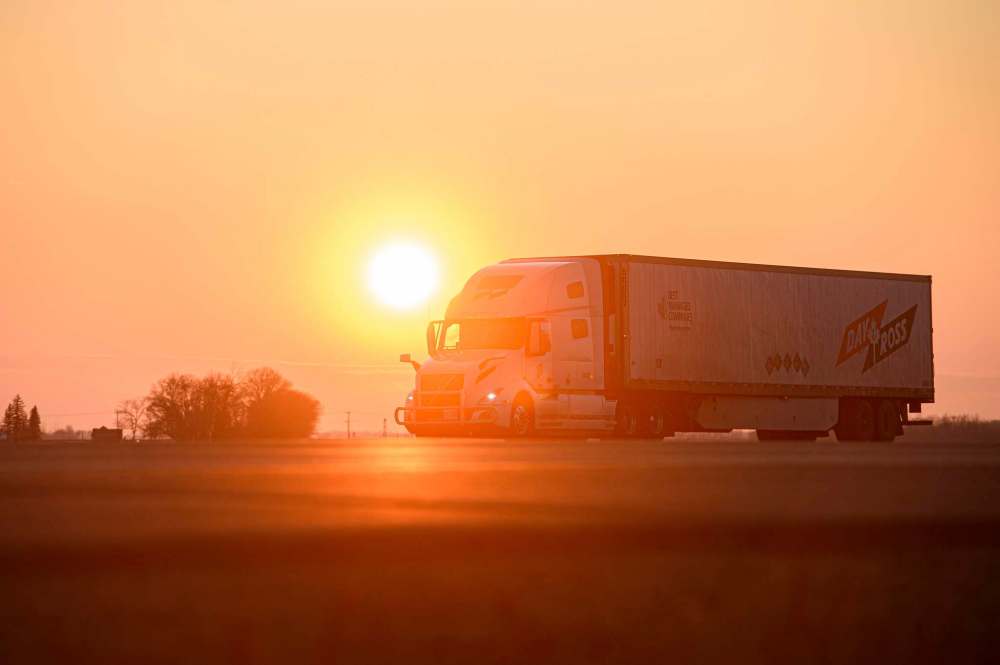
TWO University of Manitoba civil engineering professors will create maps of trucking routes on the Prairies, with the use of artificial intelligence, to make the network safer and more resilient.
Over five years, Jonathan Regehr and Babak Mehran will collect data on the number, type and weight of trucks that using the highways. Sensors will be embedded in roads in Manitoba, Saskatchewan and Alberta, along with parts of the northern territories.
They will also collect data on how traffic operates on the roads under different weather conditions. The scheme will be paid for using $1.6 million in research and development funding from the National Research Council of Canada.
Then, the researchers will work with Manitoba Infrastructure, the research council and private transportation software company International Road Dynamics to create models of the road network using artificial intelligence.
“The prairie road network is very large and sparse. We don’t have enough sensors to cover every element of it, so it’s a large network with missing data, for some lengths we have some data, for some we have nothing. One way to use (artificial intelligence) is to produce the information from existing data (through extrapolation),” Mehran said.
“So after identifying the most important roads and links in the Prairies, we form a model only based on those — AI will help us build an abstract network based on what we have.”
Researchers will be able to identify crucial links, and their weak points, in the logistical network. The data will reveal how different factors, human-made or natural, could create problems on the roads. The models will be updated when new data is added.

The data could be used to inform government decisions on infrastructure spending including upgrades to roads or bridges.
— Erik Pindera
Erik Pindera is a reporter for the Free Press, mostly focusing on crime and justice. The born-and-bred Winnipegger attended Red River College Polytechnic, wrote for the community newspaper in Kenora, Ont. and reported on television and radio in Winnipeg before joining the Free Press in 2020. Read more about Erik.
Every piece of reporting Erik produces is reviewed by an editing team before it is posted online or published in print — part of the Free Press‘s tradition, since 1872, of producing reliable independent journalism. Read more about Free Press’s history and mandate, and learn how our newsroom operates.
Our newsroom depends on a growing audience of readers to power our journalism. If you are not a paid reader, please consider becoming a subscriber.
Our newsroom depends on its audience of readers to power our journalism. Thank you for your support.
Erik Pindera is a reporter for the Free Press, mostly focusing on crime and justice. The born-and-bred Winnipegger attended Red River College Polytechnic, wrote for the community newspaper in Kenora, Ont. and reported on television and radio in Winnipeg before joining the Free Press in 2020. Read more about Erik.
Every piece of reporting Erik produces is reviewed by an editing team before it is posted online or published in print — part of the Free Press‘s tradition, since 1872, of producing reliable independent journalism. Read more about Free Press’s history and mandate, and learn how our newsroom operates.
Our newsroom depends on a growing audience of readers to power our journalism. If you are not a paid reader, please consider becoming a subscriber.
Our newsroom depends on its audience of readers to power our journalism. Thank you for your support.
Advertisement Advertise With Us
Advertisement Advertise With Us