

Refugee board questioned over sexual orientation issues

Advertisement
Read this article for free:
or
Already have an account? Log in here »
To continue reading, please subscribe:

Digital Subscription
One year of digital access for only $205*
- Enjoy unlimited reading on winnipegfreepress.com
- Read the E-Edition, our digital replica newspaper
- Access News Break, our award-winning app
- Play interactive puzzles
*First annual payment billed as $205.00 + GST for one year. This annual subscription will automatically renew at $233.00 + GST every 52 weeks (10% off the regular annual price of $259.35). Offer available to new and qualified returning subscribers only. Cancel any time.
To continue reading, please subscribe:
Add Free Press access to your Brandon Sun subscription for only an additional
$1 for the first 4 weeks*
- Enjoy unlimited reading on winnipegfreepress.com
- Read the E-Edition, our digital replica newspaper
- Access News Break, our award-winning app
- Play interactive puzzles
*Your next Brandon Sun subscription payment will increase by $1.00 and you will be charged $17.95 plus GST for four weeks. After four weeks, your payment will increase to $24.95 plus GST every four weeks.
Read unlimited articles for free today:
or
Already have an account? Log in here »
Hey there, time traveller!
This article was published 28/03/2018 (3073 days ago), so information in it may no longer be current.
The Immigration and Refugee Board of Canada needs to do a better job of training its members to deal with sexual orientation and gender identity cases, a standing committee on citizenship and immigration in Ottawa heard Tuesday.
“It is not uncommon for IRB members to ask why a lesbian has children or is married to a man,” Mike Tutthill, executive director of Winnipeg’s Rainbow Resource Centre, said in his presentation to the committee looking into the board’s appointment, training and complaint processes.
“(It’s) the same reason that a lesbian in Canada may have children or that a gay man is married to a woman.”
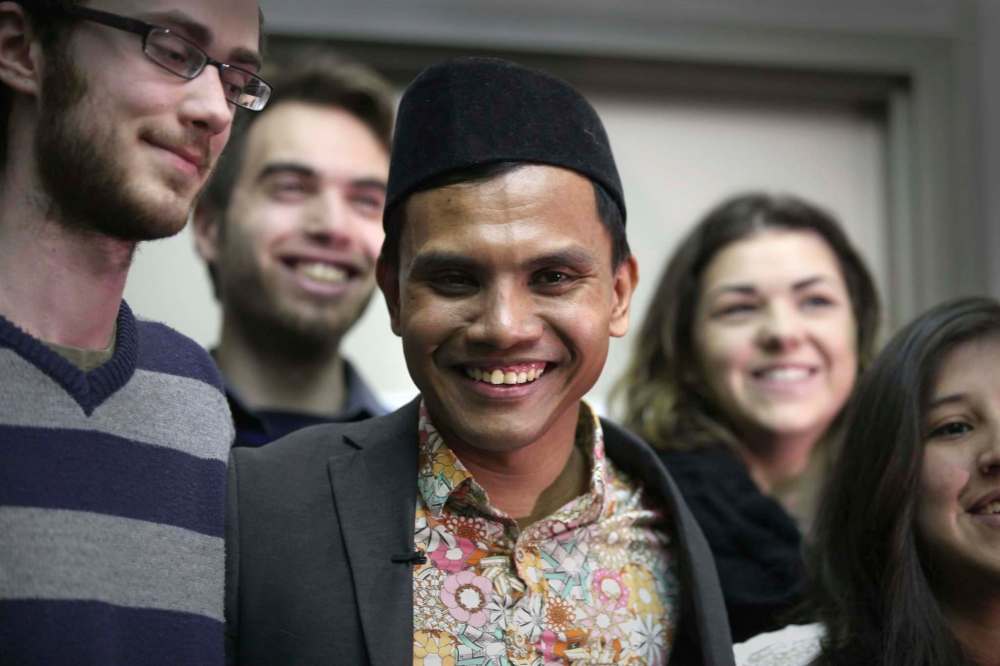
Sexual orientation and gender identity is one of the fastest-rising categories of refugee claims in Manitoba, according to data obtained by the Free Press.
The claims accounted for one per cent to three per cent of overall hearings from 2010 to 2015, before rising to six per cent in 2016, and 10 per cent in 2017. Those claims include Hazim Ismail, a gay Malaysian university student who was granted refugee protection in Canada in 2016, and Seidu Mohammed, a bisexual man from Ghana whose refugee claim was accepted in 2017 after he lost his fingers to frostbite walking into Canada in the dead of winter.
In both Malaysia and Ghana, non-hetero sex is a crime and homosexual people are persecuted.
Much of what IRB members are looking for is proof of a refugee claimant’s identity as LGBTTQ*, but if that is the reason for their persecution it’s not something they can safely proclaim to the world, said Tutthill.
“We need to be looking at the persecution faced by the individual, regardless of their identity,” he said.
Requiring evidence of self-identification to substantiate asylum claims — photos, social media posts, letters of support and membership in LGBTTQ* advocacy groups as “proof” of being queer — is one of three recurring themes with the IRB that troubles the Canadian HIV/AIDS Legal Network.
But publicly self-identifying as an LGBTTQ* person in some of the 71 countries where same-sex sexual activity is illegal is a veritable death sentence, either literally or culturally, the network said in its brief prepared for the committee.
Some IRB members, the network said, think a claimant who cannot self-identify in their home country should do so immediately, proudly and publicly once they arrive in Canada.
There is also an implicit or unwritten expectation that an LGBTTQ* person should then become involved in the LGBTTQ* community in Canada. Even when there is such involvement, the motivations and intentions of the claimant come under scrutiny, the Canadian HIV/AIDS Legal Network said.
“The objective of their refugee claim is not to participate in a pride float, but to be safe in Canada from the constant threat of persecution or even murder in their home country,” the Toronto-based organization said.
Misconceptions about looking and acting LGBTTQ* were another recurring theme the Canadian HIV/AIDS Legal Network said it found after conducting sweeping interviews.
Many of the interviewees recounted personal experiences, or those of other refugees, being told by board members they did not “look” or “act” gay, it said. “The stereotype of the effeminate gay male still persists.”
One immigration lawyer recounted an IRB interview with a muscular male client who told of being physically assaulted in a bar in his home country. The IRB did not believe such a superficially “strong” individual would have experienced such treatment, and his refugee claim was denied.
It was only after a complaint to a superior that he was given a second hearing and a new panel without the preconceptions.

His refugee claim was accepted within 30 minutes.
The third troubling theme the network said it picked up on was the “unfounded notion that a claim of same-sex persecution is the easiest way to gain asylum, summed up in the idiom, ‘If you say you’re gay, you get to stay.’”
While the risk of fraudulent or ineligible asylum-seekers is real, fewer than three per cent of sexual orientation and gender identity claims have been found to have no credible basis, the Toronto-based group said.
“It is hardly an epidemic that needs to be assiduously protected against by the IRB,” said the organization that helped to found the Dignity Network across Canada, working to encourage a stronger voice on human rights issues facing LGBTTQ* communities.
carol.sanders@freepress.mb.ca
Carol Sanders
Legislature reporter
Carol Sanders is a reporter at the Free Press legislature bureau. The former general assignment reporter and copy editor joined the paper in 1997. Read more about Carol.
Every piece of reporting Carol produces is reviewed by an editing team before it is posted online or published in print — part of the Free Press‘s tradition, since 1872, of producing reliable independent journalism. Read more about Free Press’s history and mandate, and learn how our newsroom operates.
Our newsroom depends on a growing audience of readers to power our journalism. If you are not a paid reader, please consider becoming a subscriber.
Our newsroom depends on its audience of readers to power our journalism. Thank you for your support.
Guidelines updated
On May 1, 2017, Immigration and Refugee Board of Canada guidelines for adjudicators took effect to “help promote greater understanding of cases involving sexual orientation and gender identity and expression (SOGIE) and the harm individuals may face.”
They would prevent a refugee claimant from being grilled on intimate details of their sex life, and direct the board member to the heart of the matter: what kind of mistreatment they’ve faced or could face in their home country, if they go back.
Shortly before the guidelines were issued, Rainbow Resource Centre executive director Mike Tutthill said representatives from the centre spoke to an LGBTTQ* community member about their IRB hearing.
“We were horrified by the invasiveness and inappropriateness of the questions asked,” he said.
The guidelines implemented last year are a “great foundation” to understanding the complexity of sexual orientation and gender identity realities, but they’re not enough, Tutthill said. “I would encourage the department to consider training that is more than one day, and is ongoing.”
The Immigration and Refugee Board’s 2017 chairperson’s guideline 9 — proceedings before the IRB involving sexual orientation and gender identity and expression — provides guidance on the following themes:
Understanding the unique challenges faced by individuals with diverse SOGIE in presenting evidence pertaining to SOGIE;
Using appropriate terminology and language in both proceedings and reasons for decision when referring to individuals with diverse SOGIE;
Protecting sensitive information in reasons for decision;
Avoiding stereotyping and inappropriate assumptions when making findings of fact;
Assessing credibility;
Increasing awareness of circumstances unique to individuals with diverse SOGIE that may affect findings of fact and findings of mixed fact and law in each of the four divisions.
— Carol Sanders
Carol Sanders
Legislature reporter
Carol Sanders is a reporter at the Free Press legislature bureau. The former general assignment reporter and copy editor joined the paper in 1997. Read more about Carol.
Every piece of reporting Carol produces is reviewed by an editing team before it is posted online or published in print — part of the Free Press‘s tradition, since 1872, of producing reliable independent journalism. Read more about Free Press’s history and mandate, and learn how our newsroom operates.
Our newsroom depends on a growing audience of readers to power our journalism. If you are not a paid reader, please consider becoming a subscriber.
Our newsroom depends on its audience of readers to power our journalism. Thank you for your support.
Advertisement Advertise With Us
Advertisement Advertise With Us