

Rethinking how to care for dementia patients

Advertisement
Read this article for free:
or
Already have an account? Log in here »
To continue reading, please subscribe:
Monthly Digital Subscription
$1 per week for 24 weeks*
- Enjoy unlimited reading on winnipegfreepress.com
- Read the E-Edition, our digital replica newspaper
- Access News Break, our award-winning app
- Play interactive puzzles
*Billed as $4.00 plus GST every four weeks. After 24 weeks, price increases to the regular rate of $19.95 plus GST every four weeks. Offer available to new and qualified returning subscribers only. Cancel any time.
Monthly Digital Subscription
$4.99/week*
- Enjoy unlimited reading on winnipegfreepress.com
- Read the E-Edition, our digital replica newspaper
- Access News Break, our award-winning app
- Play interactive puzzles
*Billed as $19.95 plus GST every four weeks. Cancel any time.
To continue reading, please subscribe:
Add Free Press access to your Brandon Sun subscription for only an additional
$1 for the first 4 weeks*
*Your next subscription payment will increase by $1.00 and you will be charged $16.99 plus GST for four weeks. After four weeks, your payment will increase to $23.99 plus GST every four weeks.
Read unlimited articles for free today:
or
Already have an account? Log in here »
Hey there, time traveller!
This article was published 19/05/2019 (2489 days ago), so information in it may no longer be current.
When someone who has dementia yells, swears or lashes out, it’s tough to know what to do. Teepa Snow has the answer.
The sought-after expert educator on dementia care was at Riverview Health Centre in Winnipeg Thursday to train staff at the Alzheimer’s Centre of Excellence. It was one of more than 300 sessions a year the outgoing, outspoken occupational therapist from the U.S. puts on every year in Canada, the U.S. and the U.K.
Instead of doing things to residents with dementia, Snow’s “positive approach to care” is about gaining a greater understanding of the strengths and abilities that residents still have as the disease progresses, and adapting the way staff approaches them and their environment to maximize residents’ quality of life.
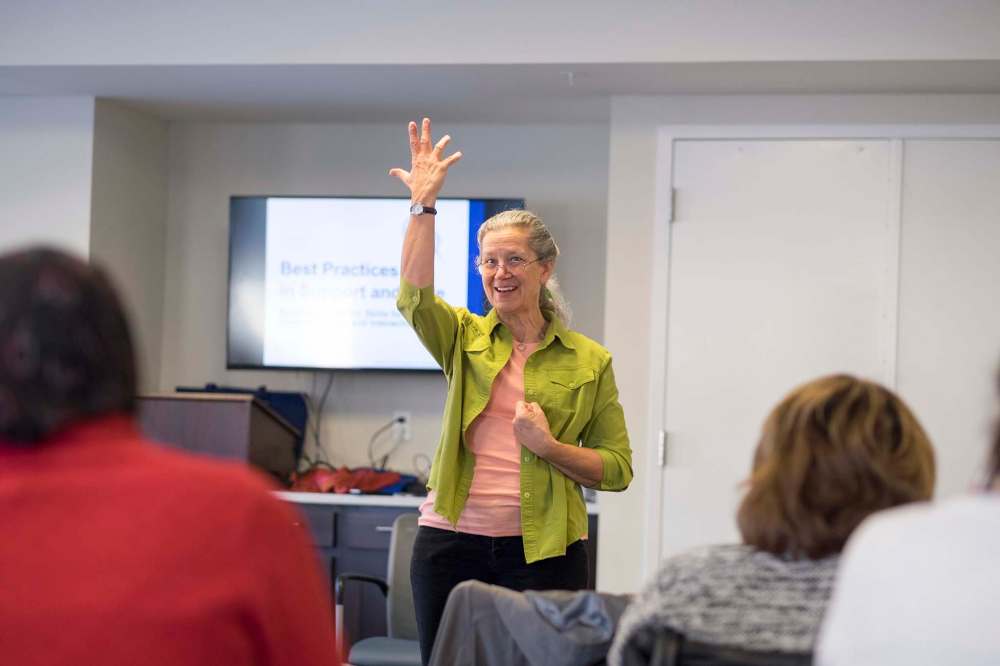
“Our ultimate goal is to provide the best possible care for our residents living with advanced dementia,” said Andrea Meakin, director of resident care services at Riverview. Care teams have been trained in Snow’s “new philosophy of care,” Meakin said,
After spending time with the residents interacting with Riverview staff, Snow met with the employees and asked them to talk about what or who they found to be a challenge and what or who was a favourite. Then she helped them figure out what’s going on with their interaction and how to improve it.
“We tend to do things to people,” said Snow.
Approaching someone from their side with a damp washcloth and trying to wipe their face can seem like an unprovoked attack to a person whose field of vision has narrowed, for instance, said the instructor who uses role playing to demonstrate.
She gets a staff member to sit in a chair and use their hands to make binoculars and see what the resident with dementia or Alzheimer’s sees. Snow crouches down in front of the person so they’re at eye level. She shows them the washcloth, says what it is and what she wants to do with it and asks their permission. That’s not how people have been trained, though, Snow said in an interview after the session.
“We’re so busy teaching people how to do tasks we forget that tasks should never be done without permission,” she said.
“We forget that issue of seeking and receiving permission to provide support and care because, historically, we thought people with dementia don’t know whether they need something. It’s like ‘Yeah, I do and I don’t – I know whether I like you and if I don’t like you, why would I want you to be in it with me?'” They still have perceptions and feelings about the way they’re treated by staff.
“Am I the good person or the bitch messing with you?”
Getting permission from someone who doesn’t have language isn’t easy, Snow admitted.
“It’s a message of ‘I’m working with you’ not ‘I’m not doing to you,'” she said. “That’s not how people are trained. They’re trained to be caregivers not partners. Dementia needs to be a partnership because their brain is dying — it’s not dead,” said Snow. “I haven’t been given permission just to take over,” she said. “We like to think we’re doing it right but if they tell us ‘no,’ then how are we going to get there?”
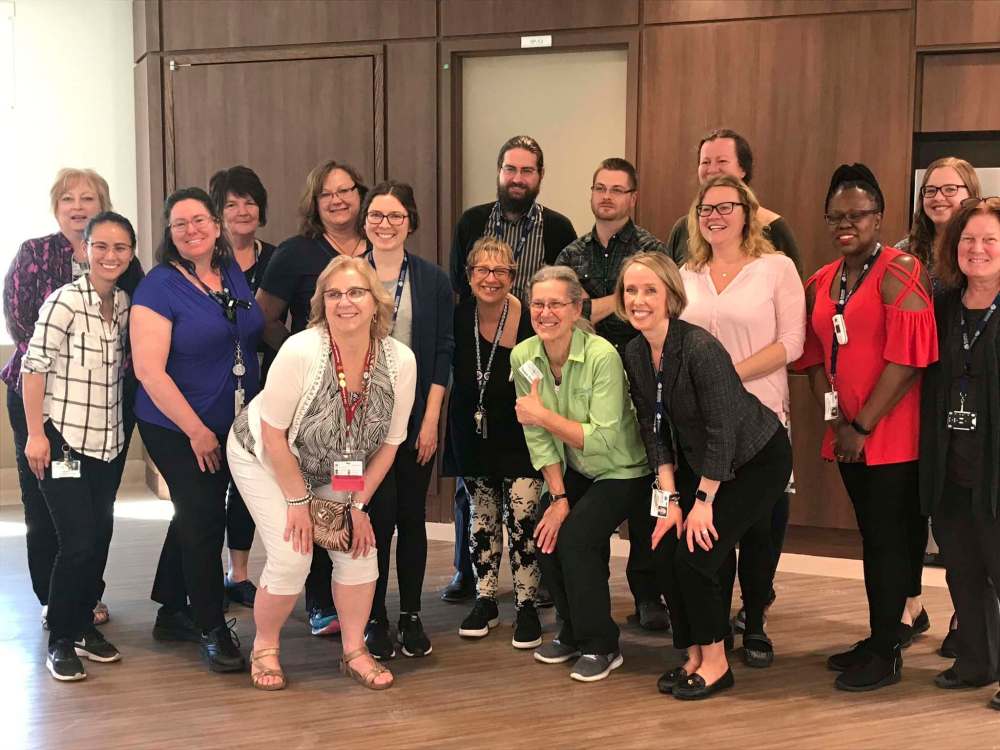
There’s been a lot of “doing to” and “doing for” people with dementia that hasn’t done them any favours, Snow said.
They used to do so many things before the disease attacked their brains — writing, wiping, cleaning, fixing, carrying, lifting, preparing and pulling — and they still need that activity, said Snow.

Simple things like rolling out dough, placing plastic chips on a bingo card, tearing a newspaper, stooping to pick to up a bean bag and placing it on a counter are things that keep bodies strong and flexible so they’re less prone to falls and injury, she said.
People who need to be fed can take part in the feeding by placing their hand on the wrist of the person holding the spoon as it moves from the dinner table to their mouth. After the activity, there should be some positive feedback such as, “Thank you for working with me,” Snow said. “It affirms their role in our relationship.”
Doing things to dementia patients has seemed easier than figuring out ways of doing things with them but, in those cases, no one wins, she said.
“It’s just easier to assume they don’t know what they’re talking about, because then I don’t have to own that they’re not liking something, and maybe I’m the one who has to change.”
carol.sanders@freepress.mb.ca
Carol Sanders
Legislature reporter
Carol Sanders is a reporter at the Free Press legislature bureau. The former general assignment reporter and copy editor joined the paper in 1997. Read more about Carol.
Every piece of reporting Carol produces is reviewed by an editing team before it is posted online or published in print — part of the Free Press‘s tradition, since 1872, of producing reliable independent journalism. Read more about Free Press’s history and mandate, and learn how our newsroom operates.
Our newsroom depends on a growing audience of readers to power our journalism. If you are not a paid reader, please consider becoming a subscriber.
Our newsroom depends on its audience of readers to power our journalism. Thank you for your support.
Carol Sanders
Legislature reporter
Carol Sanders is a reporter at the Free Press legislature bureau. The former general assignment reporter and copy editor joined the paper in 1997. Read more about Carol.
Every piece of reporting Carol produces is reviewed by an editing team before it is posted online or published in print — part of the Free Press‘s tradition, since 1872, of producing reliable independent journalism. Read more about Free Press’s history and mandate, and learn how our newsroom operates.
Our newsroom depends on a growing audience of readers to power our journalism. If you are not a paid reader, please consider becoming a subscriber.
Our newsroom depends on its audience of readers to power our journalism. Thank you for your support.
Advertisement Advertise With Us
Advertisement Advertise With Us