

Rural paramedic shortage burning out existing staff, raising response times, union warns

Advertisement
Read this article for free:
or
Already have an account? Log in here »
To continue reading, please subscribe:

Digital Subscription
One year of digital access for only $205*
- Enjoy unlimited reading on winnipegfreepress.com
- Read the E-Edition, our digital replica newspaper
- Access News Break, our award-winning app
- Play interactive puzzles
*First annual payment billed as $205.00 + GST for one year. This annual subscription will automatically renew at $233.00 + GST every 52 weeks (10% off the regular annual price of $259.35). Offer available to new and qualified returning subscribers only. Cancel any time.
To continue reading, please subscribe:
Add Free Press access to your Brandon Sun subscription for only an additional
$1 for the first 4 weeks*
- Enjoy unlimited reading on winnipegfreepress.com
- Read the E-Edition, our digital replica newspaper
- Access News Break, our award-winning app
- Play interactive puzzles
*Your next Brandon Sun subscription payment will increase by $1.00 and you will be charged $17.95 plus GST for four weeks. After four weeks, your payment will increase to $24.95 plus GST every four weeks.
Read unlimited articles for free today:
or
Already have an account? Log in here »
Hey there, time traveller!
This article was published 28/03/2022 (1648 days ago), so information in it may no longer be current.
PORTAGE LA PRAIRIE — The union representing paramedics in rural Manitoba is accusing the province of ignoring a critical staff shortage that is fuelling burnout and slowing response times.
Bob Moroz, president of the Manitoba Association of Health Care Professionals, claims the government doesn’t have a suitable plan to recruit, train and retain staff to ease pressure that has grown during the COVID-19 pandemic.
“We’ve been talking about (a staff shortage) for months and years. It continues to get worse,” said Moroz, whose union represents about 800 paramedics. “They absolutely love what they do, but they are being taken advantage of. They’re unappreciated by this government.”
Moroz said response times in rural Manitoba have been “trending up” due to a lack of paramedics, as lower pay and difficult working conditions make small towns and cities less attractive than places such as Winnipeg.
The province said it has created 149.2 full-time equivalent paramedic positions since 2016.
Moroz said he doesn’t trust the province’s “fuzzy math,” as paramedics are telling him they’re seeing the “worst staffing crisis” of their careers, with ambulances sitting idle because they aren’t staffed.
Manitoba is still “hundreds of paramedics short,” with ambulances sitting idle due to the shortage, he said.
“We know that over the last number of months response times have been climbing, and that’s terribly concerning for rural and northern Manitoba,” he said.
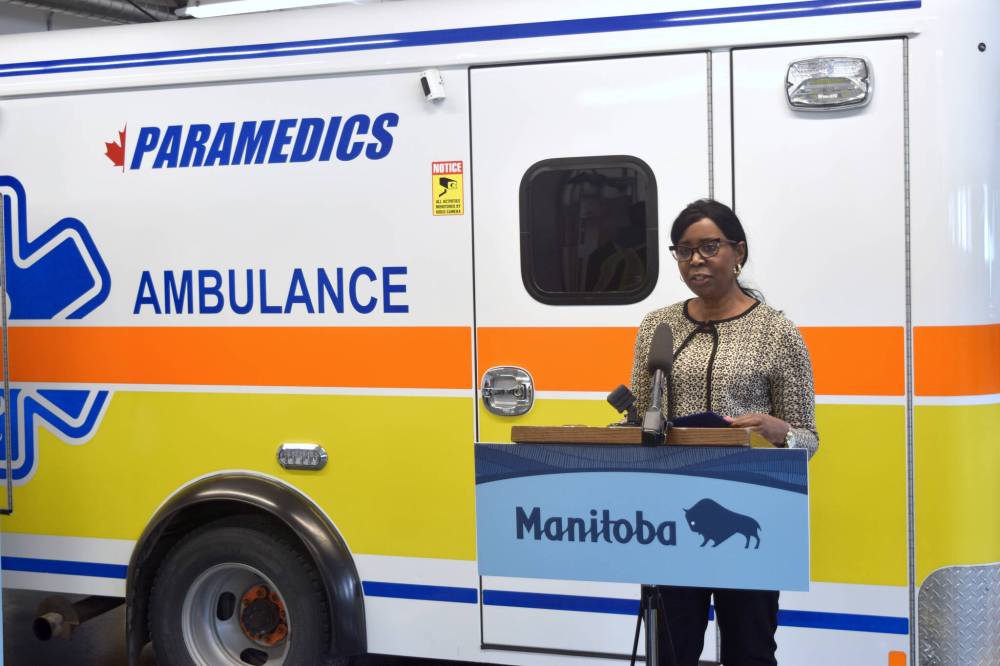
Health Minister Audrey Gordon said Manitoba must make the job “attractive” and has “a lot of work to do” regarding recruitment.
The government is working with partners such as RRC Polytech to start paramedic training programs or do “active outreach” to potential recruits, Gordon said Monday while visiting a new ambulance station in Portage la Prairie, following a tour of a new station in Crystal City.
Gordon said the emergency medical services stations — built at a cost of $3.8 million — will improve the quality of care for people in those parts of the Southern Health region, and be more suitable for paramedic training.
The EMS stations act as “operational hubs,” as paramedics are repositioned across the region based on a dispatch system that uses computer data models and tries to predict where crews will be deployed, she said.
Moroz said the “geoposting” system is only effective if there are staffed ambulances at the station. If not, ambulances are positioned further apart, and there are gaps in coverage, he said.
In recent years, the government has announced plans to close or consolidate a number of rural ambulance stations, including one in Treherne.
Staff and vehicles from that station would be moved to Glenboro, about about 45 kilometres west.
“That’s not acceptable at all,” Will Eert, reeve of the Rural Municipality of Norfolk Treherne, said last week.
As of December, Crystal City’s EMS station had the second-longest response times in Southern Health, said Moroz.
He’s happy to see modern stations being built, but said response times won’t improve if more paramedics aren’t hired.
“Stations are great, but unless you have the people to work a shift and be ready to go, it’s missing the point,” he said.
Moroz said Winnipeg paramedics receive a salary that is 25 per cent higher, on average, than their rural counterparts, making the city more attractive.
Patient transfer times are longer in rural Manitoba, where paramedics work a lot of overtime because there isn’t enough staff, he said.
Many are fatigued and unhappy with their work-life balance, he added.
Moroz said Manitoba has been losing paramedics to employers in other provinces who pay more and offer better working conditions.
“Eventually, people just get burned out and decide to leave the profession entirely or go somewhere else,” he said.
Moroz said he has asked to meet Premier Heather Stefanson and Gordon to discuss the shortage and ways to recruit and keep staff.
That would include training recruits at rural stations, he said.
Moroz and Rebecca Clifton, the administrative director of the Paramedic Association of Manitoba, called on the province to increase pay and improve working conditions for rural paramedics.
Clifton said the pandemic has put a lot more pressure on paramedics, leaving them exhausted.
“We hear the word ‘burnout’ thrown out a lot,” said Clifton, a Selkirk-based intermediate-care paramedic who works in the Interlake Eastern Regional Health Authority. “While it’s nice to have new stations, we need to have paramedics and bodies in them.”
She said Manitoba hasn’t been producing as many graduates as in the past, and some positions are vacant because employers aren’t filling them.
PAM has called on the province to end its “additional on call” practice, she said.
In some rural areas, a crew is put on call after a 12-hour shift instead of being replaced by a fresh pair of paramedics.

“If that pager goes off, they are asked to respond. If they’re scheduled to work the next day, they’re expected to be back,” said Clifton. “It is quite dangerous and needs to be removed.”
Due to shortages, some paramedics are in an “additional on call” situation for two or three consecutive days, she said.
Manitoba, meanwhile, has previously announced plans to build a new $4.2-million EMS station in Selkirk and buy 65 new ambulances at a cost of about $10 million.
chris.kitching@freepress.mb.ca
Twitter: @chriskitching
Chris Kitching is a general assignment reporter at the Free Press. He began his newspaper career in 2001, with stops in Winnipeg, Toronto and London, England, along the way. After returning to Winnipeg, he joined the Free Press in 2021, and now covers a little bit of everything for the newspaper. Read more about Chris.
Every piece of reporting Chris produces is reviewed by an editing team before it is posted online or published in print — part of the Free Press‘s tradition, since 1872, of producing reliable independent journalism. Read more about Free Press’s history and mandate, and learn how our newsroom operates.
Our newsroom depends on a growing audience of readers to power our journalism. If you are not a paid reader, please consider becoming a subscriber.
Our newsroom depends on its audience of readers to power our journalism. Thank you for your support.
Chris Kitching is a general assignment reporter at the Free Press. He began his newspaper career in 2001, with stops in Winnipeg, Toronto and London, England, along the way. After returning to Winnipeg, he joined the Free Press in 2021, and now covers a little bit of everything for the newspaper. Read more about Chris.
Every piece of reporting Chris produces is reviewed by an editing team before it is posted online or published in print — part of the Free Press‘s tradition, since 1872, of producing reliable independent journalism. Read more about Free Press’s history and mandate, and learn how our newsroom operates.
Our newsroom depends on a growing audience of readers to power our journalism. If you are not a paid reader, please consider becoming a subscriber.
Our newsroom depends on its audience of readers to power our journalism. Thank you for your support.
Advertisement Advertise With Us
Advertisement Advertise With Us