

Rural taxi owner slammed by ‘free-for-all’
Advertisement
Read this article for free:
or
Already have an account? Log in here »
To continue reading, please subscribe:
Digital Subscription
One year of digital access for only $75*
- Enjoy unlimited reading on winnipegfreepress.com
- Read the E-Edition, our digital replica newspaper
- Access News Break, our award-winning app
- Play interactive puzzles
*Billed as $5.77 plus GST every four weeks. After 52 weeks, price increases to the regular rate of $19.95 plus GST every four weeks. Offer available to new and qualified returning subscribers only. Cancel any time.
Monthly Digital Subscription
$4.99/week*
- Enjoy unlimited reading on winnipegfreepress.com
- Read the E-Edition, our digital replica newspaper
- Access News Break, our award-winning app
- Play interactive puzzles
*Billed as $19.95 plus GST every four weeks. Cancel any time.
To continue reading, please subscribe:
Add Free Press access to your Brandon Sun subscription for only an additional
$1 for the first 4 weeks*
- Enjoy unlimited reading on winnipegfreepress.com
- Read the E-Edition, our digital replica newspaper
- Access News Break, our award-winning app
- Play interactive puzzles
*Your next Brandon Sun subscription payment will increase by $1.00 and you will be charged $17.95 plus GST for four weeks. After four weeks, your payment will increase to $24.95 plus GST every four weeks.
Read unlimited articles for free today:
or
Already have an account? Log in here »
Hey there, time traveller!
This article was published 07/08/2018 (2845 days ago), so information in it may no longer be current.
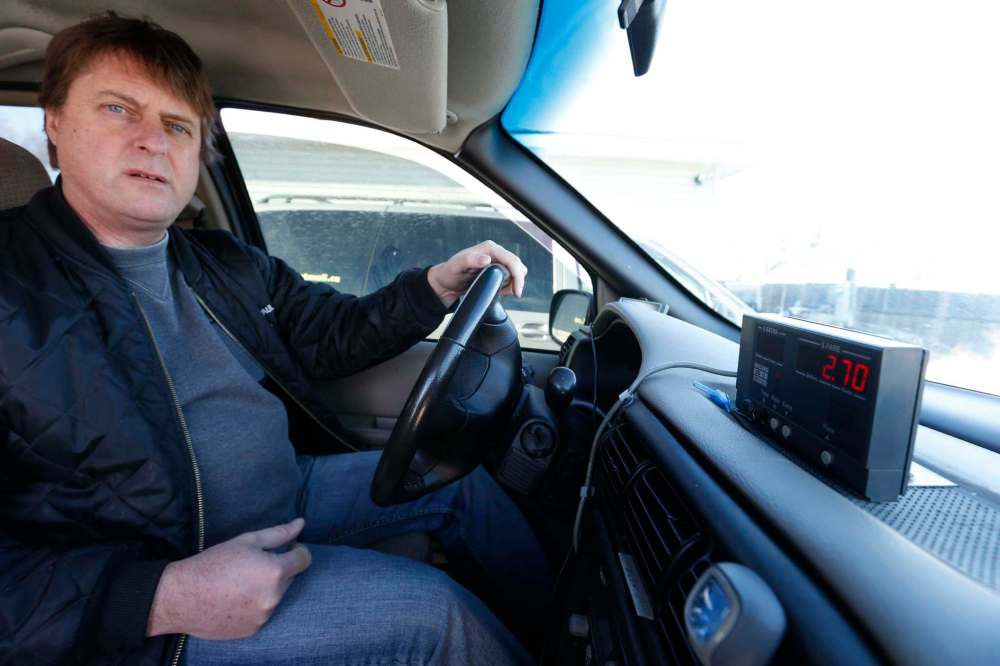
The Manitoba government’s decision to transfer regulation of the taxi industry to municipalities has led to a competitive “free-for-all” in bedroom communities north of Winnipeg, said a long-established operator who says his livelihood is threatened.
Rural taxi owner Glen Phillips said before the Local Vehicles For Hire Act came into force Feb. 28, Winnipeg taxis were prevented, by provincial regulation, from picking up fares in the four municipalities he serves (although they could deliver passengers to those communities).
That changed when the Progressive Conservatives, led by Premier Brian Pallister, transferred regulation over taxi and ride-hailing services to municipalities. Only the City of Winnipeg was required, under Bill 30, to write a bylaw. Other municipalities have the option of doing so or not.

“It’s a free-for-all,” said Phillips, owner of Lockport Taxi and its subsidiary, East St. Paul Taxi.
“I’ve got no business. If I made $100 a day, I’d be happy. I’m not even doing that,” he said.
At one time, the multi-generational family business operated five cars. It is now running just two.
Phillips has been battling encroachment from city taxi firms for years. The Free Press chronicled his predicament in late 2015.
At that time, rules were in place preventing Winnipeg taxis, such as Unicity and Duffy’s, from travelling to his territory — the rural municipalities of East St. Paul, West St. Paul, St. Andrews and St. Clements — to pick up fares.
Phillips’ concern had been the province was failing to enforce its regulations. Now, his beef is there aren’t any.
Under the new law, city taxis are free to pick up passengers in neighbouring municipalities unless the local governments in those communities create bylaws to keep them out. So far, none of the municipalities Phillips serves has drafted one.
“They don’t want to even get involved,” he said.
A lack of local bylaws also means ride-hailing services, such as TappCar, are free to compete with him. He knows of customers who have used the service.
“I was under legislation. Now, I’m not. So my business is worthless,” he said.
While city taxis are free to pick up rides in Phillips’ company’s territory, a City of Winnipeg spokesman confirmed Lockport Taxi cannot do so in Winnipeg.
The city bylaw allows for a taxi from another jurisdiction to operate in Winnipeg as long as the trip “originates or terminates outside of the city boundary,” the spokesman said.
Sheila Mowat, chief administrative officer for the RM of East St. Paul, said the rural municipality is still studying its options and will prepare a report for the local council, which will decide if a bylaw is necessary.
“We haven’t decided anything yet. It’s still on the table to discuss. We just need to do some more research… before we even give it to council for consideration,” Mowat said.
RM of St. Andrews Mayor George Pike, who counts himself as one of Phillips’ customers, said his council has not seen a need for a bylaw.
“It’s free enterprise,” he said of the current competitive system in his municipality.
Pike said he also doubts Phillips “can supply the service he thinks he can in our area,” noting the municipality is 51.5 kilometres long.

John Morris, a spokesman for TappCar, said in the absence of a bylaw, there is nothing preventing his company’s drivers from picking up fares in the four municipalities. He couldn’t say how much business the ride-share service is doing in the communities.
TappCar has more than 400 drivers in Winnipeg, and has been operating in Steinbach for a couple of weeks, Morris said.
A government spokesman said Friday the province is aware of seven municipalities other than Winnipeg that currently have bylaws for the purpose of regulating vehicles for hire: Brandon, Gillam, Neepawa, Thompson, Selkirk, The Pas and Portage la Prairie.
larry.kusch@freepress.mb.ca