

Seeking balance on Manitoba’s climate file
Responsibility, improved communication key for facing challenges ahead: Guillemard
Advertisement
Read this article for free:
or
Already have an account? Log in here »
To continue reading, please subscribe:

Digital Subscription
One year of digital access for only $205*
- Enjoy unlimited reading on winnipegfreepress.com
- Read the E-Edition, our digital replica newspaper
- Access News Break, our award-winning app
- Play interactive puzzles
*First annual payment billed as $205.00 + GST for one year. This annual subscription will automatically renew at $233.00 + GST every 52 weeks (10% off the regular annual price of $259.35). Offer available to new and qualified returning subscribers only. Cancel any time.
To continue reading, please subscribe:
Add Free Press access to your Brandon Sun subscription for only an additional
$1 for the first 4 weeks*
- Enjoy unlimited reading on winnipegfreepress.com
- Read the E-Edition, our digital replica newspaper
- Access News Break, our award-winning app
- Play interactive puzzles
*Your next Brandon Sun subscription payment will increase by $1.00 and you will be charged $17.95 plus GST for four weeks. After four weeks, your payment will increase to $24.95 plus GST every four weeks.
Read unlimited articles for free today:
or
Already have an account? Log in here »
Hey there, time traveller!
This article was published 01/03/2021 (2022 days ago), so information in it may no longer be current.
When Fort Richmond MLA Sarah Guillemard was tapped to join Tory Premier Brian Pallister’s cabinet in fall 2019, she wasn’t only taking on a new level of responsibility.
She was also overseeing the reorganization of the department that, for the first time, carried the name and explicit responsibility of one of the biggest challenges of modern times: climate change.
Previously known as sustainable development, Guillemard now captained the department of conservation and climate. Among her first challenges was trying to establish how to work within the climate change portfolio when climate policies naturally fall across all governmental departments from infrastructure to agriculture to municipal relations.
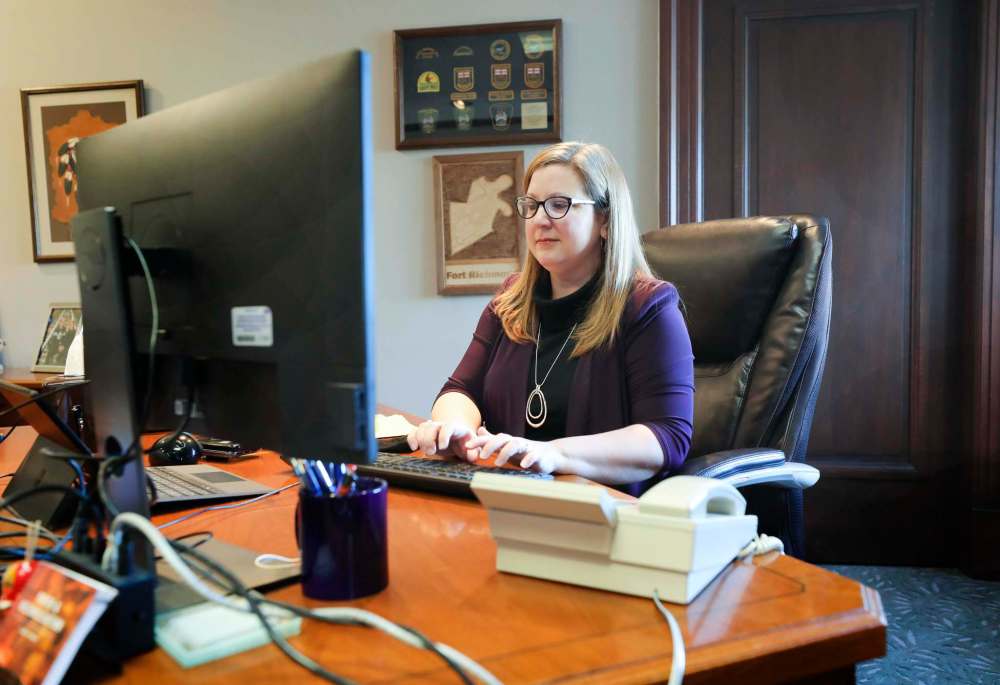
“One of the benefits of my new portfolio and having climate in the title itself means that I get to touch on almost all departments — because any initiatives that we’re going to move forward as a government, regardless of what department is leading it, has to have that climate lens on it,” Guillemard said in a one-on-one interview with the Free Press.
“It doesn’t mean there’s still not challenges before us. But I think that the communication has been a lot better just because there is that added responsibility.”
When asked what she considers some of the department’s biggest wins in the last year-and-a-half, she points to the efficient trucking program (which provides funding to retrofit heavy-duty transport vehicles) and increased funding for energy efficiency building retrofits through Efficiency Manitoba.
Both of these programs had provincial funding matched by the federal government.
Meanwhile, the latest data shows emissions are still climbing in Manitoba, year after year.
When she entered the role, this was a concern for her, Guillemard said, but has since gotten behind the Progressive Conservative party’s policy direction guided by incrementalism. It does not aim for absolute emissions reductions, but rather relative reductions.
A key tenet of Manitoba’s climate plan is the so-called carbon savings account. In five-year periods, the government would set targets for immediate reductions; if they are not met, the amount those targets are missed by gets rolled over into how much emissions must be cut in the next five-year period.
Instead of measuring success in a given year by comparing emissions to past years’ performance, the plan measures successful emissions mitigation based on what projections show emissions would have been if no action had been taken place.
A hypothetical scenario: in 2022, provincial projections show emissions were likely to rise to approximately 22 megatonnes annually. If in 2022, emissions levels are measured at 21.8 Mg, the government would count the emissions to have been reduced by 0.2 Mg that year.
However, the latest data from 2018 shows the current level of emissions from across the province total 21.8 Mg of carbon — a record high. So, whether emissions went down or stayed the same depends on who you ask.
“So those actual emissions that are collected are not necessarily the concern,” Guillemard said.
“The concern is: are we following a trajectory that’s going to get us to really dangerous levels? Well, we’re already at dangerous levels, and we need to reduce them — but are they going to be climbing at a rate that is just absolutely going to be detrimental faster to us?
“Or have we reduced the projected numbers of if we had done no changes at all?”
The best available climate science and research on the emissions reductions needed to avoid catastrophe shows relative emissions reductions are not enough — absolute declines are needed around the world, and fast.
The Intergovernmental Panel on Climate Change, the world’s leading authority on climate research, showed in a 2018 report in order to limit warming to roughly 2 C, emissions have to be reduced globally by approximately 25 per cent by 2030 over 2010 levels, and then reaching net-zero emissions by approximately 2070.
The United Nations’ latest Emissions Gap report found Canada was unlikely to meet its emissions reduction commitments made in the 2015 Paris Agreement (which doesn’t even have targets stringent enough to meet a 2 C-of-warming scenario).
Asked about the difference between this research and the provincial government’s approach, Guillemard said a priority of the Pallister government is to focus on minimizing the potential cost of climate policies for Manitobans now.
“The question is always going to be: are we doing enough? What could we do differently?” Guillemard said. “We’re always open to looking at doing more, but we’ve always got to balance the impacts of what our initiatives are doing.
“We definitely have a focus on making sure we have a responsibility to keep our environment clean, and to not be as harmful as we’ve been in the past. But as we’re rolling out those new initiatives or those ideas, we also have to be cognizant of how they are impacting the people that we’re serving, as well,” said the MLA first elected in 2016.

“So have we found that balance? I think that when you have situations where, you know, both sort of extreme opinions are both angry at you sometimes. Yes, I’ve got that balance.”
Moving forward, Guillemard said she is looking for opportunities that will help Manitobans lower their carbon footprint by incentivizing good behaviour, instead of taxing carbon-intensive behaviour. She is also waiting for a report on the electrification of the transportation sector.
“I think that we’ve got a lot of work to do. And I know that at the municipal, provincial and federal level we are working together to create these opportunities,” Guillemard said.
sarah.lawrynuik@freepress.mb.ca
Twitter: @SarahLawrynuik