

Sensory sleeve creations offer touch of relief

Advertisement
Read this article for free:
or
Already have an account? Log in here »
To continue reading, please subscribe:
Monthly Digital Subscription
$1 per week for 24 weeks*
- Enjoy unlimited reading on winnipegfreepress.com
- Read the E-Edition, our digital replica newspaper
- Access News Break, our award-winning app
- Play interactive puzzles
*Billed as $4.00 plus GST every four weeks. After 24 weeks, price increases to the regular rate of $19.95 plus GST every four weeks. Offer available to new and qualified returning subscribers only. Cancel any time.
Monthly Digital Subscription
$4.99/week*
- Enjoy unlimited reading on winnipegfreepress.com
- Read the E-Edition, our digital replica newspaper
- Access News Break, our award-winning app
- Play interactive puzzles
*Billed as $19.95 plus GST every four weeks. Cancel any time.
To continue reading, please subscribe:
Add Free Press access to your Brandon Sun subscription for only an additional
$1 for the first 4 weeks*
*Your next subscription payment will increase by $1.00 and you will be charged $16.99 plus GST for four weeks. After four weeks, your payment will increase to $23.99 plus GST every four weeks.
Read unlimited articles for free today:
or
Already have an account? Log in here »
Hey there, time traveller!
This article was published 19/02/2020 (2219 days ago), so information in it may no longer be current.
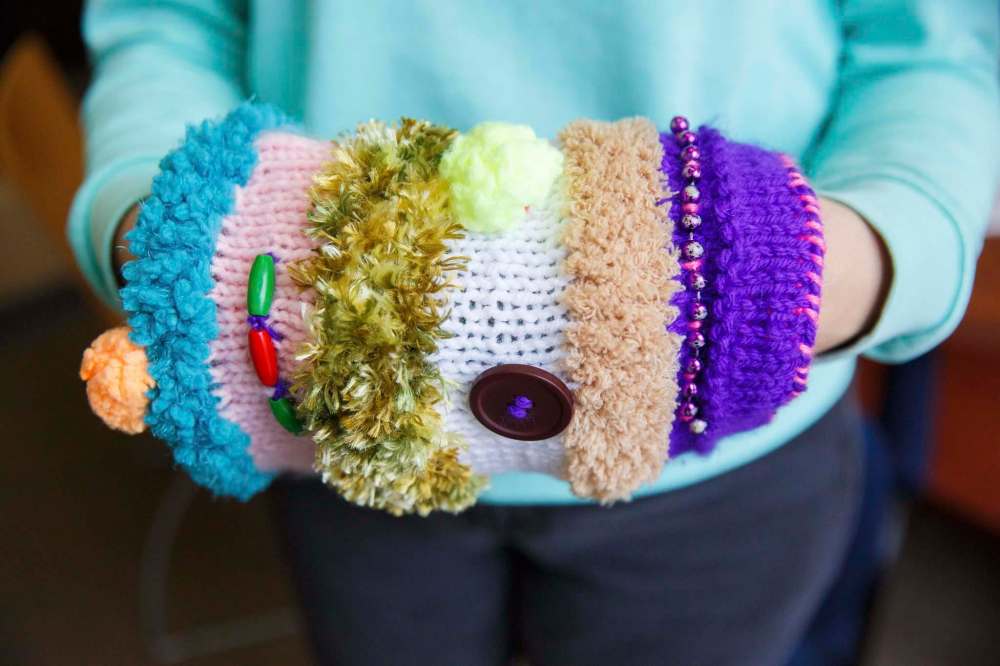
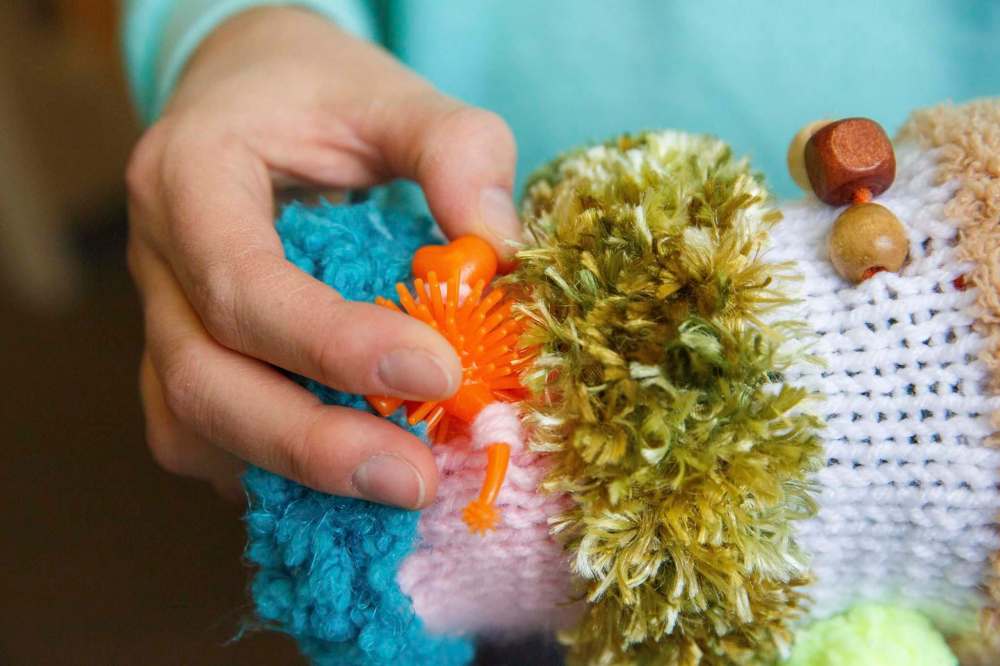
A tiny purple horse made of plastic peeks out from the cuff of a woolen hand warmer, one of the hidden treasures sewn inside. Buttons, beads, pompoms, squishable toys and different textures of brightly coloured yarn adorn the open-ended cylinder. Each gadget appears to have been carefully stitched on to appeal to fidgety fingertips.
Several of the hand-knitted creations turned up among anonymous donations delivered last week to the Main Street Project. Staff knew exactly what to do with them.
They’ve dubbed them “sensory sleeves” and given them to people who’ve used methamphetamine. It keeps their hands busy to help calm the anxiety caused by the drug. It’s a technique that was already being used. Small objects or beads were given to clients who had asked for something to fidget with.
“Before this, staff were sort of hoarding all of the costume jewelry that was coming in because it’s bulgey and clickety-clackety,” said Adrienne Dudek, the Main Street Project’s director of supportive and transitional housing.
“Then we found a few of these were donated and we thought ‘wow, let’s try this, what a great idea.’”
Similar fidget tools have become popular among people with anxiety, autism, Alzheimer’s and other neurological conditions. Three different harm-reduction experts reached by the Free Press hadn’t heard of using the devices specifically for meth-related symptoms, but they said it made sense.
Bryce Koch, a harm-reduction nurse with Project Safe Audience, said he’s benefited from using fidget tools for his attention-deficit hyperactivity disorder, and can see how they might help someone who’s been using meth.
They can “have a pretty high amount of anxiety, just being on the substance themselves, so having something to fidget with or kind of move with your hands can be helpful for having calming techniques,” he said.
“Comfortable, satisfying movements like running your hands over beads or having different textures can actually do quite a lot to calm people down.”
Since last year, there has been a slight increase in the number of people who want to detox from meth, who show up at the Main Street Project. So far this year, it’s the main substance used by roughly 72 per cent of female clients and by 58 per cent of male clients.

The majority of people who go to detox aren’t experiencing meth-related psychosis, the organization says, but it is common for the meth users they see to be fearful and anxious. Fidgeting can help, Dudek said.
“It’s a tactic that the staff have been using to, like I said, just redirect people, because quite often in our physical environment, it can be over-stimulating for somebody who’s already over-stimulated,” she said. When the atmosphere is calm, it’s easier to talk about long-term solutions, treatment and recovery.
“Sometimes the easiest solutions in the moment are the solutions we overlook,” Dudek said, as she gestured to a sensory sleeve. “But sometimes in that moment, just redirecting somebody to bring the tension down is the most impactful thing to then be able to have that conversation.”
katie.may@freepress.mb.ca
Twitter: @thatkatiemay
Katie May is a multimedia producer for the Free Press.
Our newsroom depends on a growing audience of readers to power our journalism. If you are not a paid reader, please consider becoming a subscriber.
Our newsroom depends on its audience of readers to power our journalism. Thank you for your support.
Katie May is a multimedia producer for the Free Press.
Our newsroom depends on a growing audience of readers to power our journalism. If you are not a paid reader, please consider becoming a subscriber.
Our newsroom depends on its audience of readers to power our journalism. Thank you for your support.
Advertisement Advertise With Us
Advertisement Advertise With Us