

Sinclair warns of slowing progress on reconciliation
Report's calls to action need to be heeded
Advertisement
Read this article for free:
or
Already have an account? Log in here »
To continue reading, please subscribe:

Digital Subscription
One year of digital access for only $205*
- Enjoy unlimited reading on winnipegfreepress.com
- Read the E-Edition, our digital replica newspaper
- Access News Break, our award-winning app
- Play interactive puzzles
*First annual payment billed as $205.00 + GST for one year. This annual subscription will automatically renew at $233.00 + GST every 52 weeks (10% off the regular annual price of $259.35). Offer available to new and qualified returning subscribers only. Cancel any time.
To continue reading, please subscribe:
Add Free Press access to your Brandon Sun subscription for only an additional
$1 for the first 4 weeks*
- Enjoy unlimited reading on winnipegfreepress.com
- Read the E-Edition, our digital replica newspaper
- Access News Break, our award-winning app
- Play interactive puzzles
*Your next Brandon Sun subscription payment will increase by $1.00 and you will be charged $17.95 plus GST for four weeks. After four weeks, your payment will increase to $24.95 plus GST every four weeks.
Read unlimited articles for free today:
or
Already have an account? Log in here »
Hey there, time traveller!
This article was published 16/12/2020 (2106 days ago), so information in it may no longer be current.
OTTAWA — Canadians pledged to not let the Truth and Reconciliation Commission’s final report on residential schools gather dust. Five years later, there is still no one tracking its 94 calls to action.
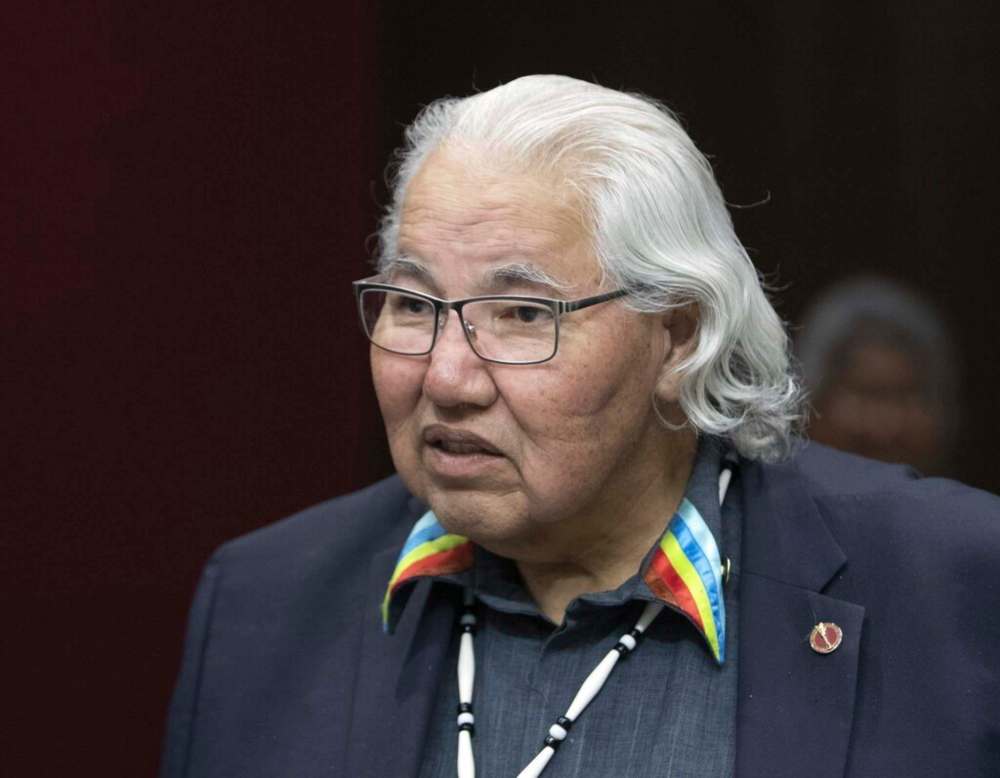
“Reconciliation and healing are matters of urgency — if anything, that urgency is greater and more apparent today than ever,” said Sen. Murray Sinclair, who chaired the TRC.
Sinclair joined his two fellow commissioners Tuesday to warn progress has slipped since they presented the final report in June 2015.
“We feel strongly that this sense of urgency, purpose and unity must be renewed,” said Chief Wilton Littlechild.
More than 150,000 Indigenous children attended residential schools, and thousands of Manitoba families still live with the scars of sexual abuse and intergenerational trauma.
The commissioners are encouraged by work to restore Indigenous laws and better educate Canadians on how the schools tried to forcibly assimilate cultures.
Yet, they were troubled by halting progress on things such as systemic racism in health care, and an attempt by the Alberta government to curtail its curriculum on residential schools.
Littlechild also took aim at provinces such as Manitoba for pushing back on a federal bill to enact the United Nations Declaration on the Rights of Indigenous Peoples.
Yet, the commissioners were unable to offer a comparison of how Ottawa, the provinces and territories are living up to their commitments — because the Trudeau government still hasn’t created a national body to monitor progress.
For example, there are numerous child-welfare reforms and initiatives to reinvigorate Indigenous languages. However, it’s unclear what progress is being made on those fronts, and how it compares to what the TRC called for.
Another commissioner, Marie Wilson, noted the RCMP have been caught in numerous videos perpetuating or allowing violence against Indigenous people.
A national council could track how often this is happening, instead of just when video footage hits the news, Wilson said. She said such a council would bring evidence to issues that often get bogged down in politics.
“We need to remind the country: these are non-partisan issues and non-partisan challenges.”
In March 2019, the Liberals earmarked $126.5 million to be spent by April 2021 to establish a National Council for Reconciliation. They started a consultation process, but never tabled a bill to make form the council.
Crown-Indigenous Relations Minister Carolyn Bennett said that’s due to red tape. “It’s a legislative priority for me for 2021, as soon as we can do it,” Bennett told the Free Press. “I wish it was already up and running myself, because I think it is that objective view of the progress.”
She said a transition committee requires a security clearance before members can be officially appointed through cabinet orders to help craft legislation.
“It has been a frustration, in terms of how difficult it is for people to find the time to do the work it takes, to fill out the forms, and get them in and do all of that,” Bennett said.

When the council is running, it could help guide Canadians through issues such as systemic racism, she said.
“It has the opportunity to give us an ongoing accounting of progress on reconciliation writ large.”
The Winnipeg-based National Centre for Truth and Reconciliation said numerous survivors feel not enough progress has been made, and the COVID-19 pandemic distancing rules is extremely triggering for them.
Today, Sinclair will address the Assembly of Manitoba Chiefs about where the TRC calls to action stand in the province, and he will join his fellow commissioners in an afternoon virtual discussion hosted by the NCTR.
dylan.robertson@freepress.mb.ca