

NDP wants to change budget law to take MB Hydro out of the equation
NDP wants to change budget law because of utility's mounting debt
Advertisement
Read this article for free:
or
Already have an account? Log in here »
To continue reading, please subscribe:

Digital Subscription
One year of digital access for only $205*
- Enjoy unlimited reading on winnipegfreepress.com
- Read the E-Edition, our digital replica newspaper
- Access News Break, our award-winning app
- Play interactive puzzles
*First annual payment billed as $205.00 + GST for one year. This annual subscription will automatically renew at $233.00 + GST every 52 weeks (10% off the regular annual price of $259.35). Offer available to new and qualified returning subscribers only. Cancel any time.
To continue reading, please subscribe:
Add Free Press access to your Brandon Sun subscription for only an additional
$1 for the first 4 weeks*
- Enjoy unlimited reading on winnipegfreepress.com
- Read the E-Edition, our digital replica newspaper
- Access News Break, our award-winning app
- Play interactive puzzles
*Your next Brandon Sun subscription payment will increase by $1.00 and you will be charged $17.95 plus GST for four weeks. After four weeks, your payment will increase to $24.95 plus GST every four weeks.
Read unlimited articles for free today:
or
Already have an account? Log in here »
Hey there, time traveller!
This article was published 06/06/2015 (4051 days ago), so information in it may no longer be current.
Manitoba Hydro’s mounting debt is behind the provincial government’s move to change the balanced-budget law so it doesn’t include the results of Crown corporations, Premier Greg Selinger said.
The issue has left the Selinger government scrambling despite knowing for more than five years Hydro’s dam project and new transmission line would hit the province’s bottom line.
Challenges facing Hydro are part of the reason the government wants to change its budget law, Selinger said Friday.
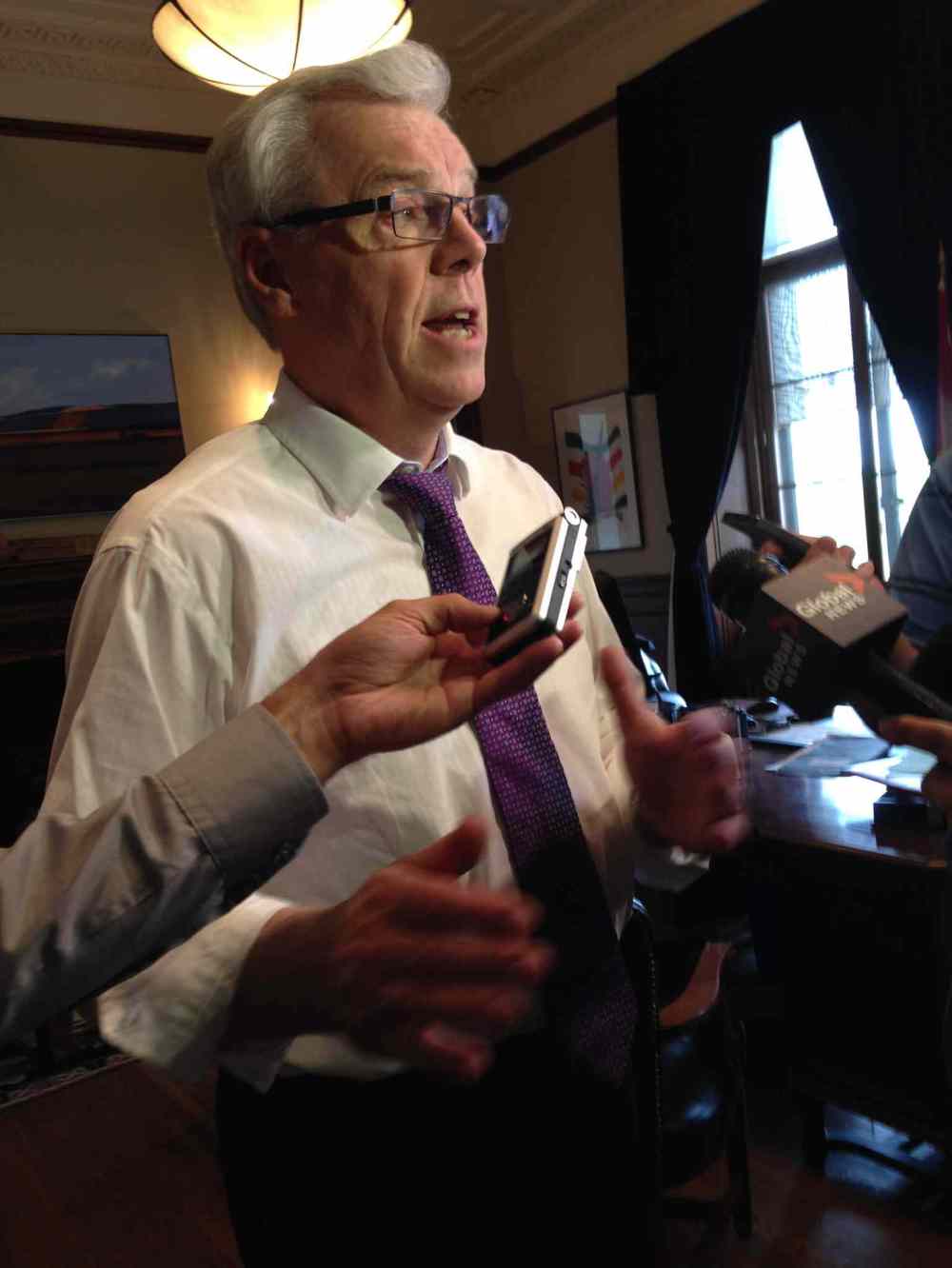
“Drought is always a risk,” he said. “Our point is that we want to have a system of accountability that does not put core services at risk (such as) health and education and family services because there is a drought.”
Since unveiling its budget April 30, the government has downplayed the importance of summary budgetary accounting, which includes the financial results of government departments as well as Crown corporations and other entities, and focused mainly on core government revenue and spending.
Opposition Leader Brian Pallister said changing how the budget is reported makes the government’s financial situation look better than it is.
“Why the deception?” Pallister asked. “This is a classic symptom of a last-stage government. Accountability? This government is where accountability goes to die.”
Hydro recently filed documents at the Public Utilities Board that show it’s taking on unprecedented levels of debt at a time when North America has cheap natural gas and an increase in other forms of renewable energy such as wind and solar power.
Hydro has said it is looking at six consecutive bad years starting in 2018-19 when the $4.6-billion Bipole III transmission comes into service.
Hydro said it projects a hit to its wallet of between $200 million and $300 million annually with no corresponding stream of revenue from increased export sales to the U.S.
Hydro’s budget gets slammed again when the $6.5-billion Keeyask generating station begins to come into service in 2019. Hydro expects to see up to $600 million in additional costs annually with only some increases in U.S. electricity sales.
Hydro is currently before the PUB asking for a 3.95 per cent rate increase for this year. It said if it doesn’t get the increase, and the same hike in each in consecutive years, it faces increased borrowing requirements and other financing costs in building Keeyask and Bipole III.
Hydro has also said it needs the rate increases to protect the province’s credit rating from being downgraded.
Besides anticipated customer rate increases, Hydro will have to borrow heavily to pay for its projects, which include a new transmission line to Minnesota.
In documents filed at the PUB, it says total debt requirements will peak at levels of more than $3 billion per year — unprecedented levels in Manitoba Hydro history — in 2017-18.
Hydro’s net debt is forecast to double to $24 billion and only begin to decline after 2025.

Hydro said while current low interest rates work in its favour, the growth in export power sales to the U.S. do not. The utility said export prices will be seven per cent lower than anticipated from 2016-17 to 2035-36 due to low natural gas prices.
Thrown into that mix is the possibility of a prolonged drought and less water to spin generating-station turbines, which could slice the utility’s retained earnings of $2.7 billion by about one-third.
The Crown corporation said it could ask for higher annual rate increases of up to six per cent, but settled on consecutive increases of 3.95 per cent.
Selinger said Hydro has confirmed $9 billion in power sales have been negotiated since 2010, with $29 billion in revenue forecast over the next 30 years.
bruce.owen@freepress.mb.ca