

The centre of attention
As WAG construction project proceeds, Winnipeggers gain early view of architectural showpiece
Advertisement
Read this article for free:
or
Already have an account? Log in here »
To continue reading, please subscribe:
Monthly Digital Subscription
$1 per week for 24 weeks*
- Enjoy unlimited reading on winnipegfreepress.com
- Read the E-Edition, our digital replica newspaper
- Access News Break, our award-winning app
- Play interactive puzzles
*Billed as $4.00 plus GST every four weeks. After 24 weeks, price increases to the regular rate of $19.95 plus GST every four weeks. Offer available to new and qualified returning subscribers only. Cancel any time.
Monthly Digital Subscription
$4.99/week*
- Enjoy unlimited reading on winnipegfreepress.com
- Read the E-Edition, our digital replica newspaper
- Access News Break, our award-winning app
- Play interactive puzzles
*Billed as $19.95 plus GST every four weeks. Cancel any time.
To continue reading, please subscribe:
Add Free Press access to your Brandon Sun subscription for only an additional
$1 for the first 4 weeks*
*Your next subscription payment will increase by $1.00 and you will be charged $16.99 plus GST for four weeks. After four weeks, your payment will increase to $23.99 plus GST every four weeks.
Read unlimited articles for free today:
or
Already have an account? Log in here »
Hey there, time traveller!
This article was published 04/02/2019 (2637 days ago), so information in it may no longer be current.
You can see the massive pillar rising next to the Winnipeg Art Gallery (WAG) as construction of the Inuit Art Centre takes shape.
The gigantic form, which was identified as the key feature when the $65-million project broke ground last May, has been the talk of architectural circles.
Canadian Architect called it a “double height visible Inuit Vault located immediately adjacent to the (centre’s) entry on the corner of St. Mary Avenue on Memorial Boulevard.”

In the precise world of architects, that dull-sounding line is a ringing endorsement for a design element that could very well be unique, both visually and architecturally.
The vault’s significance is critical, supervising architect Tim Williams said in a recent interview.
“You’ll be able to see the display from the outside, without even going inside… You can come into the gallery (at the lobby level) for free and see all these pieces. It think that’s really special,” he said.
“There’s nothing else in the world like it. Just like the collection. There’s no museum (that) we know that displays its collection like that.”
For the first time, WAG will be able to fully show off the world’s largest public collection of Inuit art: 13,000 pieces, approximately half of the gallery’s entire collection.
The pillar will house the three-storey, glass-enclosed vault in which the public can view the carefully stored artworks. Curators and scholars will work in the interior of the vault, which will also be visible to the public.
It’s little wonder then that Williams, who is managing principal with Michael Maltzan Architecture, is flying to and from Winnipeg from his firm’s home base in Los Angeles a lot these days.
“Our visible vault, I think, is not going to be just unique to Winnipeg — it’s going to be unique worldwide. I meant the fact that it’s the heart of the Inuit Art Centre, the art pieces” he said.
Art merged with architecture, in other words.
“So, if you’re driving down Memorial or say St. Mary, at the intersection the visual vault lobby is 19 feet tall, enclosed in glass. The core of the lobby is the visible vault and the visible vault will contain all those pieces,” Williams said.
As part of the design process, architects from lead design firm Michael Maltzan took a trip to Nunavut with WAG director Stephen Borys, Inuit art curator Darlene Coward Wight and associate architects from Winnipeg’s Cibinel Architecture to experience the culture and landscape of the Inuit. The pillar, and a host of other features to be built in concrete and steel over the next year, echo the northern environment.
For that and other reasons, the lobby of the new centre will be free of charge to visitors. It’s part of the vision of the gallery’s director and its board. Admission will be charged to other parts of the building.
The Inuit Art Centre will be the city’s second architectural showpiece to rise in the past decade. The first, on the other side of downtown, is the Canadian Museum for Human Rights (CMHR), with its spire and wraparound design. It has become one of the city’s top tourist attractions.
Asked whether the art gallery builders were competing with the museum, and knowing how well-received the CMHR design was in changing the city’s skyline, Williams laughed. Do journalists compete with each other, he responded.
“Obviously, the design of (WAG’s) building, the intent, is different. Striving to be different, competition is not necessarily driving this building,” Williams said, still chuckling.
What the museum did for the city’s skyline, the Inuit Art Centre will do for its streetscape.
Once it opens in 2020, it will be in the neighbourhood of both the Manitoba Legislative Building and the Law Courts Building — early 20th century, meet your architectural descendant. If the Golden Boy had sight, he could look inside the lobby himself. Williams praised Winnipeggers for their vision.
“For us to be doing a project in a city that appreciates architecture at that level is an honour. Winnipeg has been fantastic. It really does understand and appreciate good architecture, so it’s been a great city to work with.
“And as much as there is always a little bit of competition, that (the museum) actually got built here? That Winnipeg actually built it? That says a lot about the city. It definitely makes us excited to be part of it.” Williams said.
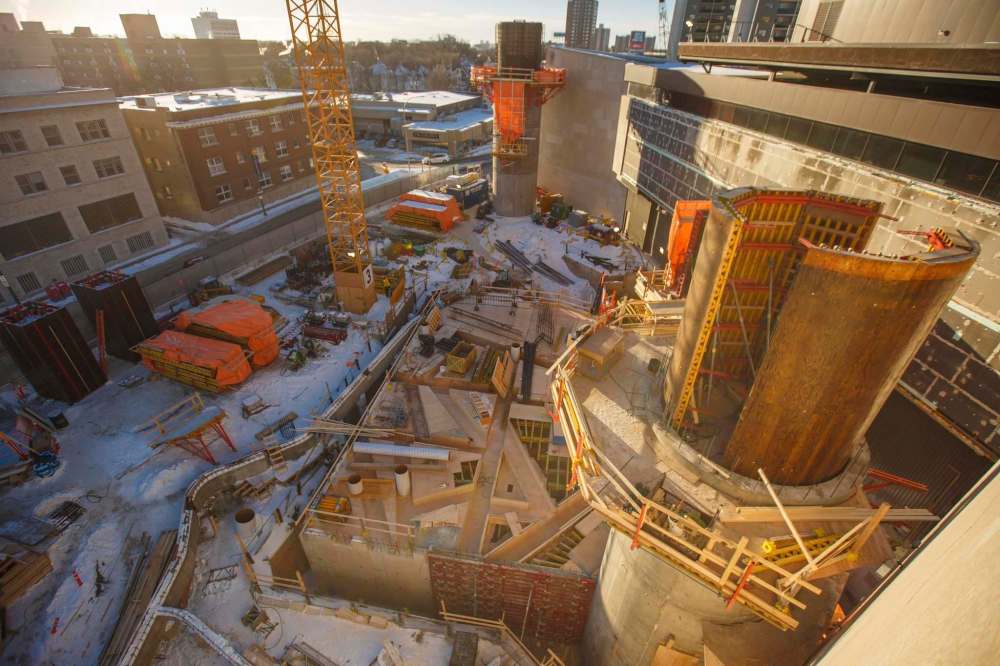
Williams, who gave the Free Press a progress report during a recent trip, said it’ll be about 18 months before the Inuit Art Centre takes its final shape.

“We’re in foundations for the ground floor, so we’re outside,” he said during his two-day visit to the site. “We’re building a lot of the main structure that holds up the building and it’s mostly concrete. Steel hasn’t started. Steel won’t start until, likely, March or so.”
Williams expected to pick up the pace of his trips as construction progresses, coming to Winnipeg more often. Right now, the intervals are about once a month. Before that, he’d made several trips to the city since 2012, and his firm is also involved with The Forks warming huts.
“I’m weathering the weather fine,” Williams said one cold January afternoon. “I’m from upstate New York and I grew up in the cold, and hockey, and all that stuff.”
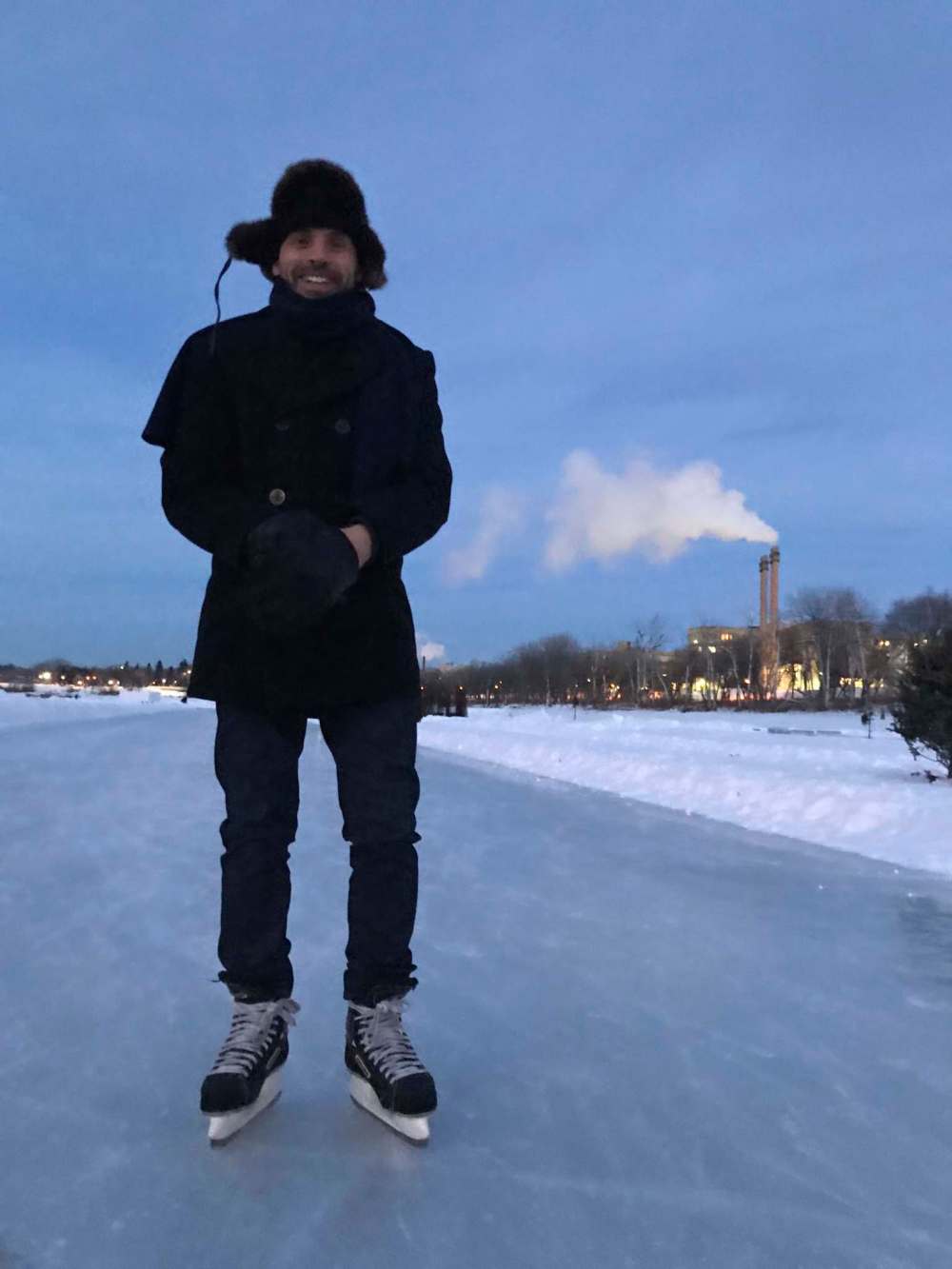
As the interview wrapped up, Williams said he’d packed his old Bauers so he could skate on the river at The Forks. He laced up a few minutes later and took one last snapshot of himself on the river, skates on, blades ready to glide.
alexandra.paul@freepress.mb.ca
History
Updated on Monday, February 4, 2019 11:54 AM CST: Updates headline