

Trump enthusiast’s crude hobby
Collection offers glimpse into Manitoba's oil history
Advertisement
Read this article for free:
or
Already have an account? Log in here »
To continue reading, please subscribe:

Digital Subscription
One year of digital access for only $205*
- Enjoy unlimited reading on winnipegfreepress.com
- Read the E-Edition, our digital replica newspaper
- Access News Break, our award-winning app
- Play interactive puzzles
*First annual payment billed as $205.00 + GST for one year. This annual subscription will automatically renew at $233.00 + GST every 52 weeks (10% off the regular annual price of $259.35). Offer available to new and qualified returning subscribers only. Cancel any time.
To continue reading, please subscribe:
Add Free Press access to your Brandon Sun subscription for only an additional
$1 for the first 4 weeks*
- Enjoy unlimited reading on winnipegfreepress.com
- Read the E-Edition, our digital replica newspaper
- Access News Break, our award-winning app
- Play interactive puzzles
*Your next Brandon Sun subscription payment will increase by $1.00 and you will be charged $17.95 plus GST for four weeks. After four weeks, your payment will increase to $24.95 plus GST every four weeks.
Read unlimited articles for free today:
or
Already have an account? Log in here »
Hey there, time traveller!
This article was published 05/08/2017 (3347 days ago), so information in it may no longer be current.
MORDEN — Manitoba once had its own Trump.
It was an upstart oil and gas company called Trump Oil that existed in the 1930s and ’40s.
Its oil refinery was near Morris, about 60 kilometres south of Winnipeg, and it had numerous gas stations in southern and central Manitoba.
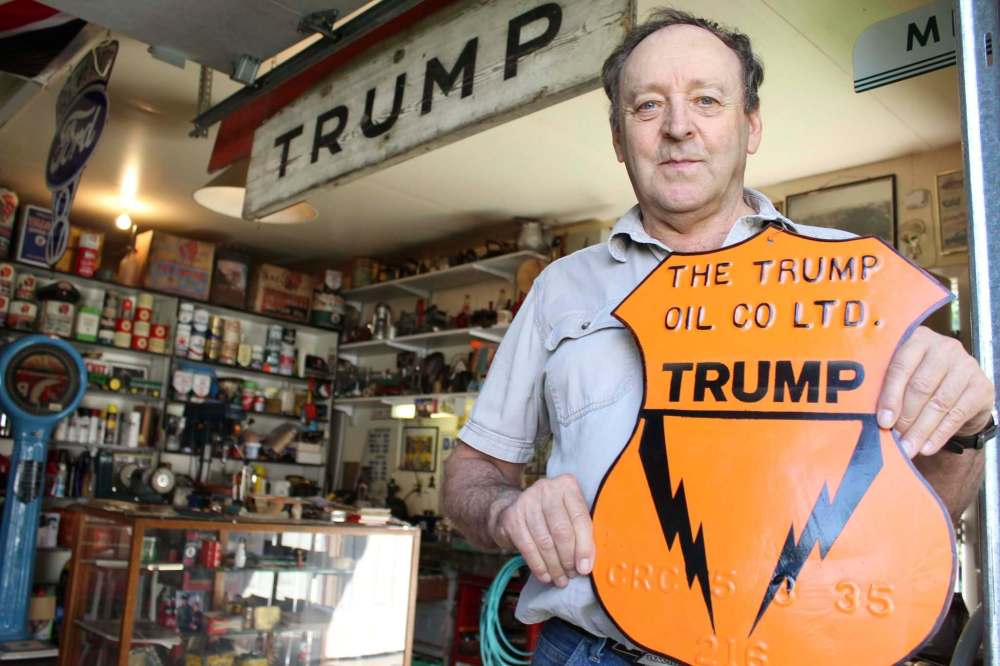
Morden resident Harvey Thiessen, who collects petroliana (gas station memorabilia), has several artifacts from Trump Oil, including a Trump Oil calendar with a thermometer. But he’d give his left arm for a Trump Oil gas pump.
“They’re almost impossible to find.”
One item in his possession is a metal Trump Oil sign in the shape of a knight’s shield, in bright orange, with lightning bolts angling down the sides.
“It was affiliated with Phillips 66, and sold their oil, so they have a shield logo,” Thiessen said.
The Trump Oil name, now more than ever with Donald Trump as president of the United States, intrigues.

Most accounts are that Trump Oil was merely named after Trump Siding, a section of rail line where trains could pull over and load or unload a product, where its refinery was located.
In 1915, a group of farmers from nearby Rosenort used the siding, ordering rail tank cars with oil and gas to distribute among themselves. In the early 1930s, the directors sold shares in the community and built a refinery and lubricating oil plant called Trump Oil. Soon, Trump Oil gas stations were sprouting up around Manitoba.
Another version of the story, however, is that the siding was named after the Trump Oil refinery, not vice versa, and that the Trump family invested in the refinery.
“I always understood it was from the Trump family,” said Mervin Dueck, a councillor in the Regional Municipality of Morris who grew up next door to the refinery and who named his farm Trump Farm.
After all, the upstart Trump Oil had its own brand of notoriety, not unlike the more famous namesake. It was a thorn in the side of big oil companies because it undercut prices. It could do so, in part, because it processed only sweet crude oil (high sulphur content) from the United States.

There’s little evidence to support that the Trump family was ever in Manitoba’s oil business. In fact, Trump Siding preceded the refinery, according to early maps, said Des Kappel, the provincial toponymist in charge of naming land features.
However, the Trump family, which made its fortune in real estate, could have engaged in land speculation in Manitoba, and had Trump Siding named after them, Kappel said. There was tremendous land speculation in Manitoba, which was booming before the Panama Canal opened in 1914.
Thiessen’s collection, which includes seven vintage gas pumps, shows how the oil and gas landscape has changed in Manitoba over the past century. His most prized possessions are from Trump Oil, Buffalo Oil and Red Indian.
Buffalo Oil was the brand name of Prairie City Oil Co., based in Winnipeg. It started in 1911 and served all of Western Canada. North Star Oil bought out Buffalo in 1937, which was bought out by Shell in 1962. Shell also bought out White Rose around that time.
There was a Buffalo gas station in Morden in the 1920s.

“There were once a dozen gas stations in town,” Thiessen said.
Now there are three: two Co-ops and an Esso. The Co-op stations chased many Shell dealers out of rural Manitoba, Thiessen said.
Another big Canadian oil company back then was British American, started in Toronto in 1906. Its Western Canada headquarters were in Winnipeg. Gulf Oil gained control of a majority share in BA, Thiessen said. Petro-Canada later bought out Gulf’s Canadian operations, and its American side merged with Standard Oil to become Chevron.
Red Indian is the most controversial name for an oil company. McColl-Frontenac Oil Company, from Eastern Canada, had Red Indian gas stations and oil products across Canada. Thiessen has at least 30 pieces from Red Indian, including gas pumps.

The Texas Company, or Texaco, took over Red Indian in 1938 and gradually converted the stations to its own name, starting with Sky Chief, which eventually morphed into Texaco. In the early 1990s, Esso (Imperial Oil) purchased Texaco’s Canadian division. Esso also owns the Fas Gas stations sprinkled throughout rural Manitoba.

“I am not too politically correct,” Thiessen said of his fondness for Red Indian petroliana. “I like Trump — Donald Trump — too.”
Thiessen cautioned the member of the “mainstream media” (his words) that the coffee shops of Morden are full of Trump supporters.
Trump Oil operated until the Second World War, when Ottawa passed a law requiring Canadian refineries use a percentage of Canadian crude, in its efforts to keep more money within the country. The Trump Oil refinery wasn’t equipped to process Canadian sour crude; that marked the end. However, it was still operating in some capacity as late as 1952, as Thiessen’s Trump Oil calendar attests.
bill.redekop@freepress.mb.ca
