

What in God’s name?
To some, earthquake a natural disaster, to others divine punishment
Advertisement
Read this article for free:
or
Already have an account? Log in here »
To continue reading, please subscribe:
Monthly Digital Subscription
$1 per week for 24 weeks*
- Enjoy unlimited reading on winnipegfreepress.com
- Read the E-Edition, our digital replica newspaper
- Access News Break, our award-winning app
- Play interactive puzzles
*Billed as $4.00 plus GST every four weeks. After 24 weeks, price increases to the regular rate of $19.95 plus GST every four weeks. Offer available to new and qualified returning subscribers only. Cancel any time.
Monthly Digital Subscription
$4.99/week*
- Enjoy unlimited reading on winnipegfreepress.com
- Read the E-Edition, our digital replica newspaper
- Access News Break, our award-winning app
- Play interactive puzzles
*Billed as $19.95 plus GST every four weeks. Cancel any time.
To continue reading, please subscribe:
Add Free Press access to your Brandon Sun subscription for only an additional
$1 for the first 4 weeks*
*Your next subscription payment will increase by $1.00 and you will be charged $16.99 plus GST for four weeks. After four weeks, your payment will increase to $23.99 plus GST every four weeks.
Read unlimited articles for free today:
or
Already have an account? Log in here »
Hey there, time traveller!
This article was published 20/03/2011 (5500 days ago), so information in it may no longer be current.
LOS ANGELES — What hath God wrought?
In the Bible, that’s an exclamation, not a question (Numbers 23:23). Still, it’s a common response to any natural disaster, especially one on the scale of the Japanese earthquake and tsunami, now compounded by the unnatural disaster of a nuclear crisis.
If there is a God, and if He (for the sake of convention) is all-powerful, what in God’s name was He thinking?
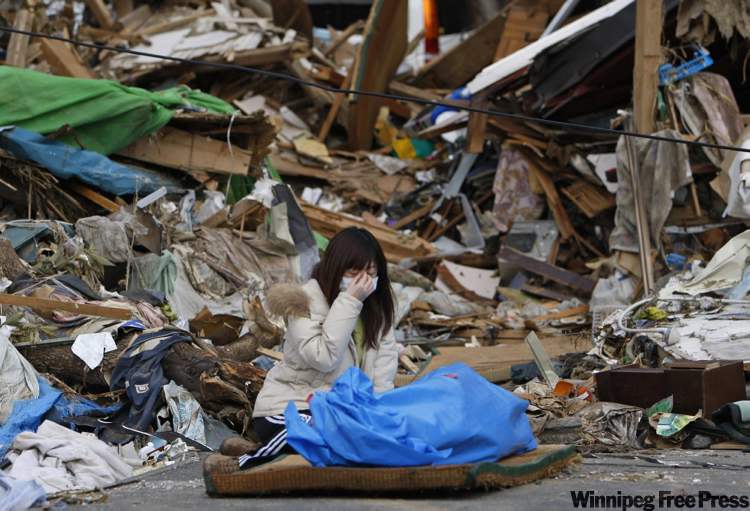
This is perhaps the oldest of theological questions — the one that may, in fact, explain the nearly universal human yearning for faith, what evolutionary psychologist Jesse Bering calls “the belief instinct.” How can we explain the inexplicable? How can we make sense of suffering?
Atheists say we can explain life’s complexities through science and there is no meaning in suffering. It just is, and we should do our best to alleviate it.
Monotheists see it somewhat differently. Faith offers answers, if only the unsatisfying: “It’s a mystery.” But there is little consensus among the faithful.
In the days following the magnitude 9.0 earthquake in Japan, some saw the punishing hand of God. Others saw a sign of the end of times, the coming of the apocalypse. Still others saw, well, an earthquake.
On Fox News, host Glenn Beck said he was “not saying that God is, you know, causing earthquakes,” but he was “not not” saying that.
“Whether you call it Gaia or whether you call it Jesus, there’s a message being sent,” said Beck, who is Mormon. “And that is, ‘Hey, you know that stuff we’re doing? Not really working out real well.’ “
The governor of Tokyo prefecture, Shintaro Ishihara, was compelled to apologize when he was quoted after the quake as saying Japanese politics was “tainted with egoism and populism,” causing “tembatsu,” or divine punishment.
Those remarks, theologians say, reflect a natural human desire to make sense of a disaster whose force and scale are difficult to comprehend. But many Christians, Jews and others profoundly disagree with the idea the quake can be explained by the “doctrine of retribution,” the idea God punishes evil in the world.
“I think that’s a common, almost instinctive, knee-jerk reaction,” said Warren McWilliams, an ordained Baptist minister who is a professor of Bible studies at Oklahoma Baptist University. “The danger, I think, is in moving backwards — moving from effect to cause. It’s what I call the thinking process of Job’s friends.” The reference was to the biblical figure whose trials helped create the archetype of a good person forced to endure inexplicable suffering.
“So long as he prospered, they thought he was good,” McWilliams said of Job. “The moment he suffered, they thought there must be some sin.” When hurricane Katrina struck, he added, “a lot of conservative Christians said, you know, New Orleans is a sin city, and so God judged them. I don’t think it’s my place to make that judgment. I think it’s a dangerously simple way to think of a complex situation.”
Certainly, the Bible is full of examples of divine retribution: Noah’s flood or the plagues that afflict the Egyptians. And Jesus warns of earthquakes (Matthew 24:7-8) as “birth pains” before the end of the world.
Erik Thoennes, a professor of theology at Biola University and a pastor at Grace Evangelical Free Church in La Mirada, Calif., said he believes human iniquity does, in fact, play a role in natural disasters. But he does not want to cast blame on the Japanese.

“Is God judging Japan?” he asked. “Well, no more than He’s judging me.”
Thoennes added events like the Japanese earthquake can bring people closer to God. It “calls us back to rethink the biggest questions of life,” he said.
God created the world but isn’t micromanaging it, Rabbi Julie Schonfeld, executive vice-president of the Rabbinical Assembly, an organization of Conservative Jewish rabbis, believes. “I live in a real world of science and technology,” she said. “We know that these things happen, and we are humbled by them.”
— Los Angeles Times