

Winnipeg lab leads charge to combat biological threats
Advertisement
Read this article for free:
or
Already have an account? Log in here »
To continue reading, please subscribe:

Digital Subscription
One year of digital access for only $205*
- Enjoy unlimited reading on winnipegfreepress.com
- Read the E-Edition, our digital replica newspaper
- Access News Break, our award-winning app
- Play interactive puzzles
*First annual payment billed as $205.00 + GST for one year. This annual subscription will automatically renew at $233.00 + GST every 52 weeks (10% off the regular annual price of $259.35). Offer available to new and qualified returning subscribers only. Cancel any time.
To continue reading, please subscribe:
Add Free Press access to your Brandon Sun subscription for only an additional
$1 for the first 4 weeks*
- Enjoy unlimited reading on winnipegfreepress.com
- Read the E-Edition, our digital replica newspaper
- Access News Break, our award-winning app
- Play interactive puzzles
*Your next Brandon Sun subscription payment will increase by $1.00 and you will be charged $17.95 plus GST for four weeks. After four weeks, your payment will increase to $24.95 plus GST every four weeks.
Read unlimited articles for free today:
or
Already have an account? Log in here »
Hey there, time traveller!
This article was published 02/11/2017 (3226 days ago), so information in it may no longer be current.
OTTAWA — Winnipeg-based National Microbiology Laboratory is a world leader in studying animal and human pathogens, an international conference heard on Wednesday, as experts pondered whether Manitoba’s deadly pig-diarrhea outbreak might have been sparked by terrorist groups.
Primal Silva, the science head for the Canadian Food Inspection Agency, is leading a group of 11 high-risk labs from five developed countries to standardize their protocols for preventing and dealing with outbreaks, as well as transporting pathogens across borders for study.
Much of it is based off practices at the Winnipeg lab, which was largely behind the recently discovered Ebola vaccine. The lab has a “biosafety Level 4” classification, the world’s highest, and Silva describes its security protocols as “a box in a box.”
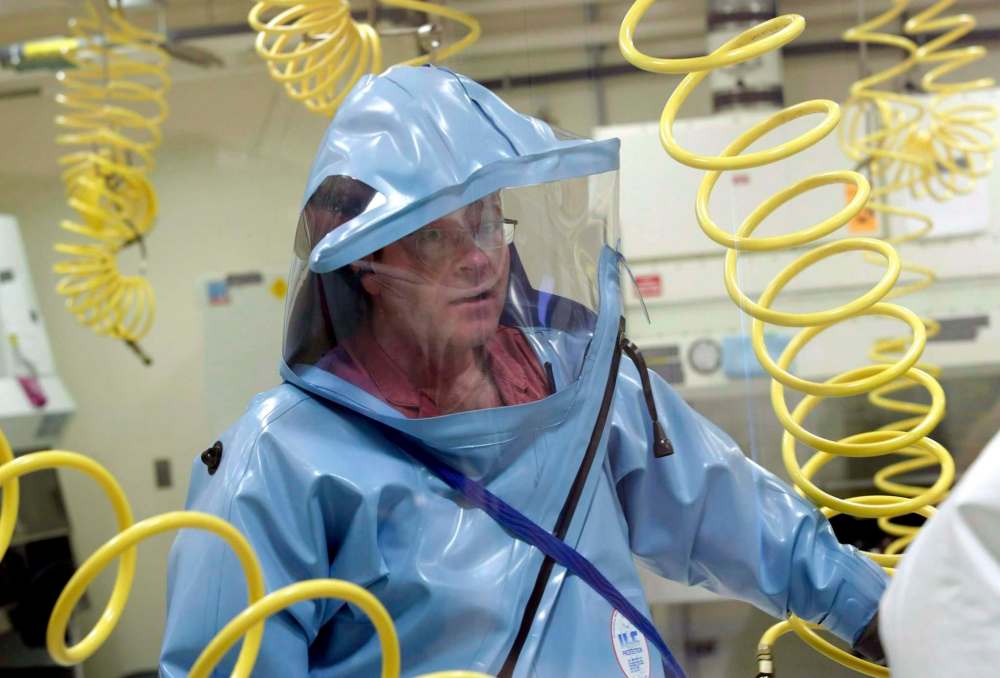
Silva said by standardizing how countries use these labs, they can prepare their governments to deal with outbreaks.
“For us it is about responding, in terms of the knowledge… that we harness in the laboratories, and turn it into advice for the decision-makers,” Silva told a conference on biological threat reduction in Ottawa.
The conference, hosted by the World Organisation for Animal Health, has brought scores of scientists from multiple countries to look at biological threats — including terrorist acts — that threaten the world’s animals.
A common theme was the need to study animal diseases alongside human ones. Silva said Winnipeg was ahead of its time in placing public-health and animal-diseases specialists together at the national Microbiology Laboratory. Research suggests at least 60 per cent of infectious diseases originate in animals before they infect humans.
Silva, who’s based in Ottawa and visits the Winnipeg lab multiple times each year, says viruses can circulate between humans, poultry and pigs, combining with other illnesses.
“They become more capable for survival. From the human perspective, that’s very deadly for us,” he said in an interview.
Silva said his multi-country group — including the United States, Britain, Australia and Germany — has attracted interest from various countries, but hinted the exchange can only admit countries with solid science and good relations.
“It’s a tricky balance,” he said.
“It really needs a trusted partnership.”
At a Tuesday lunch session, a senior FBI official warned the ongoing outbreak of porcine epidemic diarrhea (PED) — which has devastated scores of farms around Steinbach — may have been an act of terrorism.
The PED outbreak started in the U.S. in 2013, decimating the American pork industry and crossing into Ontario and Mexico. PED came back with a vengeance this spring, affecting more than 60 Manitoba farms, despite just 10 cases in the previous three years combined.
Officials believe Manitoba’s current woes were caused by a poorly washed truck that arrived from the U.S.
As for the 2013 spread in the U.S., Special Agent Stephen Goldsmith reportedly told the conference, “pigs can’t fly; it was not a natural incursion” — and law enforcement was only tipped off three years afterward, making it impossible to tell whether it was accidental.
Jaspinder Komal, Canada’s acting chief veterinary officer, said he wasn’t surprised to hear those remarks.
“We have had incidents, where we found our system was working,” Komal said, without specifying how many.
“I can talk about many examples of how they catch meat products, vials of viruses or bacteria. It happens all the time, but I think we are able to catch them through the system.”

Komal said border services’ entry card has been an effective tool to thwart biological threats, by asking travellers whether they’re bringing meat products, and if they’ve recently been to a farm abroad.
“We know what the risks are, and we’re accordingly managing those risks,” Komal said.
Last month, Komal took part in a meeting of G7 countries’ chief veterinarians where they discussed antibacterial resistance and bird-flu risks. Next year is Canada’s turn to lead the G7, and Komal said Canada will likely highlight both issues during its term.
“Canada is actually leading the pack in many ways,” Komal said.
dylan.robertson@freepress.mb.ca