

Bowman, Trudeau agree to meet as survey finds Winnipeggers feel crime on rise

Advertisement
Read this article for free:
or
Already have an account? Log in here »
To continue reading, please subscribe:

Digital Subscription
One year of digital access for only $205*
- Enjoy unlimited reading on winnipegfreepress.com
- Read the E-Edition, our digital replica newspaper
- Access News Break, our award-winning app
- Play interactive puzzles
*First annual payment billed as $205.00 + GST for one year. This annual subscription will automatically renew at $233.00 + GST every 52 weeks (10% off the regular annual price of $259.35). Offer available to new and qualified returning subscribers only. Cancel any time.
To continue reading, please subscribe:
Add Free Press access to your Brandon Sun subscription for only an additional
$1 for the first 4 weeks*
- Enjoy unlimited reading on winnipegfreepress.com
- Read the E-Edition, our digital replica newspaper
- Access News Break, our award-winning app
- Play interactive puzzles
*Your next Brandon Sun subscription payment will increase by $1.00 and you will be charged $17.95 plus GST for four weeks. After four weeks, your payment will increase to $24.95 plus GST every four weeks.
Read unlimited articles for free today:
or
Already have an account? Log in here »
Hey there, time traveller!
This article was published 07/11/2019 (2476 days ago), so information in it may no longer be current.
Winnipeg Mayor Brian Bowman said in a tweet late Thursday he had talked to Prime Minister Justin Trudeau about the city’s public safety problems and “the need for all levels of government to work together.” Bowman said the two agreed to meet as soon as their schedules would allow it.
The announcement came on the same day the Winnipeg Police Service released a survey, which was conducted in the summer, that shows city residents generally thought crime was on the upswing — long before a spate of slayings and crime began commanding headlines and public attention.
During a five-day stretch in July and August, an Edmonton-based research firm polled 620 people, on mobile and landline phones, with 72 per cent of respondents saying they thought crime had risen in Winnipeg over the previous year. In 2017, fewer than 30 per cent of respondents felt that way. (The survey has been conducted on a biennial basis since 2001.)
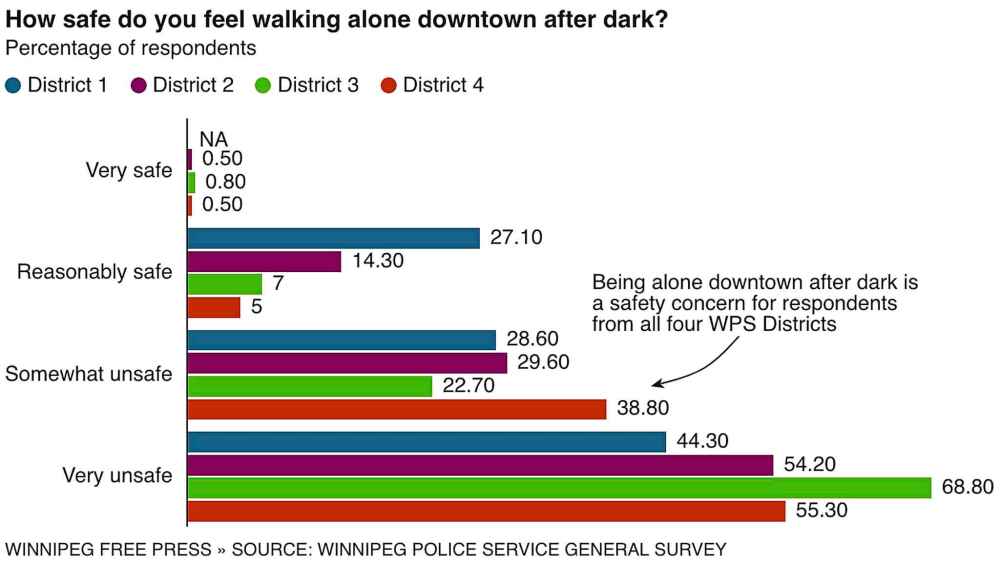
While the survey has a four per cent margin of error and is largely based on anecdotal, emotional responses, not empirical data, its results indicate perceptions of a general increase in crime and a decrease in safety, as compared to previous years. Fewer respondents in each of the city’s four districts said they felt safe walking in their neighbourhoods and downtown than they did in 2017, and fewer respondents than ever before felt crime had decreased.
Appreciated a call tonight from @JustinTrudeau to discuss current public safety issues affecting our community & need for all levels of government to work together. We’ve committed to meeting in-person as soon as our schedules can accommodate. Thank you Prime Minister Trudeau.
— Mayor Brian Bowman (@Mayor_Bowman) November 8, 2019
Based on comparisons of the WPS monthly crime statistics reports from July 2018 and July 2019, the perception on rising crime does somewhat align with what’s been reported by police.
In 2018, from January through July, there were 33,231 total crimes in Winnipeg; over the same seven-month stretch in 2019, there were 37,327 — an increase of about 12.33 per cent. The most recent annual statistical report, which includes crime data from 2018, showed an 11 per cent increase in total reported crime compared to the previous year.
However, the survey is flawed in many ways, says University of Manitoba criminologist Frank Cormier.
For one thing, it’s based on respondents’ feelings at a particular moment in time, which is largely influenced by what’s happened recently. At the time the poll was conducted, the WPS had just released its annual report, with Chief Danny Smyth and Winnipeg Mayor Brian Bowman calling for “urgent” or “immediate” action to deal with crime.
By the end of July, the city had already reported 25 homicides, well above normal levels.
Such information colours perceptions, Cormier said, thus skewing survey results.
That influence, one informed by recency bias, could have spilled into the results on downtown safety, as well, Cormier added. “It’s not rational, but it is human.”
As well, Cormier pointed out that over time, the number of people who felt crime had decreased stayed relatively consistent since 2001, hovering within one standard deviation, but the number of respondents who felt it remained the same or increased has been much more variable. If people are more riled up about crime, it’s reasonable to assume they’re more likely to say yes to a telephone survey, he added.
The WPS did not ask respondents their race nor ethnicity, nor whether they identified their gender as outside the male-female binary.
Research and statistics show traits such as race, sexual orientation, and gender identity can play a major role in how individuals relate to both crime and the police. For example, the 2014 national survey on victimization showed the rate of self-reported sexual assault of Indigenous people was nearly triple that of non-Indigenous people. Racialized people are disproportionately represented in the criminal justice system and LGBTTQ* people are at higher risk of being targeted with violence.
Without information on how many respondents fit in those categories, the data isn’t too helpful, Cormier said. “I’m not saying it’s useless, but there are so many (elements) we don’t know, so it’s difficult what to make of it.”
Thanks for the call today, @Mayor_Bowman. Keeping our communities safe is our top priority, and we’ll keep working together to reduce violence in Winnipeg & across Canada. https://t.co/5x5PiBxgdK
— Justin Trudeau (@JustinTrudeau) November 8, 2019
Meanwhile, at a crime prevention breakfast Thursday hosted by the Manitoba Criminal Justice Association, Smyth talked about the city’s crime issues, which include 11 homicides in the last month.
“People are reeling, they’re looking for answers,” he told the crowd. “A lot of anger, anguish, remorse, and frustration.”
The city has experienced 40 homicides so far in 2019, one short of matching the recorded high of 41 in 2011.
Violent crimes have taken a toll on the community at large of late, deputy mayor Markus Chambers said at the morning event.
“As we enter into the last two months of 2019, Winnipeggers are gripped with fear and concerns over the rise in crime, senseless deaths, and brazen acts of daylight robberies… seem to be an everyday occurrence in our news,” he said.
ben.waldman@freepress.mb.ca
Ben Waldman is a National Newspaper Award-nominated reporter on the Arts & Life desk at the Free Press. Born and raised in Winnipeg, Ben completed three internships with the Free Press while earning his degree at Ryerson University’s (now Toronto Metropolitan University’s) School of Journalism before joining the newsroom full-time in 2019. Read more about Ben.
Every piece of reporting Ben produces is reviewed by an editing team before it is posted online or published in print — part of the Free Press‘s tradition, since 1872, of producing reliable independent journalism. Read more about Free Press’s history and mandate, and learn how our newsroom operates.
Our newsroom depends on a growing audience of readers to power our journalism. If you are not a paid reader, please consider becoming a subscriber.
Our newsroom depends on its audience of readers to power our journalism. Thank you for your support.
Ben Waldman is a National Newspaper Award-nominated reporter on the Arts & Life desk at the Free Press. Born and raised in Winnipeg, Ben completed three internships with the Free Press while earning his degree at Ryerson University’s (now Toronto Metropolitan University’s) School of Journalism before joining the newsroom full-time in 2019. Read more about Ben.
Every piece of reporting Ben produces is reviewed by an editing team before it is posted online or published in print — part of the Free Press‘s tradition, since 1872, of producing reliable independent journalism. Read more about Free Press’s history and mandate, and learn how our newsroom operates.
Our newsroom depends on a growing audience of readers to power our journalism. If you are not a paid reader, please consider becoming a subscriber.
Our newsroom depends on its audience of readers to power our journalism. Thank you for your support.
Advertisement Advertise With Us
Advertisement Advertise With Us
History
Updated on Thursday, November 7, 2019 9:59 PM CST: Embeds tweets
Updated on Thursday, November 7, 2019 11:35 PM CST: Updates headline, lede