

Ambulance funding frozen
Cancellation of WRHA cost-sharing deal means seven-figure shortfalls: city
Advertisement
Read this article for free:
or
Already have an account? Log in here »
To continue reading, please subscribe:
Monthly Digital Subscription
$1 per week for 24 weeks*
- Enjoy unlimited reading on winnipegfreepress.com
- Read the E-Edition, our digital replica newspaper
- Access News Break, our award-winning app
- Play interactive puzzles
*Billed as $4.00 plus GST every four weeks. After 24 weeks, price increases to the regular rate of $19.95 plus GST every four weeks. Offer available to new and qualified returning subscribers only. Cancel any time.
Monthly Digital Subscription
$4.99/week*
- Enjoy unlimited reading on winnipegfreepress.com
- Read the E-Edition, our digital replica newspaper
- Access News Break, our award-winning app
- Play interactive puzzles
*Billed as $19.95 plus GST every four weeks. Cancel any time.
To continue reading, please subscribe:
Add Free Press access to your Brandon Sun subscription for only an additional
$1 for the first 4 weeks*
*Your next subscription payment will increase by $1.00 and you will be charged $16.99 plus GST for four weeks. After four weeks, your payment will increase to $23.99 plus GST every four weeks.
Read unlimited articles for free today:
or
Already have an account? Log in here »
Hey there, time traveller!
This article was published 29/11/2017 (3038 days ago), so information in it may no longer be current.
Mayor Brian Bowman is decrying further cost-offloading from the provincial government after learning Winnipeggers are going to have to pay more for ambulance service.
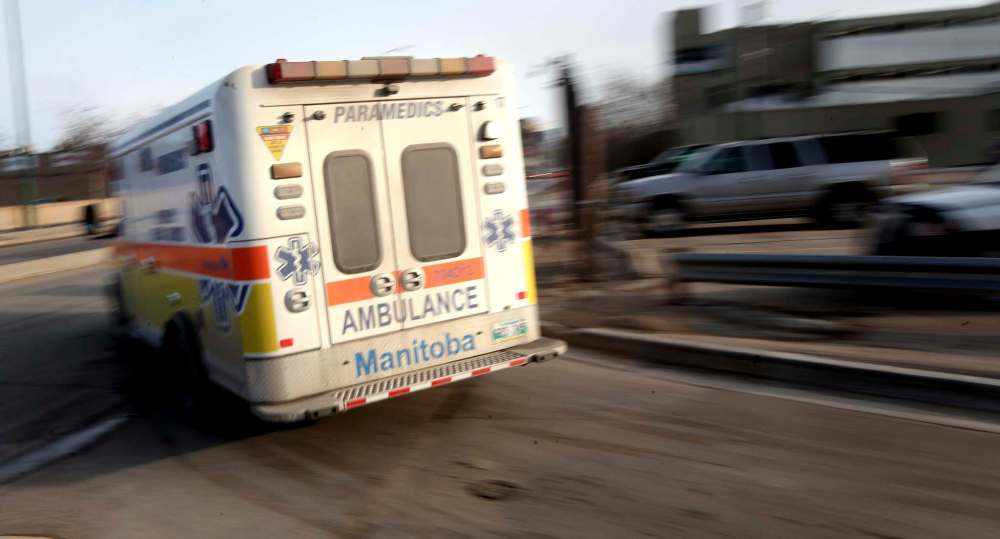
The Winnipeg Regional Health Authority has let city officials know it is ending its ambulance cost-sharing agreement, and is freezing funding at 2016 levels for both this year and 2018.
Bowman told reporters Wednesday that the decision — delivered in a letter dated Nov. 22, the day the 2018 civic budget was tabled — will cost city hall millions of dollars.
He said he only learned about the decision on Tuesday.
“Like transit, the provincial government appears to have unilaterally decided to abandon a long-standing city-provincial cost-sharing agreement,” he said.
“This will create significant financial issues for the city in both the 2017 fiscal year, which we’ve almost completed, as well as 2018… Very early estimates suggest the financial impact in 2017 will be in the millions (of dollars) and the impact will increase in 2018.”
Unlike the rest of the province, where regional health authorities provide ambulance services, Winnipeggers were charged 50 per cent of the cost and city hall and the WRHA each contributed 25 per cent. The city’s share was even higher because it had to cover the shortfall for those patients unable to pay.
Premier Brian Pallister promised to slash ambulance fees in half while campaigning before the April 2016 election. Manitobans were paying the highest rates in the country at $522 at the time. Since taking office, the government has twice reduced fees by $50, but this will again raise the cost, albeit indirectly.
In the Nov. 22 letter to City of Winnipeg CAO Doug McNeil, the WRHA said it is capping funding for ambulance services at $20.677 million, which would mean a shortfall. A civic spokesman said that would leave the ambulance-services shortfall for this year at $2.5 million and $4.6 million for 2018.
Council committees are reviewing the preliminary 2018 budget. The ambulance services portion of the budget will be examined Dec. 4.
With weeks remaining in 2017, its uncertain how the city will make up the $2.5-million shortfall, Bowman said. Just two weeks ago, finance officials projected a small year-end surplus of $400,000.
“For the second time, a unilateral decision has been made provincially that carries with it a significant financial impact on Winnipeg residents,” Bowman said. “Health care is a provincial responsibility and it seems odd to me the province is backing away from an agreement to fund the service the city provides on their behalf.”
City hall and the WRHA are currently negotiating an extension of the ambulance funding agreement.
Health Minister Kelvin Goertzen took exception to the accusation that the WRHA was freezing or cutting support to the city for paramedic services. In a question-and-answer exchange with reporters at the legislature, Goertzen said that in 2016, the city received a 27 per cent increase in funding compared with 2015.
“I’m not accepting the premise that they’re falling short millions of dollars. They got a significant increase from (20)15 to (20)16.”
Goertzen said there is “no blank cheque” for the city.
“Twenty-seven per cent increases year-over-year-over-year isn’t sustainable. I’m sure the city recognizes that.”
“Mayor Bowman has obviously made some comments. We’ve indicated to him through the Winnipeg Regional Health Authority the funding would remain at least the same. There’s always discussions around top-ups as it goes forward. It’s not a blank cheque. We have to ensure that we’re being responsible for citizens’ tax dollars. He does, too.”
NDP Leader Wab Kinew said the province is breaking its promise not to cut front-line services. Ambulance services, he said, “are the most front-line of services you can get.”
If ambulance services suffer, it will be a sad reflection on the relationship between the city and the province, Kinew said.
“If there was a good relationship between the premier and the mayor, they ought to be able to sort this thing out, figure out a way to deliver this essential service while ensuring that it doesn’t require them to go back to the taxpayer again and again and again.”
Goertzen said he didn’t think the change in the funding agreement would prompt city hall to reduce ambulance services, adding “common sense” would prevent the city from even considering such an option. He said he’s known the mayor “for a little while” and doesn’t think he’s a “reactionary individual.”

“He would know that there’s been significant funding increases year over year. He would also know that there are always discussions within (the) year about funding and reconciliation. That would not be in keeping with the individual that I know as a person.”
Goertzen would not say whether the province had ordered the WRHA to take the position it has.
“The funding flows through the Winnipeg Regional Health Authority,” he said. “I was aware of the decision.”
larry.kusch@freepress.mb.ca