

Analysis
Opinion

Who will vote for trees?
5 minute read 2:01 AM CDTIn July 2026, Terrasse-Vaudreuil, a small Quebec town, made international headlines.
And no, it wasn’t the result of murder and mayhem or a catastrophic flood. The headlines were about a remarkable resolution passed by its town council, making Terrasse-Vaudreuil the first city in the world to recognize the rights of trees.
Advertisement
Opinion
Who does Manitoba’s police watchdog represent?
4 minute read 2:00 AM CDTCassity Delvenne, a 24-year-old Indigenous woman, was arrested by the Brandon Police Service (BPS) and charged with impaired driving and resisting arrest on June 12.
Opinion
Airport sales pose risks
4 minute read Updated: 6:10 AM CDTI am a retired Transport Canada manager and an aviation and airports management consultant who devoted my career serving the principal goal of making air travel and civil aviation operations safe, efficient and cost-effective. I had the pleasure of working with so many colleagues in the airports and aviation industry who shared that same goal.
I think I can speak for most of us in saying I am concerned with the latest trial balloon floated by Prime Minister Mark Carney — that our four largest airports could be turned over to huge investment funds and multinational corporations to operate as airport authorities replacing the local, non-profit authorities now in place.
Concerns have already been voiced about increased costs for air travel.
These huge investors care only about return on investment, and so they will certainly be looking at ways to maximize profit.

Opinion
Where is the rest of the plan?
4 minute read Saturday, Sep. 19, 2026Manitoba has a climate plan. Where is the pathway for protecting nature?
The Manitoba government has released its long awaited Path to Net Zero Plan, outlining ways to tackle emissions and build a more climate resilient future.
But something essential is missing.
In 2023, the Manitoba government committed to developing an action plan to protect 30 per cent of Manitoba’s lands and waters by 2030. The Path to Net Zero Plan recognizes the importance of nature in addressing climate change, calling for measures that restore, conserve, and enhance natural ecosystems. That recognition is welcome.
Opinion
Canada must not accept another Iranian autocracy
5 minute read Saturday, Sep. 19, 2026Iran is a state run by a radical government victimizing its citizens and its neighbours. How do we change that? Any regime change that repeats the mistakes of the past is not a solution.
What went wrong in the past which led to the current regime? One answer is the U.K. and American aided coup which led to the ouster in 1953 of a democratically elected government headed at the time by Mohammad Mossadegh and its replacement with an American friendly autocrat, the Shah of Iran, Mohammad Reza Pahlavi.
The Shah imposed his rule through the Iranian National Intelligence and Security Organization — SAVAK, the acronym of its Persian name. SAVAK systematically inflicted torture, arbitrary killings and extra-judicial killings on perceived opponents of the regime. It was only a matter of time before repression of a regime directed to serving foreign interests would be overthrown.
What replaced the regime of the Shah, in 1979, the current regime of the mullahs, is a regime as intolerant and violent as the regime of the Shah and then some. That was not inevitable. But neither was it surprising. The vicious nature of the current regime, following the example set by the Shah, and its hatred for the United States, reacting to the U.S. aided imposition of the Shah, both echoes and reacts to the past. In 1979, the U.S. reaped what it sowed in 1953.
Opinion
Building Northern Manitoba right
4 minute read Friday, Sep. 18, 2026I had the pleasure of attending the recent celebrations welcoming grain shipments back to the Port of Churchill, alongside business leaders, port workers, community members and government partners. We find ourselves at an important and pivotal moment and there is a lot of optimism about Northern Manitoba.
Whether it’s the Port of Churchill Plus, all-weather roads and trade corridors, new mines and exploration, a transmission line to Nunavut or billions going into modernizing our hydro-electric systems, one thing is clear: Northern Manitoba needs to be prepared for a potential boom in development.
Now more than ever, Canada and Manitoba have to get this right.
Prime Minister Carney and Canada’s premiers have met with some of the world’s largest investors to discuss nation-building projects that will shape our country’s future.

Opinion
Space war and other distractions
5 minute read Friday, Sep. 18, 2026When Troy Meink, the chief of the U.S. Space Force, announces for no obvious reason that the United States “now has on-orbit space-control weapons,” people naturally assume that something is up. Why is Meink admitting the truth now? He’s even boasting about it!
Opinion
Gas turbine peaker plants are a mistake
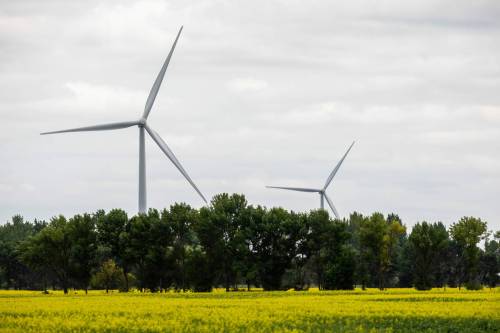
7 minute read Thursday, Sep. 17, 2026Technology respecting electricity generation, storage and grid management is rapidly advancing and displacing gas-fired peaker plants. New battery storage systems are more efficient and less costly, smooth grid flow and are non-polluting. Texas, California and Australia are replacing gas turbine peaker plants with more effective storage batteries.
Solar and wind energy generation combined with battery storage at both the grid and home/business level is the most efficient way to meet peak demand. Building expensive, outdated, polluting American gas turbines, as Manitoba Hydro is proposing, is not in Manitoba’s interest.
Premier Wab Kinew noted that a final decision to build a new turbine power plant in Brandon has not been made. I hope he’s correct, for if Manitoba Hydro already made the decision and entered binding financial obligations with GE Vernova, the PUB’s role was superfluous.
In 2025/26 Nova Scotia Power installed 3 x 50 MW Lithium-ion grid batteries with the storage capacity of over 600 MWh. Installed by Kitchener/Waterloo based Canadian Solar’s subsidiary e-Storage who have operations around the world, they accomplished this in less than two years from the approval date in June 2024. Two were operational within 18 months, the third in 24. The cost was $237 million. At Nova Scotia’s cost per MW, a 750 MW battery peaker facility would cost Hydro $1.185 billion, just 40 per cent of the proposed $3 billion gas peaker plant.
Opinion
What constitutes criminal justice?
4 minute read Wednesday, Sep. 16, 2026The recent controversial, high-profile judicial declaration of a mistrial in the case of Lindsay Clancy for killing her three young children while suffering postpartum psychosis ironically came days after an op-ed in a local newspaper entitled “Murderers should be locked up for life.”
As both the court case and the op-ed manifest, debates about what constitutes criminal justice persist.
A crime is a violation of law in which the offender must have acted voluntarily, with intent, and with no legally acceptable excuse or justification, such as being diagnosed as mentally “not criminally responsible.” The criminal justice system is an institutional response to violations of law by police, courts and prisons, employing four differing rationales for its response to crime.
Retribution is a punitive function, operating as moral vengeance by which society subjects an offender to suffering comparable to that caused by the offence — capital punishment being the ultimate. It may also, where possible, include restitution in which offenders compensate their victims. As the oldest justification for punishment, retribution is a form of public revenge and retaliation intended to restore “moral balance” to society.
Opinion
Winnipeg, economic diversity and risks from AI
5 minute read Wednesday, Sep. 16, 2026I run a company that builds software to read documents and fill out forms. When I look at Winnipeg, I see a lot of potential customers. I also think the city should be asking some fairly uncomfortable questions about what companies like mine are selling.
Winnipeg has spent decades building an economy that does not depend on any one industry. Insurance, agriculture, transportation, aerospace, manufacturing, government, health care. That mix has served it well. A bad year for one employer does not necessarily become a bad year for the whole city.
But there is another way to look at that economy: what people actually do when they arrive at work.
Great-West Lifeco, Wawanesa, IGM Financial and Manitoba Public Insurance are all headquartered in Winnipeg. There are provincial departments, Shared Health and businesses handling the freight moving through CentrePort. Their purposes are different. A surprising amount of their paperwork follows the same routine.

LOAD MORE ANALYSIS ARTICLES