Why I won’t be attending the Giller Prize gala this year

Advertisement

Advertise with us

My family is Mennonite, and one of the tenets of the Mennonite faith is pacifism.

Read this article for free:

or

Already have an account? Log in here »

To continue reading, please subscribe:

Subscribe and receive a limited-edition Free Press branded hat or tote.

Digital Subscription

One year of digital access for only $205*

  • Enjoy unlimited reading on winnipegfreepress.com
  • Read the E-Edition, our digital replica newspaper
  • Access News Break, our award-winning app
  • Play interactive puzzles

*First annual payment billed as $205.00 + GST for one year. This annual subscription will automatically renew at $233.00 + GST every 52 weeks (10% off the regular annual price of $259.35). Offer available to new and qualified returning subscribers only. Cancel any time.

To continue reading, please subscribe:

Add Free Press access to your Brandon Sun subscription for only an additional

$1 for the first 4 weeks*

  • Enjoy unlimited reading on winnipegfreepress.com
  • Read the E-Edition, our digital replica newspaper
  • Access News Break, our award-winning app
  • Play interactive puzzles
Start now

*Your next Brandon Sun subscription payment will increase by $1.00 and you will be charged $17.95 plus GST for four weeks. After four weeks, your payment will increase to $24.95 plus GST every four weeks.

Opinion

Hey there, time traveller!
This article was published 18/11/2024 (622 days ago), so information in it may no longer be current.

My family is Mennonite, and one of the tenets of the Mennonite faith is pacifism.

Signing up for the army, joining the police force, owning a gun — these were all forbidden.

As a boy, it was required that I memorize certain passages from the Bible. The Sermon on the Mount was one: “You have heard that it was said, ‘An eye for an eye and a tooth for a tooth.’ But I tell you… whoever slaps you on your right cheek, turn the other to him also.”

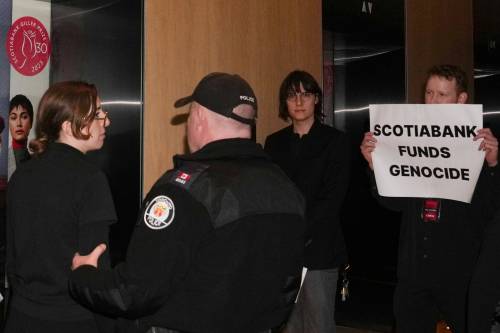
Protesters are escorted out of the Four Seasons Hotel by the police after interrupting the Scotiabank Giller Prize ceremony in Toronto, on Nov. 13, 2023. (Chris Young / The Canadian Press files)

Protesters are escorted out of the Four Seasons Hotel by the police after interrupting the Scotiabank Giller Prize ceremony in Toronto, on Nov. 13, 2023. (Chris Young / The Canadian Press files)

My grandfather chose to be a conscientious objector in the First World War, and my father made the same choice in the Second World War.

This is the world I come from, and non-violent resistance is one of the remaining vestiges of my education.

Like most people, when the protests took place at last year’s Scotiabank Giller gala, I had not known that Scotiabank was heavily invested in Elbit Systems, Israel’s largest arms manufacturer.

Nor, as I learned later, that their sponsor Indigo Books is owned by the principal funders of the HESEG Foundation, who give grants to foreigners who enlist in the Israeli military.

Doing what I do, I wrote a letter to Scott Thompson, the president of Scotiabank. I received a response, written by a minion, the tone of which was like Pablum.

As the slaughter of Gazans continued, and the number of dead grew, I pulled out of participating in the Giller Book Club.

I subsequently joined a collective of writers, called CanLit Responds, that is boycotting the Giller Foundation until it cuts all ties to sponsors invested in Israel’s occupation of Palestine and siege on its people. Among the writers in this collective are many young, first-time novelists, who refused to submit their books to the Giller Prize. I admire the young — they so often put the old to shame.

My connections to the Giller Prize run very deep.

In 2005 I won the prize. In many ways, this changed my life as an author. I sold more books, I was fêted, I thought I was hot stuff. In subsequent years, I had more novels both longlisted and shortlisted. Curiously, three of those novels dealt with war and its aftermath.

The Giller’s influence on the Canadian literary scene has been huge, which is why its ethical collapse around its decisions is vast.

How can I celebrate literary excellence at a gala that’s financially tied to the destruction of a small strip of land where most books have been burned and destroyed?

My sister-in-law lived in the West Bank for seven years doing humanitarian work with Palestinians in Gaza. One of the friends she made back then, “A.,” speaks to her every day.

He runs — to avoid the bombs, to elude the snipers, to hunt for food, to find an internet connection. He reports that a sack of flour costs US$100 and will feed his extended family of 16 for four days. There is no canned fruit or vegetables. Men buy a single cigarette for US$32 and share it. Why not have a $32 cigarette when you could be dead tomorrow? It’s cold these days. Rainy. My sister-in-law waits for the day when A. will not call.

After last year’s Giller prize disruption, over 2,500 Canadian authors signed a letter asking the Giller Foundation to call for charges against the protesters at the event to be dropped. But it was only when 40 authors refused to participate in the prize and its programming that the Giller was forced to respond.

Novelists are split. We do not write op-eds. We do not proclaim.

And yet, given the destruction of humanity in Gaza, and the deaths of thousands of children, and the connections that the Giller has to the army that is committing those atrocities, we must not only speak, but act.

David Bergen is an award-winning Canadian writer based in Winnipeg.

Report Error Submit a Tip

More Stories

As wildfire season rages, new book explores the frontlines of battling Canadian blazes

Reviewed by GC Cabana-Coldwell 4 minute read Preview

As wildfire season rages, new book explores the frontlines of battling Canadian blazes

Reviewed by GC Cabana-Coldwell 4 minute read Yesterday at 2:02 AM CDT

Mother Nature’s talking but we haven’t been listening, according to Jesse Winter, author of Wild Fire: Dispatches from a Country Ablaze, a book, released earlier this summer detailing Canada’s wildfire woes.

Currently, almost 1,000 wildfires across Northwestern Ontario, British Columbia, the Prairies, Northwest Territories and eastern provinces are burning in Canada. Forest fires also continue to wreak havoc in France, Spain and other European countries, and in the U.S. states of Oregon, California, Florida and Texas. While 2023 still rates as the world’s worst wildfire season, 2026 is hot on its heels.

Winter, a Vancouver-based, award-winning climate disaster photojournalist, spent more than two years on Wild Fire, his first book. In-depth research included working with firefighting crews and environmentalists as well as talking to researchers, politicians and evacuees. He says we need to rethink our views on wildfires or be prepared to watch more land go up in flames.

Canada, Winter writes, is “a country almost perfectly designed to burn.” At least 70 per cent of boreal forests, which cover one-third of the country, are stuffed with highly flammable spruce, fir, pine and tamarack trees as well as aspen, poplar and birch. With a wealth of available fuel, it’s no surprise, he writes, that an area twice the size of Vancouver Island burns every summer in Canada.

Read
Yesterday at 2:02 AM CDT

Manitoba Hydro expects storm-related power outages to be repaired Saturday

Zoe Pierce 6 minute read Preview

Manitoba Hydro expects storm-related power outages to be repaired Saturday

Zoe Pierce 6 minute read Yesterday at 5:46 PM CDT

As Manitoba Hydro crews work to restore the last pockets of power following this week’s severe storms, some Winnipeg residents say the prolonged outages left them effectively stranded, unable to safely leave their apartments or charge essential mobility devices.

More than 30,000 Manitoba Hydro customers lost power after powerful storms swept across southern Manitoba Wednesday and Thursday, bringing down trees and power lines. Environment and Climate Change Canada recorded wind gusts of 133 km/h in Brandon, 113 km/h in Souris and 91 km/h in Winnipeg, along with more than 2,900 lightning strikes within 50 kilometres of the city.

In an update posted to social media Saturday morning, Manitoba Hydro said about 500 customers remained without power. The utility said it hoped to restore all remaining storm-related outages later in the day.

“Right now, we’re prioritizing customers that have been out the longest,” the post reads. “The final restoration work will still take time, in part because we’re dealing with small, localized outages and need to travel across a widespread area.”

Read
Yesterday at 5:46 PM CDT

On the night table: Colson Whitehead

1 minute read Preview

On the night table: Colson Whitehead

1 minute read Yesterday at 2:02 AM CDT

Colson Whitehead

Author, Cool Machine

I’ve been reading Caroline Fraser. She has a book called Murderland about serial killers that came out last year. Her previous book, Prairie Fires, was a biography of Laura Ingalls Wilder. She’s a new author for me, and I’m going through that biography now. I never read Wilder’s books, but I liked the TV show when I was a kid; it’s one of those books that’s about a person’s life, but also pulls back to get the larger cultural panorama of America, talking about frontier life and and prairie life — it’s really interesting.

Colson Whitehead will launch Cool Machine, the third book in his Harlem trilogy, on Tuesday at 7 p.m. in the Muriel Richardson Auditorium at WAG-Qaumajuq (300 Memorial Blvd.) in an event presented by McNally Robinson Booksellers.

Read
Yesterday at 2:02 AM CDT

Crop storage headaches loom on horizon

Laura Rance-Unger 5 minute read Preview

Crop storage headaches loom on horizon

Laura Rance-Unger 5 minute read Yesterday at 2:01 AM CDT

A sense of calm descends over Prairie fields this time of year — at least on the surface.

Activities become more limited in the weeks leading up to harvest. There’s not much farmers can do now to support this year’s crop, other than monitor and protect it from diseases such as sclerotinia in canola and leaf stripe and fusarium head blight in wheat and barley.

July is when you might see farmers wading into a thick stand of canola, conducting a so-called “wet pants test” to get a low-tech read on how much disease-inducing moisture is lurking in the canopy.

Disease pressure is high in a humid, hot summer like this one and it’s kept aerial applicators busy applying fungicides. Sclerotinia spores live on plant residues in the soil and blossom into a mould that destroys the canola stem, starving the maturing pods.

Read
Yesterday at 2:01 AM CDT

Winnipeg police ticketed a man accused of leaving his dog locked in his vehicle in a grocery store parking lot during the intense heat earlier this week, then attacking bystanders who were concerned about the animal’s welfare.

It’s not uncommon for city police to be contacted about pets left locked in cars during heat waves, but typically those calls don’t escalate to the extent of the incident Wednesday afternoon, said Winnipeg Police Service spokesman Const. Claude Chancy.

“It definitely comes up every time we have heat events in the city, we do get concerned citizens calling about pets being left in vehicles, even for a short period of time,” said Chancy.

“Typically, what will happen is that the owner or the caretaker of the pet will present themselves to police and proper, appropriate advice is given about the care of these animals — this is definitely an extreme case.”

Brighter days ahead after Camp Arnes

Joshua Frey-Sam 5 minute read Preview

Brighter days ahead after Camp Arnes

Joshua Frey-Sam 5 minute read Yesterday at 6:00 AM CDT

Keishna Abenstein remembers what it was like to be a teenager who was stuck in her shell.

She also recalls how much going to summer camp at Camp Arnes helped her spread her wings.

Abenstein has watched her middle child, Teagen, go through a similar roller-coaster as a teenager. Teagen, described as a social butterfly in his childhood, has become a bit more reserved in his adolescence after many of his closest elementary school friends went to a different middle school, forcing him to make new friends as he began the next chapter of his education.

Abenstein saw an opportunity for a similar experience at Camp Arnes that could impact her son the same way it did for her.

Read
Yesterday at 6:00 AM CDT