

After the flood, the beach
Advertisement
Read this article for free:
or
Already have an account? Log in here »
To continue reading, please subscribe:

Digital Subscription
One year of digital access for only $205*
- Enjoy unlimited reading on winnipegfreepress.com
- Read the E-Edition, our digital replica newspaper
- Access News Break, our award-winning app
- Play interactive puzzles
*First annual payment billed as $205.00 + GST for one year. This annual subscription will automatically renew at $233.00 + GST every 52 weeks (10% off the regular annual price of $259.35). Offer available to new and qualified returning subscribers only. Cancel any time.
To continue reading, please subscribe:
Add Free Press access to your Brandon Sun subscription for only an additional
$1 for the first 4 weeks*
- Enjoy unlimited reading on winnipegfreepress.com
- Read the E-Edition, our digital replica newspaper
- Access News Break, our award-winning app
- Play interactive puzzles
*Your next Brandon Sun subscription payment will increase by $1.00 and you will be charged $17.95 plus GST for four weeks. After four weeks, your payment will increase to $24.95 plus GST every four weeks.
Read unlimited articles for free today:
or
Already have an account? Log in here »
Hey there, time traveller!
This article was published 10/02/2011 (5685 days ago), so information in it may no longer be current.
In a few short weeks they’ll be in the thick of it.
The province’s three Amphibex ice-breaking machines will be out on the Red River north of Selkirk busting up as much ice as possible in advance of this spring’s floodwaters.
There’s a chance one of them will also be trucked to another part of the province to smash up ice jams on another river, to reduce the chances of a jam causing sudden flooding of homes and towns.
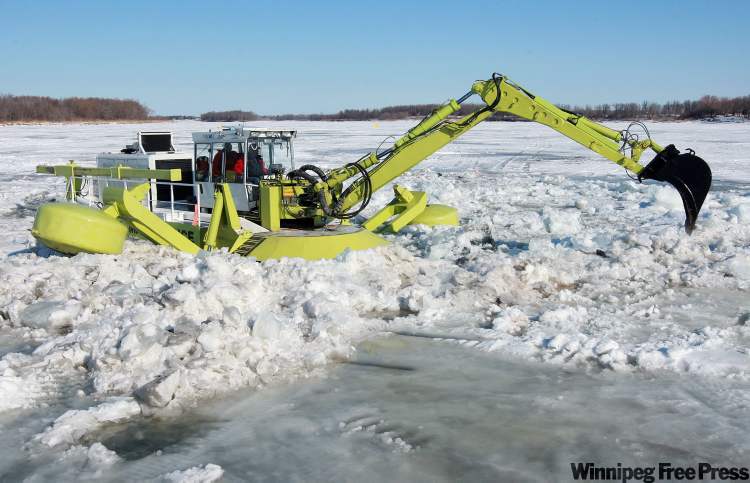
When the water recedes and the flood threat disappears, the Amphibexes will head back to the big shed in East Selkirk where they spend roughly 10 months of the year.
Or will they?
There are plans brewing where at least one of these big green and white metal monsters will head out to Victoria Beach to help the summer community replenish one of its lost beaches.
Nothing has been approved yet—there are several hoops that have to be jumped through first—but the idea is making already making the rounds.
“We’d be very excited to go out and help the situation,” says Darrell Kupchik, director of operations for North Red Waterway Maintenance and the man in charge of the three Amphibexes.
The floating machines, which move around like awkward crabs, have for the past few years been primarily used as ice-breakers during flood season.
But their main function is really dredging.
Their shovel or bucket can be modified so that when extended below the water line, they can scoop up silt, dirt and sand on the bottom much like a vacuum cleaner sucks up cookie crumbs.
Through a series of pipes, what it scoops up from the bottom can be pumped out onto the land or onto a barge or even into dump trucks to be hauled away.
The Amphibex has already been used as a dredger at Victoria Beach, last summer to deepen a boat channel near the main marina.
It’s also been used at Delta Beach on Lake Manitoba to dredge a boat channel.
The idea at Victoria Beach is to use one of the Amphibexes to suck sand off the lake bottom and pump it onto the beaches. A front-end loader would then push the new sand evenly along the beaches. Much of the sand on the beaches was washed away in a severe storm last October.
The Amphibex is capable of moving 60 to 100 cubic metres an hour through an eight-inch pipe extended as long as 1,000 feet.
“The more solid it is, the less we can move,” Kupchik says.
He cautions before any decision is made, it has to go through an approval process that includes the federal Department of Fisheries and Oceans, the province’s Conservation Department and most likely the arm’s-length Shoreline Erosion Technical Committee.
Much of cottage country in the south basin of Lake Winnipeg and Lake Manitoba were hammered in the October storm.

Many lakefront cottagers fear a similar storm will wash away more of their property and in extreme cases, their cottages.
At Victoria Beach, a controversial plan to build a rock revetment to protect several lakefront cottages is now on hold as alternatives are studied.
Kupchik says the Amphibexes may offer a viable, perhaps even ideal option. They don’t make a lot of noise, and their hydraulics run on cooking oil, not hydraulic oil.
The trick is, someone has to first ask. And pay.
“We would be called in as a service provider,” Kupchik says.
Advertisement Advertise With Us
Advertisement Advertise With Us