

Ripped from headlines: School zone speed traps?
Advertisement
Read this article for free:
or
Already have an account? Log in here »
To continue reading, please subscribe:

Digital Subscription
One year of digital access for only $205*
- Enjoy unlimited reading on winnipegfreepress.com
- Read the E-Edition, our digital replica newspaper
- Access News Break, our award-winning app
- Play interactive puzzles
*First annual payment billed as $205.00 + GST for one year. This annual subscription will automatically renew at $233.00 + GST every 52 weeks (10% off the regular annual price of $259.35). Offer available to new and qualified returning subscribers only. Cancel any time.
To continue reading, please subscribe:
Add Free Press access to your Brandon Sun subscription for only an additional
$1 for the first 4 weeks*
- Enjoy unlimited reading on winnipegfreepress.com
- Read the E-Edition, our digital replica newspaper
- Access News Break, our award-winning app
- Play interactive puzzles
*Your next Brandon Sun subscription payment will increase by $1.00 and you will be charged $17.95 plus GST for four weeks. After four weeks, your payment will increase to $24.95 plus GST every four weeks.
Read unlimited articles for free today:
or
Already have an account? Log in here »
Hey there, time traveller!
This article was published 11/09/2014 (4328 days ago), so information in it may no longer be current.
It seems there’s not a lot of difference to what’s going on in 2014 and what happened in 1965 with the debate over lower speed limits in school zones.
In police parlance, the particulars are somewhat different, but overall you could describe us as being caught in a bit of a time warp.
Back in the mid-60s, Winnipeggers were debating the safety value of a 15 mile an hour speed limit (24 km/h) in school and playground zones.
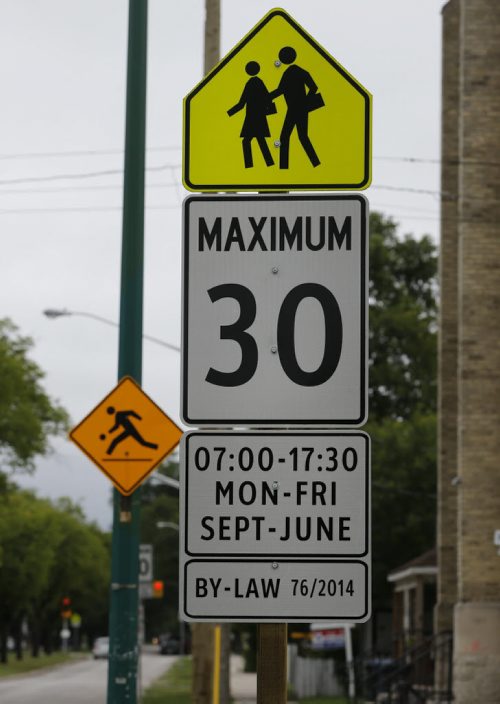
Now the focus is on whether the signage for the new 30-kilometre speed limit in school zones is properly recognized under the city bylaw authorizing enforcement.
The folks in the legislative library tell me the old 15-mile an hour limit was brought in by the province April 17, 1937 and put in force for the 1938 school year. It assessed a $5 fine for drivers caught speeding in a school zone when children were going to or leaving school during opening and closing hours, out for recess, or when the school grounds were in use by children.
The Highway Traffic Act section reads:
Notwithstanding anything contained in the preceding subsections hereof any person driving a motor vehicle upon a highway at a greater rate of speed than fifteen miles per hour when passing a school building, or the grounds thereof indicated by road signs, contiguous to the highway during school recess or while children are going to or leaving the school during the opening or closing hours, or while the playgrounds of the school are in use by school children, shall be deemed to be driving the motor vehicle in other than a careful and prident manner.
Drivers got this reminder in the Sept. 1, 1938 Winnipeg Free Press of the new law:
Speed Warning
Winnipeg motorists were warned by Traffic Inspector W.G. Capelle Wednesday that the 15-miles-per-hour speed limit in school zones will be rigidly enforced after school
opens Thursday.
He asked that all drivers obey the law when driving past schools while children are around and that they drive with caution in the vincity of schools before nine o’clock, at noon and after four o’clock.
In 1948, electric trolley buses, introduced a decade earlier, were legally considered to be a motor vehicle and also required to travel at 15 miles an hour through school and playground zones.
By the early 1950s, with more cars on the road in a growing city, the 15-mile an hour speed limit wasn’t as clear cut as when it was first imposed.
Confusion over when the limit was enforced by police–during school hours or not–and what signage with could actually posted under the province’s Highway Traffic Act about the speed limit became a concern.
From the May 7, 1953 Free Press: (Click on headline for full story)
Use Head And Brakes When Passing Schools
How do the enforcement officers, both provincial and city, interpret the act?
Inspector Robert Still, chief traffic enforcement officer in Winnipeg, says his force watches particularly during the 15 minutes before after school opens and closes, and during recess.
However, he adds that if the school ground is in heavy use at other times "it will pay you to watch your speed."
The RCMP regard the school zones in the same way and watch the same times at country points.
Both departments say, "Use common courtesy and your head, and you won’t get in trouble."
That seemed to be the general interpretation of the speed limit for the next decade, signs or not.
By the mid-60s, it was revisited again when the province launched a review of the Highway Traffic Act to bring it up to modern standards.
On Nov. 21, 1966 the 15-mile an hour speed limit was abolished and replaced by signs urging drivers to drive with "reasonable prudence."
Winnipeg School Board Trustees and the Winnipeg Free Press opposed the change saying it placed kids at unnecessary risk.
"The area of dissension appears to be centred on the hours during which the speed limit applies, the Free Press said in an Aug. 19, 1965 editorial. "Perhaps it would be foolish to expect a motorist to slow down to 15 miles an hour when he is passing a school at 4 o’clock in the morning.
"The solution would seem to be to have the times during which the limit applies clearly stated in the law and made plain to the motorists by signs. If there is no agreement on the hours, then the limit should be enforced at all times. Better to have to slow down for a few seconds in the middle of the night than to risk injuring a child in the middle of the day."
Winnipeg police supported abolition of the limit, saying the vast majority of drivers drive prudently around schools when kids are present, speed limit or not.
From an earlier Dec. 29, 1965 front page story in the Freep, one senior city police office described the school zone speed limit as "almost a trap."
Traffic Head Hits 15 m.p.h. Speed Limits
Inspector Clarke Calls School Zones ‘Almost A Trap’
"If children are on the street and not in the yard and if time regulations are not in effect, the children are not protected by the law."
"Thoughts are changing." he said. "It is no longer felt an arbitrary speed limit is necessarily a safe limit."
Any of this sound familar? Anyone?
In a follow up story, Nov. 28, 1966, Winnipeg Traffic Insp. D.A. Hicks said the elimination of the 15-mile-an-hour speed limit was sensible as it meant drivers would be more likely to obey the law even when there were no police officers around.

"Motorists will voluntarily comply with a sensible regulation," he said. "It will make for better motoring."
Amen.
bruce.owen@freepress.mb.ca
P.S. Thanks Rocky