

Abolish Indian Act prudently
Advertisement
Read this article for free:
or
Already have an account? Log in here »
To continue reading, please subscribe:
Monthly Digital Subscription
$1 per week for 24 weeks*
- Enjoy unlimited reading on winnipegfreepress.com
- Read the E-Edition, our digital replica newspaper
- Access News Break, our award-winning app
- Play interactive puzzles
*Billed as $4.00 plus GST every four weeks. After 24 weeks, price increases to the regular rate of $19.95 plus GST every four weeks. Offer available to new and qualified returning subscribers only. Cancel any time.
Monthly Digital Subscription
$4.99/week*
- Enjoy unlimited reading on winnipegfreepress.com
- Read the E-Edition, our digital replica newspaper
- Access News Break, our award-winning app
- Play interactive puzzles
*Billed as $19.95 plus GST every four weeks. Cancel any time.
To continue reading, please subscribe:
Add Free Press access to your Brandon Sun subscription for only an additional
$1 for the first 4 weeks*
- Enjoy unlimited reading on winnipegfreepress.com
- Read the E-Edition, our digital replica newspaper
- Access News Break, our award-winning app
- Play interactive puzzles
*Your next Brandon Sun subscription payment will increase by $1.00 and you will be charged $17.95 plus GST for four weeks. After four weeks, your payment will increase to $24.95 plus GST every four weeks.
Read unlimited articles for free today:
or
Already have an account? Log in here »
Hey there, time traveller!
This article was published 22/07/2010 (5768 days ago), so information in it may no longer be current.
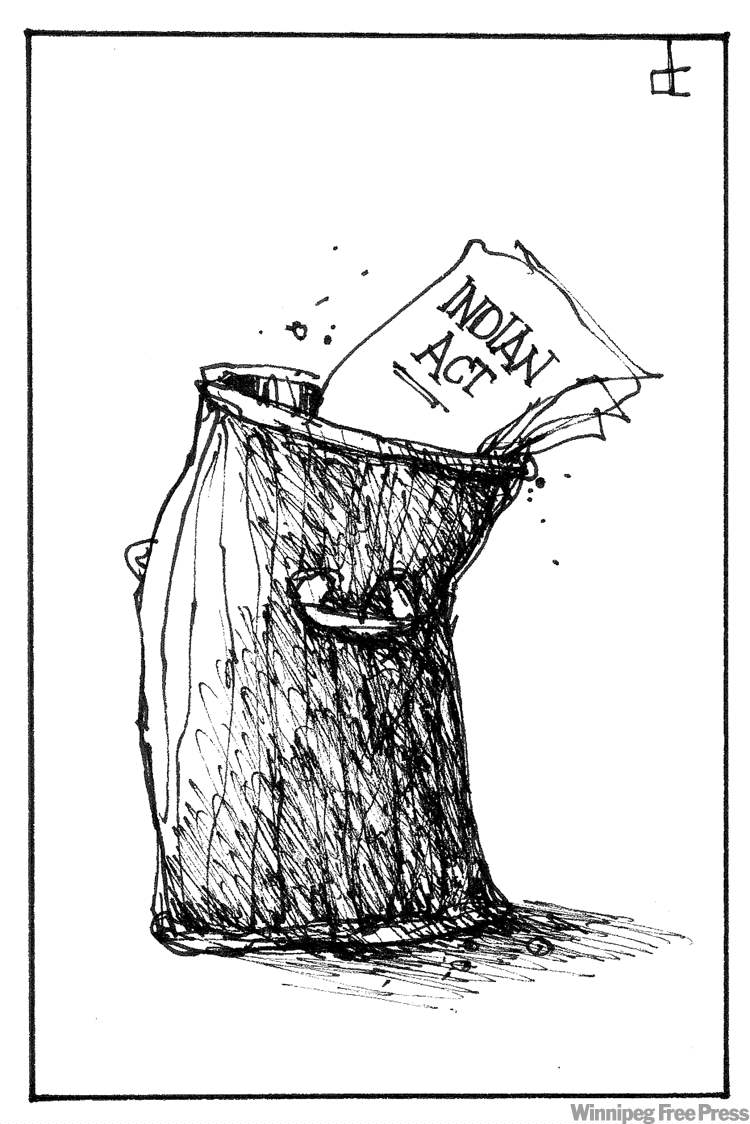
Shawn Atleo, national chief of the Assembly of First Nations, believes the Indian Act can be swept away as an historical anachronism within five years, launching a new, more legitimate relationship between Canada’s original people and the country. If only it could be done so quickly.
Few politicians in Canada would defend the Indian Act, an antiquated and paternalistic piece of legislation that is an affront to able government and the concept of an empowered electorate. The act is in constant flux as Canadian courts repeatedly find it is ill-suited to the modern, as well as historical, context of Canada’s relationship to First Nations. Federal governments continue to pressure band leaders to strengthen their accountability to band members, yet continue to administer the bands under an act that demands every band council resolution — effectively a bylaw — however minor, be approved by Ottawa. Mr. Atleo is quite right, the act must go.
But how? Mr. Atleo proposes a joint First Nations-federal working group would strike a plan on a process that would confirm aboriginal rights and titles, and preserve federal funding allowing for new transfer agreements. Band governments would be shepherded through necessary steps to strengthen their administrations. This, Mr. Atleo told the national gathering of chiefs in Winnipeg Tuesday, would eliminate the act, the Indian Affairs Department and the expensive bureaucracy it employs.
The right to self-government was confirmed by the federal government in the mid-1990s, amid a late 20th-century renewal of centuries-old recognitions by the Crown of aboriginal rights. And there is a model for the First Nations aspiration for self-government: In 2003, Westbank First Nation struck a self-government accord with Ottawa that effectively displaced the Indian Act’s power over it. Operating under its own constitution, the band remains broadly subject to federal law but it no longer needs the stamp of the Indian Affairs minister on every law or financial transaction it makes.
But self-government — the ability of an entity to run its own affairs — demands professional administration and a robust institutional infrastructure. While many of Canada’s 600-plus bands are capable, others — as Manitobans are too keenly aware — are small, profoundly economically depressed and dogged by social problems that make their reserves all but unviable. How will they spring, fully dressed, into sophisticated, self-governing bodies? Certainly not within Mr. Atleo’s time frame.

Mr. Atleo, in his speech, referred to the way the Indian Act has been used to oppress and assimilate First Nations people through the ages. He noted the last attempt was the 2002 Chrétien government’s failed First Nations Governance Act, which would have modernized governance on reserve. Chiefs across Canada rose up against the legislation. It is instructive to recall, however, that many reserve residents also rejected the act, out of fear it would transfer too much of Ottawa’s power over them to chiefs and councillors.
Many reserves have vastly improved their governance through the 1990s and since. Mr. Atleo’s challenge to relegate the Indian Act to history’s waste bin is welcome. It must be done with care, unhitched from a hard deadline, so First Nations people are left in a better place.