

Longer amber logical
Advertisement
Read this article for free:
or
Already have an account? Log in here »
To continue reading, please subscribe:
Digital Subscription
One year of digital access for only $1.44 a week*
- Enjoy unlimited reading on winnipegfreepress.com
- Read the E-Edition, our digital replica newspaper
- Access News Break, our award-winning app
- Play interactive puzzles
*Billed as $5.77 plus GST every four weeks. After 52 weeks, price increases to the regular rate of $19.95 plus GST every four weeks. Offer available to new and qualified returning subscribers only. Cancel any time.
To continue reading, please subscribe:
Add Free Press access to your Brandon Sun subscription for only an additional
$1 for the first 4 weeks*
- Enjoy unlimited reading on winnipegfreepress.com
- Read the E-Edition, our digital replica newspaper
- Access News Break, our award-winning app
- Play interactive puzzles
*Your next Brandon Sun subscription payment will increase by $1.00 and you will be charged $17.95 plus GST for four weeks. After four weeks, your payment will increase to $24.95 plus GST every four weeks.
Read unlimited articles for free today:
or
Already have an account? Log in here »
Hey there, time traveller!
This article was published 24/09/2010 (5870 days ago), so information in it may no longer be current.
Winnipeg police and Mayor Sam Katz were quick Thursday to defend the city’s red-light cameras as an efficient and effective means to improve safety. To be sure, at the corners where the cameras exist, motorists generally wise up and slow down.
Police data on the original 12 intersections where cameras were installed show the number of collisions reported to police — those where damage to vehicles is $1,000 or more — have fallen, although there is a slight increase in the number of rear-end collisions between 2002 and 2008. Similarly, injuries have fallen off, although the numbers are so small at each corner that the percentage in change looks dramatically high.
Manitoba Public Insurance’s data, which capture all accidents in which damage is reported, shows at those 12 intersections, accidents have risen by 18 per cent in the last five years. What that stark number doesn’t say, however, is whether red-light cameras played any role, although evidence exists that rear-end collisions rise with the installation of cameras because motorists panic on a yellow and slam on the brakes to the surprise of following cars. MPI’s summary tracks location of collision based on a motorist’s report, but its publicly reported data cannot be used to draw firm conclusions about whether the camera’s existence played any role.
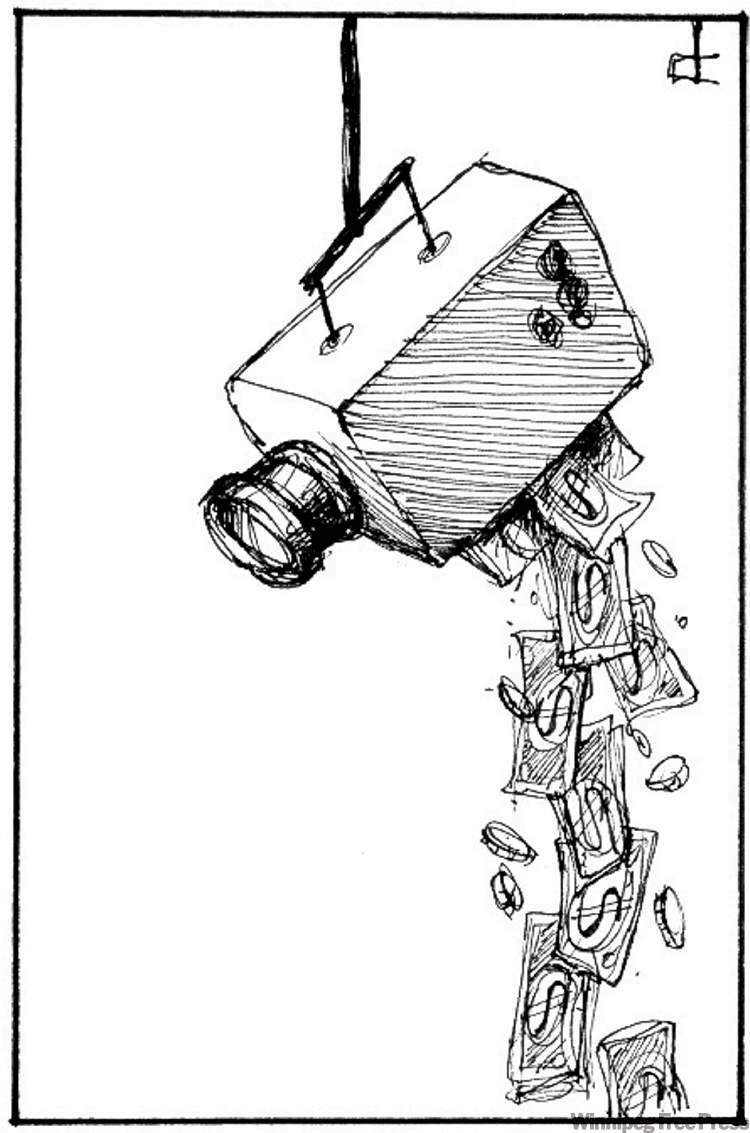
Into the morass of this polarized debate comes this abundantly reasonable suggestion: lengthen the duration of amber lights to give motorists more time to negotiate a safe crossing of an intersection. Winnipeg’s public works department, however, has decided all amber lights at the 617 signalled intersections should be of the same duration of 4.0 seconds. The logic in this is confounding. A residential intersection is easily traversed in that time for motorists driving at 50 kilometres per hour, a speed that allows for ample braking time as well; motorists travelling 70 km/h and approaching an amber at Bishop Grandin Boulevard and River Road face a real dilemma: hit the brakes or risk going in on a red and get a ticket.
While that is recognized widely, Winnipeg has instead decided to lengthen the time during which all lights are red at signalled intersections. That is logical — the length of the “all-red” duration varies depending on the characteristic of the crossing — except for the fact that when the larger intersection is also fixed with a red-light camera, inevitably more motorists will be nipped for red-light-running.
The four-second amber makes the city a target for accusations it is protecting its red-light camera revenue. Further, some believe the contract signed with ACS Public Sector Solutions prohibits altering the amber-light duration. That, says Sgt. Mark Hodgson of the traffic division, is not true. There is no clause pertaining to the amber light in the contract, he said.

Then the city is free to do what is abundantly reasonable and fair to motorists, which is to follow the example of other North American jurisdictions that have found safety is served by lengthening the amber-light times.
A length of four seconds for an amber light is a cookie-cutter response that does not meet the needs of drivers at intersections of varying design, on roads of different speeds. The city could discover the logic of that with a pilot project that extends the amber by a second or so, in select locations.
Related Articles
Speed cameras' safety value doesn't add up
Advertisement Advertise With Us
Advertisement Advertise With Us