

Politics and religion
Advertisement
Read this article for free:
or
Already have an account? Log in here »
To continue reading, please subscribe:
Monthly Digital Subscription
$1 per week for 24 weeks*
- Enjoy unlimited reading on winnipegfreepress.com
- Read the E-Edition, our digital replica newspaper
- Access News Break, our award-winning app
- Play interactive puzzles
*Billed as $4.00 plus GST every four weeks. After 24 weeks, price increases to the regular rate of $19.95 plus GST every four weeks. Offer available to new and qualified returning subscribers only. Cancel any time.
Monthly Digital Subscription
$4.99/week*
- Enjoy unlimited reading on winnipegfreepress.com
- Read the E-Edition, our digital replica newspaper
- Access News Break, our award-winning app
- Play interactive puzzles
*Billed as $19.95 plus GST every four weeks. Cancel any time.
To continue reading, please subscribe:
Add Free Press access to your Brandon Sun subscription for only an additional
$1 for the first 4 weeks*
*Your next subscription payment will increase by $1.00 and you will be charged $16.99 plus GST for four weeks. After four weeks, your payment will increase to $23.99 plus GST every four weeks.
Read unlimited articles for free today:
or
Already have an account? Log in here »
Hey there, time traveller!
This article was published 04/09/2012 (4969 days ago), so information in it may no longer be current.
Like John F. Kennedy before him, Republican presidential candidate Mitt Romney suggested to the American people Thursday night his particular brand of faith is not a threat.
President Kennedy, a Catholic, famously said he would not take directions from the church on matters of public policy, and that the Constitution guaranteed the separation of church and state. For his part, Mr. Romney shrugged off his Mormon faith, saying the fact it made him different than most Americans was no big deal.
He also made a point of saying he would guarantee freedom of religion, even though there was no obvious reason for him to make such an assurance other than polls that show some American Christians don’t like the Mormon religion.
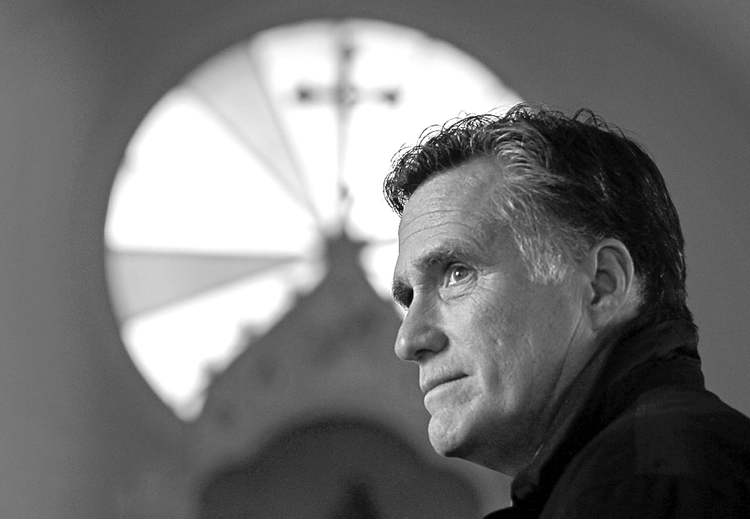
There was a certain irony about a U.S. leader feeling compelled to trumpet freedom of religion in order to appeal to the better instincts of those who might vote against him because of his religion.
American presidential candidates may not talk about their particular brand of faith, but they all establish their credentials as men of God and faith. And as if to advertise those core beliefs, every president since the Second World War, including Barack Obama, has invited evangelist Billy Graham to the White House for an audience.
Prayer breakfasts and spiritual gatherings are routine.
In Canada, politicians do not feel obliged to declare their religious affiliation and for the most part Canadians don’t seem to care if their leaders attend church or not.
It’s known that Prime Minister Stephen Harper was raised in the United Church before joining an evangelical church, but it’s never been a big issue, except among a few pundits who believe it’s evidence of a secret right-wing agenda.
When Mr. Harper finished a speech with “God bless Canada,” it caused a stir in the media because it sounded too American, but a subsequent poll found a majority of Canadians had no problem with it and they thought he should continue to use it.
Historically, Canadian Catholics, particularly the French-speaking variety, tended to support the Liberals, Protestants supported the Tories, while social gospel types and atheists backed the NDP, but those voting patterns don’t seem to be as strong anymore.
Today, most Canadian don’t even know the religious affiliations of their elected officials, or if they have one at all, but the question of religion and politics occasionally becomes an issue.

Stockwell Day was leader of the Canadian Alliance, a forerunner of the Conservative Party of Canada, when someone accused him of believing the world was only 6,000 years old and that people and dinosaurs co-existed. Mr. Day never commented on the issue, but a spokesman for the Alliance said the party believed all theories of creation should be taught alongside evolution.
More recently, B.C. Premier Christy Clark raised a few eyebrows when she appeared on a Christian TV show and said the Bible gives her courage and inspiration. In the United States, such a comment would have gone unnoticed because it is so common, but not in Canada, where high-profile politicians generally do not wear their religions on their sleeves.
In Canada, unlike the United States, there is a distaste for the extreme religious right, partly because it is associated with opposition to abortion and gay rights. It is seen as a negative force that divides people and encourages intolerance.
But there is also a religious left in Canada and the United States with strong views on current issues, yet no one accuses this group of causing divisions.
It’s regrettable that American politicians feel a need to pander to various religious constituencies, but the fact they do shows church and state are not completely separate. The relationship between pulpit and politician in Canada is far healthier, which is as it should be in a country where everyone is entitled to freedom of religion and conscience.