

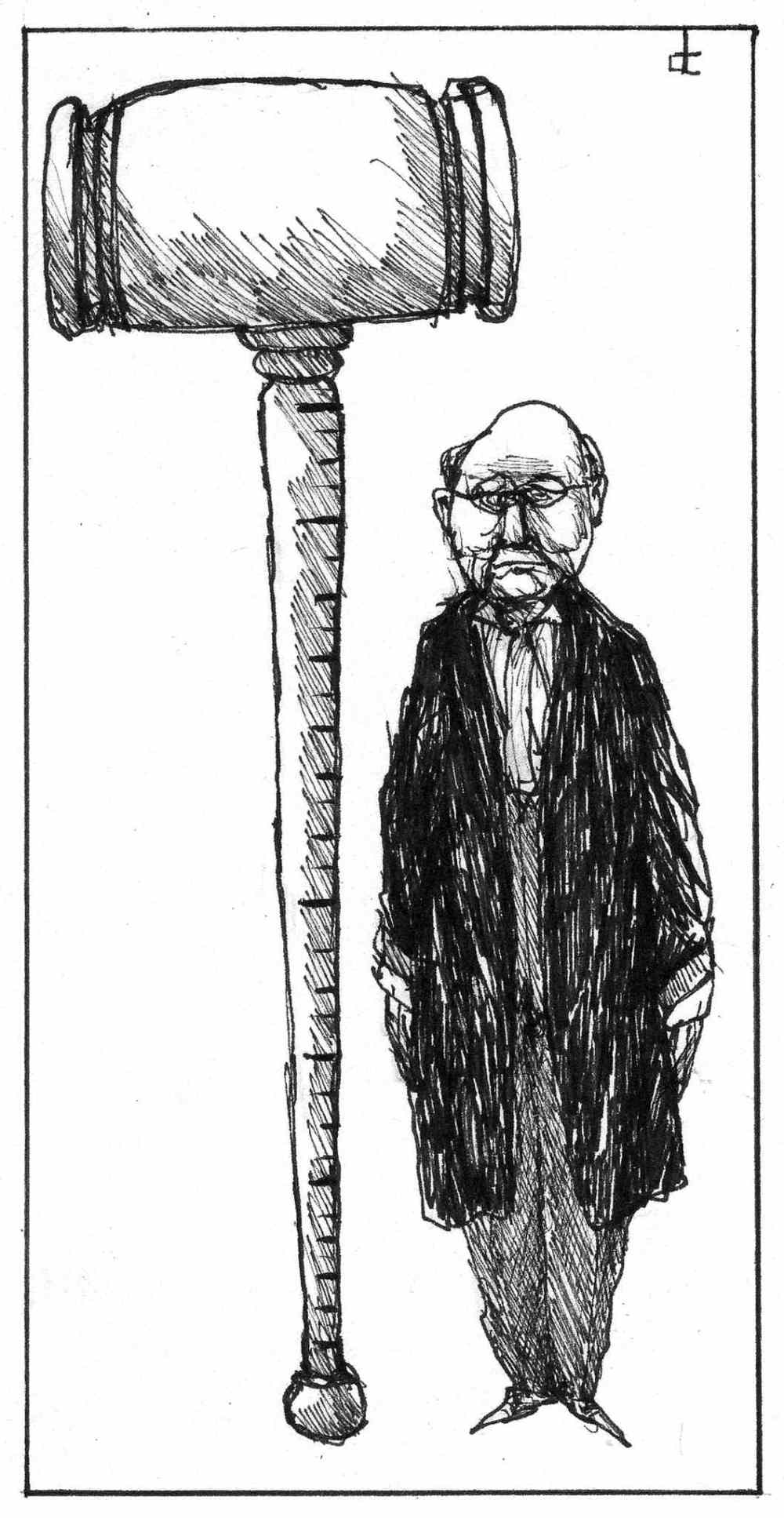
Prejudice affects all judges
Advertisement
Read this article for free:
or
Already have an account? Log in here »
To continue reading, please subscribe:
Digital Subscription
One year of digital access for only $1.44 a week*
- Enjoy unlimited reading on winnipegfreepress.com
- Read the E-Edition, our digital replica newspaper
- Access News Break, our award-winning app
- Play interactive puzzles
*Billed as $5.77 plus GST every four weeks. After 52 weeks, price increases to the regular rate of $19.95 plus GST every four weeks. Offer available to new and qualified returning subscribers only. Cancel any time.
To continue reading, please subscribe:
Add Free Press access to your Brandon Sun subscription for only an additional
$1 for the first 4 weeks*
- Enjoy unlimited reading on winnipegfreepress.com
- Read the E-Edition, our digital replica newspaper
- Access News Break, our award-winning app
- Play interactive puzzles
*Your next Brandon Sun subscription payment will increase by $1.00 and you will be charged $17.95 plus GST for four weeks. After four weeks, your payment will increase to $24.95 plus GST every four weeks.
Read unlimited articles for free today:
or
Already have an account? Log in here »
Hey there, time traveller!
This article was published 17/03/2014 (4462 days ago), so information in it may no longer be current.
The Canadian Superior Court Judges Association says judges “should be fair and open-minded, and should appear to be fair and open-minded.”
If that maxim was interpreted literally, however, it could theoretically disqualify many applicants for the job. That’s because most people, particularly lawyers, have strong opinions on some issues. You might even say their minds are closed on some subjects.
A Roman Catholic lawyer, for example, might oppose abortion and gay marriage, while another might support the legalization of marijuana and prostitution. Many prosecutors have argued for the narrowest interpretation of the Charter of Rights and Freedoms, while defence lawyers have taken the opposite view.
Crown attorneys and defence lawyers frequently express strong opinions, such as the prosecutor who once said a defendant in a relatively minor case should be “locked up and the key thrown away.”
Fortunately, most defendants aren’t aware of the prejudices of the people trying and judging their cases. If they were, the courts might be deluged with endless complaints from defendants with a reasonable apprehension of bias.
The opinions of politicians who become judges, of course, are well-known, but they are not necessarily obstacles to sitting on the bench.
Former Tory premier Sterling Lyon, for example, was appointed to the Manitoba Court of Appeal, even though he was famous for his caustic opinions on countless subjects. He was instrumental in the creation of the notwithstanding clause to ensure Parliament remained superior to the courts on Charter of Rights and Freedoms issues and opposed the then-NDP government’s plan to extend French-language services in the province as redress for past wrongs to the francophone community.
By all accounts, however, he was fair, thoughtful and open-minded on the bench.
The conduct of some sitting judges has also raised questions about their suitability.
Former Manitoba Court of Appeal chief justice Alfred Monnin, for example, ridiculed the jury system, a foundation of British justice. He said he doubted juries understood legal arguments and he referred to them as “12 jokers.” Complex cases, Justice Monnin said, should be tried by judges alone.
The recent appointment of Vic Toews to Manitoba’s Court of Queen’s Bench has again raised questions about whether politicians are suited to sit on the bench.
As a minister in Stephen Harper’s Conservative government, Mr. Toews was controversial on a wide range of legal issues. Federal Court judges even called him close-minded and unreasonable for ignoring evidence and disregarding the facts in cases involving Canadians jailed abroad.
Like all politicians, Mr. Toews had an agenda that was plain for all to see. His ministerial decisions, however, were subject to judicial review, while his party’s performance faced the judgment of the people every four years.
Mr. Toews’ opinions and agendas were supported by some Canadians, opposed by others, but his political career is over.

The question today is whether he will evaluate evidence in a fair and non-partisan manner.
Manitoba Law Society CEO Allan Fineblit has said Mr. Toews’ vast legal experience over the last 35 years will serve the community well, but inevitably some people will say his judgments were either too harsh, or not harsh enough.
Judges today are frequently criticized in the court of public opinion, but usually because they are too lenient on criminals.
The people, too, are entitled to their opinions and prejudices, but Mr. Toews will be expected to make rulings based on the best interpretation of the law. If he doesn’t do that, his judgments will be appealed and overturned.
Too many reversals would suggest he is not up to the task. Verdicts that withstand judicial scrutiny, however, would validate his appointment, regardless of whatever opinions or agendas he may still hold.