

Climate politics looking sunny
Advertisement
Read this article for free:
or
Already have an account? Log in here »
To continue reading, please subscribe:

Digital Subscription
One year of digital access for only $205*
- Enjoy unlimited reading on winnipegfreepress.com
- Read the E-Edition, our digital replica newspaper
- Access News Break, our award-winning app
- Play interactive puzzles
*First annual payment billed as $205.00 + GST for one year. This annual subscription will automatically renew at $233.00 + GST every 52 weeks (10% off the regular annual price of $259.35). Offer available to new and qualified returning subscribers only. Cancel any time.
To continue reading, please subscribe:
Add Free Press access to your Brandon Sun subscription for only an additional
$1 for the first 4 weeks*
- Enjoy unlimited reading on winnipegfreepress.com
- Read the E-Edition, our digital replica newspaper
- Access News Break, our award-winning app
- Play interactive puzzles
*Your next Brandon Sun subscription payment will increase by $1.00 and you will be charged $17.95 plus GST for four weeks. After four weeks, your payment will increase to $24.95 plus GST every four weeks.
Read unlimited articles for free today:
or
Already have an account? Log in here »
Hey there, time traveller!
This article was published 24/11/2015 (3971 days ago), so information in it may no longer be current.
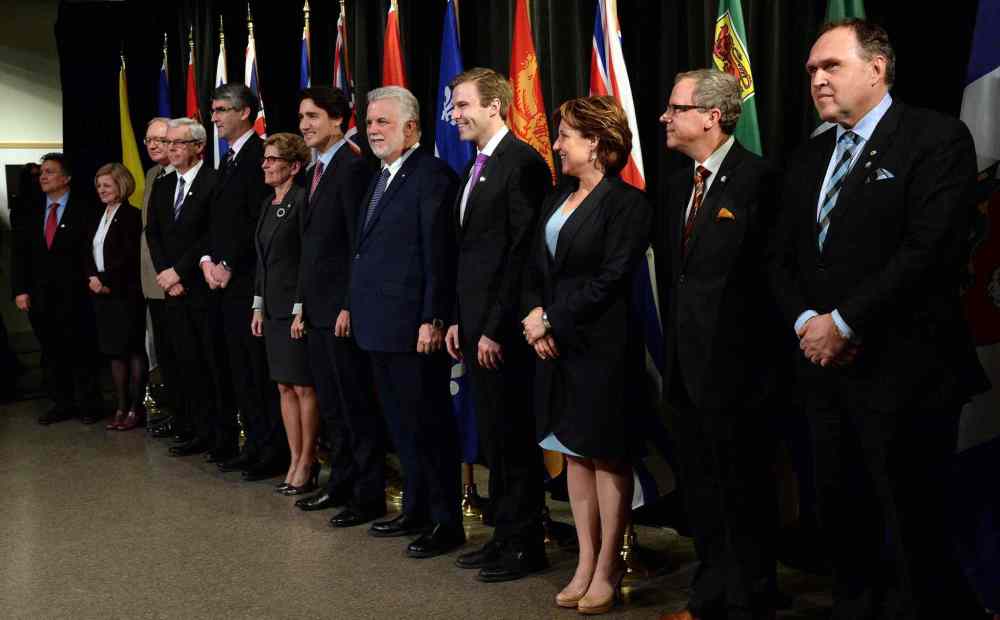
The election of Prime Minister Justin Trudeau’s Liberals seems to have ended the drought and ushered in an era of abundance in terms of willingness to tackle climate change.
It’s not that the provinces weren’t talking about the problem before. Ontario, B.C. and Quebec were moving ahead with strategies to reduce carbon emissions, while others, including Manitoba, were dilly-dallying with minor initiatives.
Today, however, the premiers are falling over themselves with promises to reduce emissions and fight climate change.
Alberta Premier Rachel Notley showed the sky won’t fall if the oil industry and the economy in general are forced to lower their emissions through carbon taxes and cap-and-trade regulations.
Oil executives even lined up behind her, saying the new environmental regime will position Alberta as a climate leader. Of course, it will also make it easier to sell that dirty oil once the price rebounds.
Ontario also announced a wide range of new measures Tuesday, promising to reduce emissions by 80 per cent over 1990 levels by 2050. In addition to a cap-and-trade system, the province will get more electric cars on the roads and change building codes to create more environmentally friendly buildings.
Premier Greg Selinger was more political, saying he won’t release Manitoba’s strategy until Dec. 3, the last day the legislature sits this year. He will then head to Paris with the other premiers for a climate conference in Paris.
Mr. Selinger did say the province would embrace a cap-and-trade system for major emitters, among other initiatives. He is opposed to a provincewide carbon tax.
It may be premature to judge his plans, but it will be interesting to see what has changed since 2010, when public consultations recommended against such a program because the province has only four large emitters.
In Manitoba, transportation accounts for 38 per cent of greenhouse gas (GHG) emissions, while agriculture is second at 30 per cent. The province clearly needs strategies for these sectors, too.
It’s obvious Mr. Trudeau’s leadership has made the difference between the lacklustre approach to climate change in the past and the enthusiastic response today.
Sunny days, however, could quickly give way to stormy weather.
So far, Mr. Trudeau has been content to let the provinces define how they will manage environmental issues. This makes sense, since most provinces are unique and have special strengths and weaknesses in combating climate change. One size does not fit all.
Mr. Trudeau, however, promised during the election campaign to provide national leadership, which included putting a price on carbon. He also wants national emissions-reduction targets.

It’s in these tricky areas the federal government may meet resistance from provincial leaders who are worried going too far too fast could cost jobs and hurt the economy.
Mr. Trudeau has promised federal cash to help with the adjustment, plus a $2-billion trust fund to “materially reduce carbon emissions under the new pan-Canadian framework.”
Somehow, all of this — the provincial plans plus federal targets — is supposed to come together within 90 days of the Paris climate conference.
It seems like a tall order, considering the country has made only minor progress on the file over the last 25 years, earning it an international reputation as a “climate laggard.”
For the first time, however, the country’s leaders seem united in their will to make real progress. Such determination, in fact, has always been the missing link in the path to success.
Related Articles
Hugging PM greets premiers with open arms
Advertisement Advertise With Us
Advertisement Advertise With Us