

No need for Uber to put it in park
Advertisement
Read this article for free:
or
Already have an account? Log in here »
To continue reading, please subscribe:

Digital Subscription
One year of digital access for only $205*
- Enjoy unlimited reading on winnipegfreepress.com
- Read the E-Edition, our digital replica newspaper
- Access News Break, our award-winning app
- Play interactive puzzles
*First annual payment billed as $205.00 + GST for one year. This annual subscription will automatically renew at $233.00 + GST every 52 weeks (10% off the regular annual price of $259.35). Offer available to new and qualified returning subscribers only. Cancel any time.
To continue reading, please subscribe:
Add Free Press access to your Brandon Sun subscription for only an additional
$1 for the first 4 weeks*
- Enjoy unlimited reading on winnipegfreepress.com
- Read the E-Edition, our digital replica newspaper
- Access News Break, our award-winning app
- Play interactive puzzles
*Your next Brandon Sun subscription payment will increase by $1.00 and you will be charged $17.95 plus GST for four weeks. After four weeks, your payment will increase to $24.95 plus GST every four weeks.
Read unlimited articles for free today:
or
Already have an account? Log in here »
Hey there, time traveller!
This article was published 13/01/2018 (3197 days ago), so information in it may no longer be current.
Is that the sound of screeching tires we just heard? Clearly, somebody slammed on the brakes.
As it turns out, the heavy foot on the “stop” pedal belongs to the ride-hailing service Uber, which declared this week that its arrival here is on hold because of Manitoba Public Insurance’s (MPI) proposal to require Uber drivers to obtain special vehicle insurance.
“Uber will find it difficult, from a risk and compliance perspective, to do business in Manitoba,” the company wrote in a submission to the Public Utilities Board. “We feel that this will be detrimental to the citizens of Manitoba who are seeking efficient, safe transportation.”
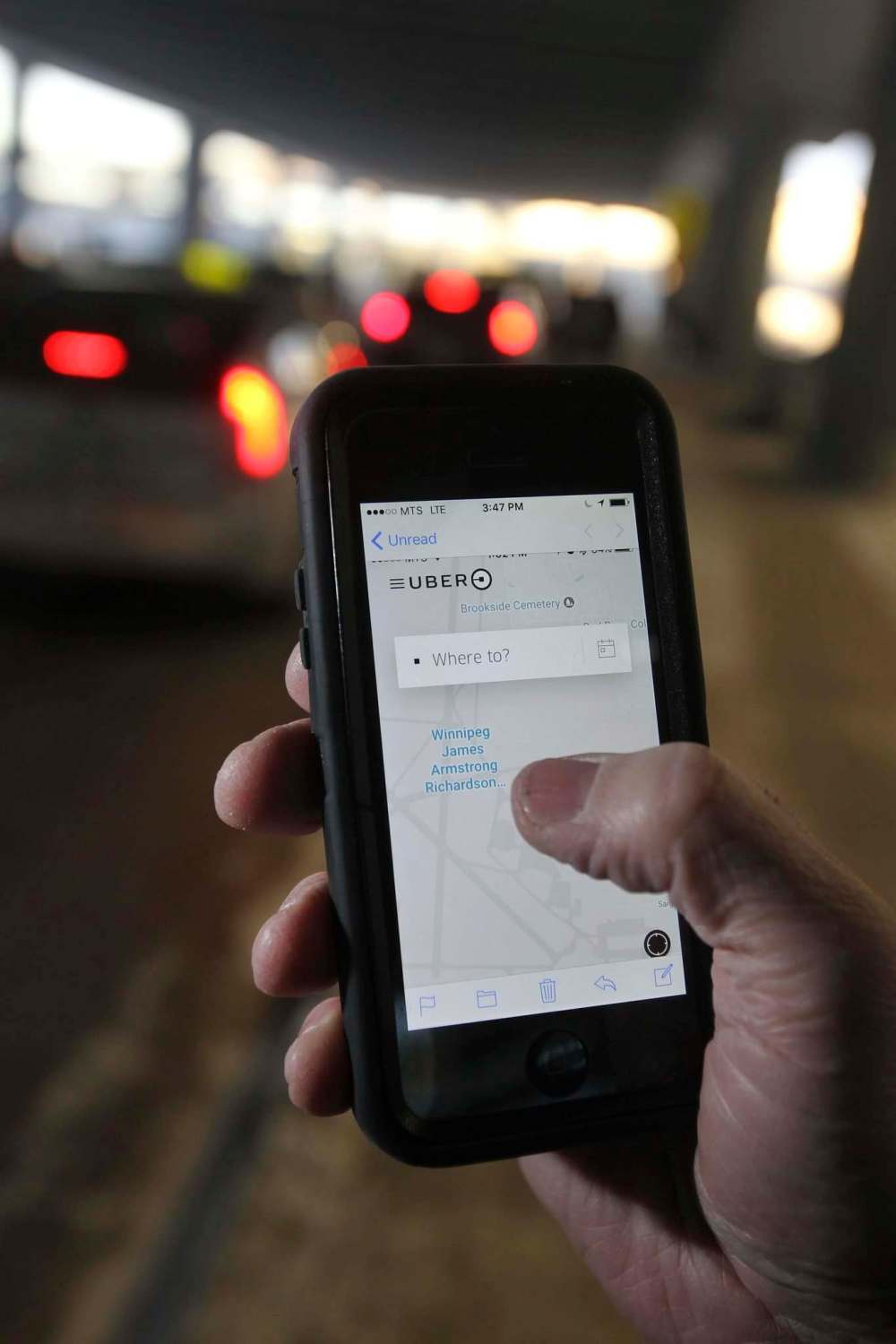
The issue is the public insurer’s suggestion that Uber drivers should have to purchase special coverage in a newly created insurance category.
The plan would be priced according to four “time bands” — weekdays, evenings, overnight or weekends — during which the driver might choose to work as an Uber provider.
According to MPI, Uber drivers could pay for one band, various combinations of them or all four.
The proposal shifted Uber’s Manitoban expansion plans into neutral. The company’s preference involves Uber buying its own blanket insurance plan, which would cover all drivers who choose to ferry passengers in the ride-hailing format.
Simply put, this misunderstanding shouldn’t make anyone take the keys out of the ignition and walk away.
It’s a solvable problem. Ride-hailing services have — albeit not without struggles, stress and protest — managed to work their way through vehicle-insurance bureaucracy in more than 600 cities worldwide.
Manitoba is unique in that it’s probably one of the few jurisdictions in which Uber must contend with a single vehicle-insuring entity. And MPI’s proposal suggests a limited grasp of the nature of ride-hailing drivers’ involvement. By proposing Uber drivers choose regular “shifts” they’re going to work, MPI reveals that it doesn’t understand that Uber drivers ply their trade at odd and irregular hours.
Ride-hailing drivers don’t work only weekdays, only overnights or only weekends. The nature of the undertaking is that they’ll work when they have time or when they feel like working.
In Ontario and Alberta, which have private auto insurance, a compromise solution involves a digital interface with the ride-hailing app that allows drivers to pay for extended coverage only when they’re transporting customers.

Manitoba’s problem could probably be solved — or, at least, pushed closer to a resolution — by MPI simplifying the ride-hailing insurance category to a single additional-coverage cost or by implementing a more technologically complex part-time coverage. For its part, Uber needs to adjust its expectations; its blanket-coverage demand suggests it needs a better understanding of the peculiarities of Crown-monopoly insurance jurisdictions.
In British Columbia — another province with a Crown-corporation monopoly, the Insurance Corporation of British Columbia (ICBC) — an all-party committee held public hearings this week on ride-hailing’s potential arrival.
There, as well, Uber is pursuing a blanket-coverage arrangement in which, according to a company spokesman, “Uber would purchase insurance from ICBC that would cover every trip from when the driver accepts a trip request to when they drop off the last passenger.”
On the coast, as on the Prairies, ride-hailing’s arrival is essentially a foregone conclusion.
What’s required is for both sides to reconsider the unique challenges posed by digital-age for-hire transport in single-insurer markets in a way that allows Uber to ease off the brakes and step back on the accelerator.