

Plural pronoun poses singular problem
Advertisement
Read this article for free:
or
Already have an account? Log in here »
To continue reading, please subscribe:
Monthly Digital Subscription
$1 per week for 24 weeks*
- Enjoy unlimited reading on winnipegfreepress.com
- Read the E-Edition, our digital replica newspaper
- Access News Break, our award-winning app
- Play interactive puzzles
*Billed as $4.00 plus GST every four weeks. After 24 weeks, price increases to the regular rate of $19.95 plus GST every four weeks. Offer available to new and qualified returning subscribers only. Cancel any time.
Monthly Digital Subscription
$4.99/week*
- Enjoy unlimited reading on winnipegfreepress.com
- Read the E-Edition, our digital replica newspaper
- Access News Break, our award-winning app
- Play interactive puzzles
*Billed as $19.95 plus GST every four weeks. Cancel any time.
To continue reading, please subscribe:
Add Free Press access to your Brandon Sun subscription for only an additional
$1 for the first 4 weeks*
*Your next subscription payment will increase by $1.00 and you will be charged $16.99 plus GST for four weeks. After four weeks, your payment will increase to $23.99 plus GST every four weeks.
Read unlimited articles for free today:
or
Already have an account? Log in here »
Hey there, time traveller!
This article was published 30/12/2019 (2289 days ago), so information in it may no longer be current.
These days, it seems, the word “they” poses a singular problem.
Recently chosen by Merriam-Webster dictionary as the “Word of the Year” (indicating it was one of the most-searched-for definitions), “they” as a pronoun meaning a single person without specifying gender is sparking questions. Is it good grammar? Is it proper? Is it right?
As any linguist knows, those are questions with different meanings.
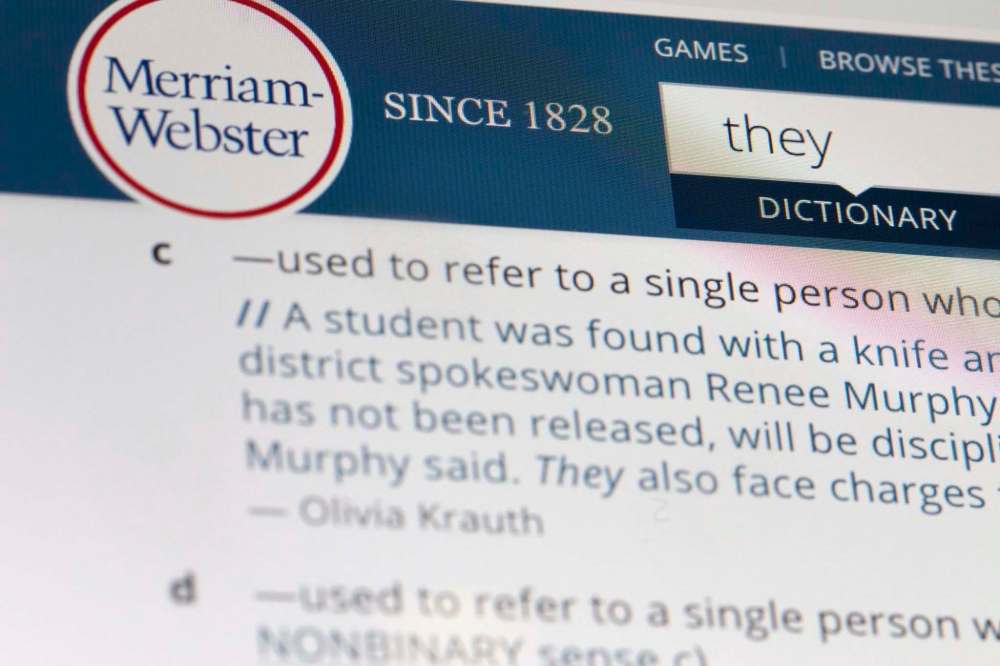
“They” can certainly be used as a singular pronoun, and it has been used that way since at least 1375, according to the Oxford English Dictionary, the gold standard for definitions showing the past and present usage of English words.
In fact, it was only Latin-loving grammarians in the 18th century who began frowning on the use of “they” in this fashion, advising English speakers to use “he,” “him” or “his” as a default pronoun instead, as in “Everyone should do his best.”
(Latin, unlike English, has three grammatical genders — masculine, feminine and neuter. Choosing the masculine pronoun as the default in English was necessarily exclusionary.)
English speakers have also been using the singular “you” for centuries, having discarded “thou/thee/thy” (despite similar exhortations in the 17th century against the change). There’s also the editorial and the royal “we,” in which the plural pronoun is used as a singular, and somehow, er, we can do that as well, without the world ending.
Suffice it to say, then, that there’s nothing grammatically incorrect with a sentence like “Everyone should do their best.”
But grammar is not the same as style, and the singular “they” is accepted (or not) depending on the conventions one follows. The American Psychological Association has adopted it as correct for scholarly writing, as has the Chicago Manual of Style.
On the other hand, following a suggestion at the University of Tennessee that teachers ask students their preferred pronouns, in 2016 the state legislature passed a law banning the use of taxpayer dollars for gender-neutral pronouns. (“Despite,” as linguistics professor Dennis Baron points out on the Oxford University Press blog, “the fact that no one knows how much a pronoun actually costs.”)

The increasing acceptance of the usage in day-to-day publication is reflected in the 2017 decision by The Associated Press to add the singular “they” to its stylebook. Paula Froke, the stylebook’s lead editor, told the Washington Post (which itself embraced the usage in 2015) the decision reflects “recognition that the spoken language uses ‘they’ as singular and we also recognize the need for a pronoun for people who don’t identify as a he or a she.”
The Winnipeg Free Press follows The Canadian Press style, which allows the singular they (with an explanation), but generally prefers to repeat the person’s proper name, instead of using pronouns, to avoid confusion. So as to whether it’s proper, check your style guide.
Threadbare linguistic arguments aside, there is the remaining question: is it right?
That depends on whether one feels it’s right to listen to another person and address them as they wish to be addressed. The singular “they/them” is a pronoun that many non-binary people use. Just as we might ask a person how to pronounce their name, or address someone as “Doctor” or “Reverend,” it’s a matter of respect to use “they/them” if that’s what the person wishes.
Language evolves through our usage of it. If we’re serious about untangling the unconscious sexism in a default “he,” and according non-binary people the basic dignity of a pronoun, we should give serious consideration to our personal pronoun choices.