

New theory induces re-examination of traffic flow
Advertisement
Read this article for free:
or
Already have an account? Log in here »
To continue reading, please subscribe:

Digital Subscription
One year of digital access for only $205*
- Enjoy unlimited reading on winnipegfreepress.com
- Read the E-Edition, our digital replica newspaper
- Access News Break, our award-winning app
- Play interactive puzzles
*First annual payment billed as $205.00 + GST for one year. This annual subscription will automatically renew at $233.00 + GST every 52 weeks (10% off the regular annual price of $259.35). Offer available to new and qualified returning subscribers only. Cancel any time.
To continue reading, please subscribe:
Add Free Press access to your Brandon Sun subscription for only an additional
$1 for the first 4 weeks*
- Enjoy unlimited reading on winnipegfreepress.com
- Read the E-Edition, our digital replica newspaper
- Access News Break, our award-winning app
- Play interactive puzzles
*Your next Brandon Sun subscription payment will increase by $1.00 and you will be charged $17.95 plus GST for four weeks. After four weeks, your payment will increase to $24.95 plus GST every four weeks.
Read unlimited articles for free today:
or
Already have an account? Log in here »
Hey there, time traveller!
This article was published 03/10/2020 (2158 days ago), so information in it may no longer be current.
Winnipeg administrators are preparing a report on a controversial transportation theory that, if put into practice, would likely have environmentalists pumping their fists with jubilation.
It’s called induced transportation demand, which is planner-speak for the counterintuitive idea that when a city adds more lanes or builds more roads, it actually worsens traffic congestion.
How can that be? Common sense suggests the opposite — that adding lanes and roads relieves congestion by increasing capacity. That’s why Winnipeg aims to widen Kenaston Boulevard and build the 10-kilometre long Chief Peguis Trail extension, among other expensive road projects.
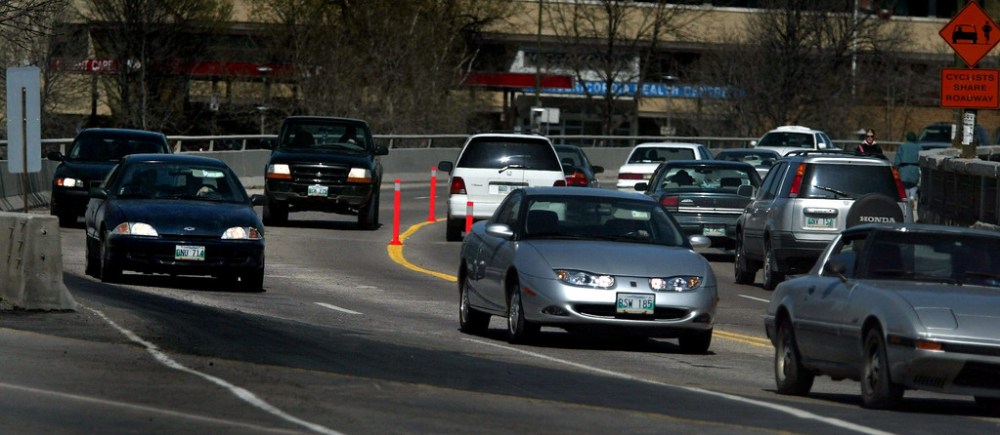
But the theory of induced demand, which has been backed by data in several reputable studies, is that increasing roadway capacity encourages people to drive more. Build more kilometres of lanes, more kilometres will be driven.
In the unlikely event that this theory would ever be allowed to fully dictate Winnipeg’s transportation priorities, it would do nothing less than revamp the city’s notion of how Winnipeggers will move around in the future.
One reason for the suprising conclusion of induced demand is that better roads attract people who previously found transportation alternatives because they didn’t like congested traffic. Once the routes were enlarged, these people drove their own vehicles instead of taking transit, cycling, carpooling or working from home.
A second reason expanding roadways actually adds congestion is that people feel more free to move a longer distance away from their work and commute, which lessens the demand for infill housing in cities like Winnipeg.
Coun. Matt Allard, chairman of the public works committee, successfully steered a motion through a Sept. 16 meeting calling for the city to analyze the concept of induced demand and recommend how it could be added to Winnipeg’s master transportation plan. Administrators have six months to report back.
Induced demand has been accepted by many city planners, but it has also been challenged by skeptics. Elon Musk, the U.S. billionaire behind Tesla, tweeted in December about induced demand: “It is one of the most irrational theories I’ve ever heard. Correlation is not causation.”
Not that it would bother a self-confident pontificator like Musk, but his views are not shared by an advocacy group called Transportation for America, which last March issued a report called The Congestion Con, which suggested: “We have added 30,511 new freeway lane-miles of road in the largest 100 urbanized areas in the U.S. between 1993 and 2017, an increase of 42 per cent… yet ‘congestion has grown by a staggering 144 per cent’ due to ‘induced demand.’”
The report recommends the U.S. should stop building new roads and instead “bring jobs, housing, and other destinations closer together.”
You need not be a soothsayer to predict that, in a city with a strong car culture like Winnipeg’s, any suggestion to “stop building new roads” would not be universally cheered.
“If recognized, induced transportation does flip everything on its head,” said Allard, the councillor who gets the credit — or the blame, depending on your view — for pushing the city to rethink its master transportation plan through the lens of induced demand.
His argument is partly financial. There are better places to spend the money it would take Winnipeg to continue to widen roads, build underpasses and spread out as a city. It’s hard to disagree with him, considering Winnipeg currently lacks full funding for its sewage treatment plan, improvements to its transit system, long-overdue maintenance of infrastructure — including roads that already exist — and growing financial obligations due to COVID-19.
Another part of his argument is the green factor. When we drive less, it’s good for the environment. Allard is lobbying council to permanently add seasonal active-transportation routes to 15 streets.
If the city committed fully to the implications of induced demand, a fraction of the money not spent on roadway expansion could be spent on a first-class network of walkways, cycling paths and public transit. As well, infill development would benefit if the city was disinclined to build and expand roads to new housing developments on the city outskirts.

Allard doesn’t expect an immediate, ardent conversion to the induced-demand doctrine. Rather, he says he’s chosen the “softer approach” of getting the concept recognized in the city’s traffic master plan. And then, let the discussion begin.
He recognizes that to change Winnipeg’s entrenched thinking about transportation, he has a long road ahead of him. Or, perhaps it’s more fitting to say he has a long walking and cycling path ahead of him.
— with files from Sarah Lawrynuik
carl.degurse@freepress.mb.ca
Carl DeGurse is a member of the Free Press editorial board.