

Signposts on the road to reconciliation
Advertisement
Read this article for free:
or
Already have an account? Log in here »
To continue reading, please subscribe:

Digital Subscription
One year of digital access for only $205*
- Enjoy unlimited reading on winnipegfreepress.com
- Read the E-Edition, our digital replica newspaper
- Access News Break, our award-winning app
- Play interactive puzzles
*First annual payment billed as $205.00 + GST for one year. This annual subscription will automatically renew at $233.00 + GST every 52 weeks (10% off the regular annual price of $259.35). Offer available to new and qualified returning subscribers only. Cancel any time.
To continue reading, please subscribe:
Add Free Press access to your Brandon Sun subscription for only an additional
$1 for the first 4 weeks*
- Enjoy unlimited reading on winnipegfreepress.com
- Read the E-Edition, our digital replica newspaper
- Access News Break, our award-winning app
- Play interactive puzzles
*Your next Brandon Sun subscription payment will increase by $1.00 and you will be charged $17.95 plus GST for four weeks. After four weeks, your payment will increase to $24.95 plus GST every four weeks.
Read unlimited articles for free today:
or
Already have an account? Log in here »
Hey there, time traveller!
This article was published 10/10/2022 (1433 days ago), so information in it may no longer be current.
Motorists on Saskatchewan’s busy Highway 11 will see new signage, welcoming them to Treaty 6, if they are travelling north, or Treaty 4, if they are travelling south. The signs are emblazoned with an image of a treaty medal, a greeting in an Indigenous language specific to the respective treaty area, and this phrase: “as long as the sun shines, grass grows and rivers flow.”
That is the language of the original treaties, indicating how long they will remain valid. To see those words in a high-traffic area, on a 1.5 by 3.6 metre sign, is not only an acknowledgment of the traditional land this highway traverses, but a hyper-visible reminder of the constitutionally recognized agreements between Indigenous people and the Crown and the original spirit in which they were created.
Installed at the end of September, the signs make Saskatchewan the first province in Canada to mark a treaty boundary in this manner. Other provinces with treaty territories would do well to take a cue from the land of the living skies to ensure Saskatchewan is not the only province to do so.
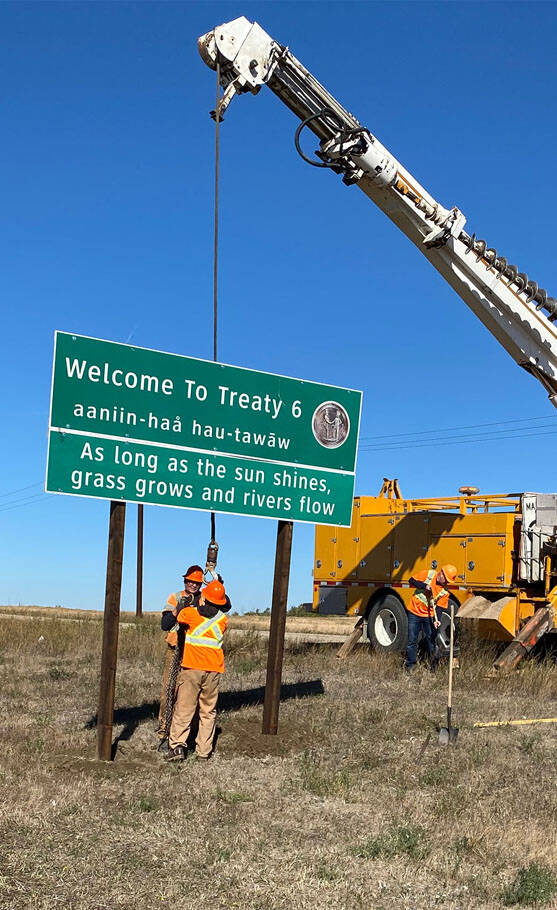
Government of Saskatchewan image
Workers install a sign on Highway 11.
The numbered treaties, a series of 11 treaties established between 1871 and 1921, span a vast area from northern Ontario to the Rocky Mountains in Alberta, spreading up into northern B.C. and the Northwest Territories. Treaty 1 — where Winnipeg is located — shares boundaries with Treaty 3 to the east, Treaty 2 to the west, and a sliver of Treaty 5 to the north. Erecting similar signs in Manitoba is a small but significant action our government could take.
Recognizing treaty territories and the Indigenous land on which Canadians are settled has become more mainstream by way of the kinds of land acknowledgments heard at public events. But while more Canadians may now know which treaty territory they live on, many still do not know — or were never taught — the history of those treaties nor their relevance today, which means they also may not be aware of all the ways in which they’ve been violated and broken.
The Crown has long failed to honour its treaty obligations. Instead of sharing land and resources equitably, Indigenous people were and continue to be marginalized — via the passing of assimilation policies such as the Indian Act and the advent of residential schools, but also through the exploitation and extraction of natural resources without proper consultation from Indigenous nations, or the wrongful prosecution of Indigenous hunters and fishers.
Correcting that gap in knowledge may be a lot to ask of a highway sign. But as Saskatchewan Treaty Commissioner Mary Culbertson has said, it is an educational tool. “And when we’re all educated, we have less ignorance,” she said in a recent interview. “Less ignorance leads to a little less racism.”

While it’s a small step, Saskatchewan’s new highway signs make visible what has, for too long, been rendered invisible — not just treaty territories, but Indigenous languages, as well. They have the power to spark both curiosity and pride.
This work, of course, can’t begin and end with mere acknowledgment. But the long and winding road to reconciliation can benefit from as many signposts — literal and figurative — as possible. After all, as long as the sun shines, grass grows and rivers flow, we are all treaty people.