Highway repair will take long-term commitment
Advertisement
Read this article for free:
or
Already have an account? Log in here »
To continue reading, please subscribe:

Digital Subscription
One year of digital access for only $205*
- Enjoy unlimited reading on winnipegfreepress.com
- Read the E-Edition, our digital replica newspaper
- Access News Break, our award-winning app
- Play interactive puzzles
*First annual payment billed as $205.00 + GST for one year. This annual subscription will automatically renew at $233.00 + GST every 52 weeks (10% off the regular annual price of $259.35). Offer available to new and qualified returning subscribers only. Cancel any time.
To continue reading, please subscribe:
Add Free Press access to your Brandon Sun subscription for only an additional
$1 for the first 4 weeks*
- Enjoy unlimited reading on winnipegfreepress.com
- Read the E-Edition, our digital replica newspaper
- Access News Break, our award-winning app
- Play interactive puzzles
*Your next Brandon Sun subscription payment will increase by $1.00 and you will be charged $17.95 plus GST for four weeks. After four weeks, your payment will increase to $24.95 plus GST every four weeks.
Read unlimited articles for free today:
or
Already have an account? Log in here »
Hey there, time traveller!
This article was published 17/04/2023 (1265 days ago), so information in it may no longer be current.
If Manitoba-born rocker Tom Cochrane is correct, and life is indeed a highway, then Highway 75 needs to be in an intensive-care unit.
It’s in stable condition, but that’s part of the problem, because the 110-kilometre, four-lane route that connects Winnipeg with the U.S. border at Pembina, N.D., has been in awful shape for years.
Successive Manitoba governments have promised multimillion-dollar improvements, but the pavement-crumbling effects of spring thaws are far more consistent than funding from those seeking to gain political mileage.
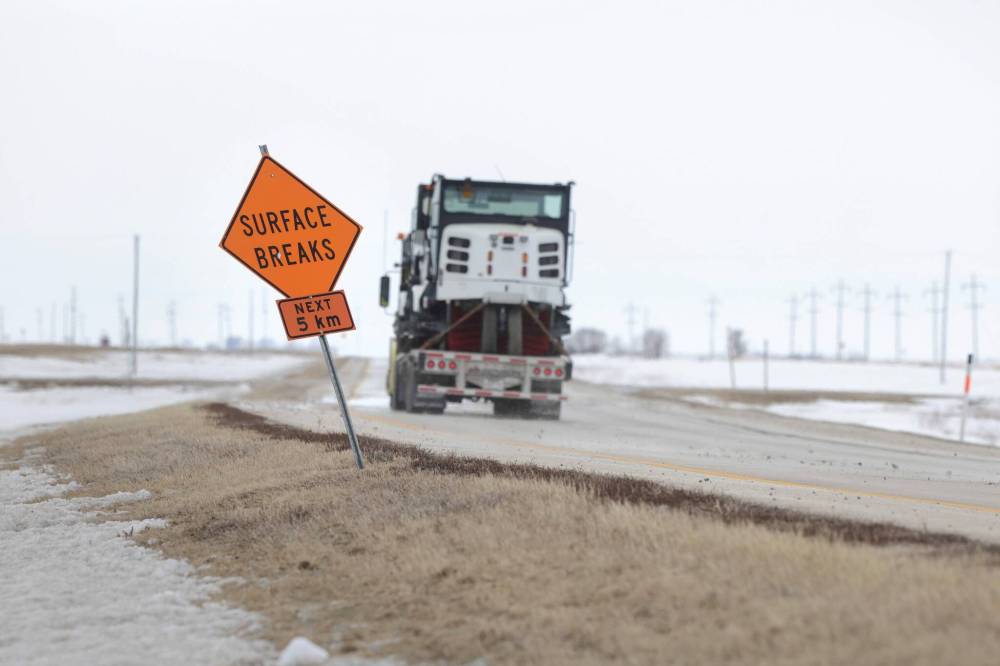
RUTH BONNEVILLE / WINNIPEG FREE PRESS/FILES Highway 75 , south of Ste. Agathe, heading to Morris. April 4th, 2023
RUTH BONNEVILLE / WINNIPEG FREE PRESS FILES
Highway 75, south of Ste. Agathe, heading to Morris.
The latest promise came April 4, when Doyle Piwniuk, Manitoba’s transportation and infrastructure minister, announced the province would soon award contracts to rebuild a 27-kilometre stretch to an interstate-like standard between Ste. Agathe and Morris, with work to finish by Oct. 31.
As motorists know all too well — especially those who’ve been stranded after potholes and highway cracks shredded their vehicles’ tires — Highway 75 pales in comparison to I-29, the road’s name after it enters North Dakota.
In 2013, Greg Selinger, who was premier when the NDP was last in power, issued promises similar to those recently issued by Mr. Piwniuk, pledging Highway 75 would drive like a U.S. interstate after an announced four-year, $215-million makeover that would also keep Red River flooding from closing the road unless the river rises to levels reached during 1997’s catastrophic flood.
Neither has come true. Flooding continues to close portions of the highway, including a month-long period in May 2022 near Morris. And the highway is more treacherous than ever, if an incident that happened Feb. 9 is any indication.
That’s when, according to a report in the Steinbach Carillon, a tractor-trailer driven by Eddie Friesen was passed by another semi, which kicked up a 1.3-kilogram chunk of the road and propelled it through Mr. Friesen’s windshield.
It struck Mr. Friesen’s head, crushing his eye socket and cheekbone, breaking his nose and the upper part of his jaw. He’s also recovering from a brain bleed and a severe concussion, and while he said he can see through his injured eye when he opens his swollen eyelids with his fingers, it’s unclear how his vision will be in the future after surgery.
Mr. Friesen’s experience is just the latest warning bell for those who live and travel along the road. Many have chosen to travel kilometres out of their way to avoid using Highway 75 this spring, especially at night, when it’s more difficult to notice dangerous debris or cracks in the road.

Those who demand Highway 75 to be quickly transformed from its crumbling state to an interstate standard need to click on their figurative high-beams and look at the bigger picture.
The money Manitoba and the federal government spend on roads such as Highway 75 comes nowhere close to how much U.S. federal and state governments choose to spend on that country’s interstate system.
The new Bipartisan Infrastructure Law, which was passed last November by the U.S. Congress, will deliver more than US$778 million to North Dakota for roads, bridges and roadway safety, on top of cash already available through trust funds dedicated to interstate highways.
While the commitment to repair the 27-kilometre stretch of Highway 75 this summer is welcome, the road’s state is a product of two forms of erosion: physical forces that chisel away at roadbeds, and austerity budgets that scrape funds away from maintaining them.
There is no quick fix for Highway 75. The province must do the work required to make it safe for travellers before offering another round promises it is unlikely to keep.