

Smoke, fire and the climate
Advertisement
Read this article for free:
or
Already have an account? Log in here »
To continue reading, please subscribe:

Digital Subscription
One year of digital access for only $205*
- Enjoy unlimited reading on winnipegfreepress.com
- Read the E-Edition, our digital replica newspaper
- Access News Break, our award-winning app
- Play interactive puzzles
*First annual payment billed as $205.00 + GST for one year. This annual subscription will automatically renew at $233.00 + GST every 52 weeks (10% off the regular annual price of $259.35). Offer available to new and qualified returning subscribers only. Cancel any time.
To continue reading, please subscribe:
Add Free Press access to your Brandon Sun subscription for only an additional
$1 for the first 4 weeks*
- Enjoy unlimited reading on winnipegfreepress.com
- Read the E-Edition, our digital replica newspaper
- Access News Break, our award-winning app
- Play interactive puzzles
*Your next Brandon Sun subscription payment will increase by $1.00 and you will be charged $17.95 plus GST for four weeks. After four weeks, your payment will increase to $24.95 plus GST every four weeks.
Read unlimited articles for free today:
or
Already have an account? Log in here »
Hey there, time traveller!
This article was published 19/06/2023 (1155 days ago), so information in it may no longer be current.
North Americans are understandably concerned by the increasing frequency with which we look around and see our world enshrouded by a hazy orange sky.
On the surface, the waves of wildfire smoke choking skies across the continent — federal data showed 186 “uncontrolled” wildfires in Canada as of June 7 in addition to those contained, controlled or otherwise responded to — have a clear cause: climate change. Warming temperatures and drier seasons are making wildfires easier to spark, quicker to spread and harder to contain.
This is partly true. But wildfires are, climate change or not, part of an ecosystem’s natural cycle. The burning of old growth makes way for new plant life to sprout, renewing aged landscapes. Even without the effects of climate change at play, wildfires would still occur.
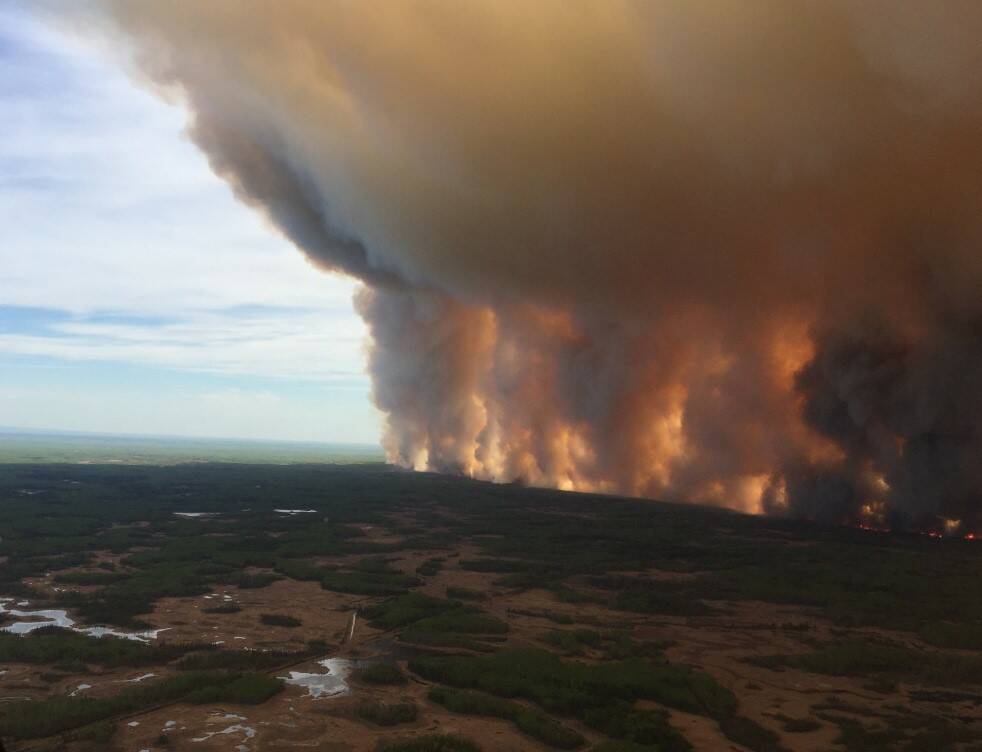
THE CANADIAN PRESS/HO, Twitter, @AlbertaWildfire
Forest fires are changing, and so are their far-reaching effects.
Trees do not spontaneously combust, even amid a record heat wave. A fire requires an ignition source. In nature, this tends to be something like a lightning strike, and such strikes still account for the majority of fires. The other possibility is that the fires are sparked by human activity.
Which brings us to the question of who to blame.
When New York City became shrouded in smog blown south from Canadian blazes, the front page of the New York Post cheekily invoked South Park to pin the blame on Canada. Surely, any fossil-fuel dependent nation such as Canada must take its share of the blame for the way climate change is exacerbating such natural events. But it is fair to say that some Canadians have played a direct part in the fires.
The British Columbia Wildfire Service reported that in 2022, 578 fires — about the third that year — were caused by human beings.
In Halifax, also alight with wildfires, one woman in the Maritime province was recently fined $29,000 for having an unsupervised fire amid a provincewide ban.
Be it over careless burning or engine use, human activity in the great outdoors is sending a lot of smoke in the air that needn’t be unleashed, and taxing fire response units who already have too much on their plate.
This problem isn’t confined to Canada: University of California researchers released study results earlier this month showing wildfires in the West Coast state burned up five times more between 1996 and 2020 than they did from 1971 to 1995 — and that nearly all the extra fire is down to human activity.

So, what to do about it?
Whether they are completely due to climate change or not, these fires make the effects of climate change undeniable. While many may be able to turn a blind eye to news of a glacier halfway across the world losing a lot of its mass to the sea, no one can ignore the state of affairs we live in when Canadian wildfires can cast an orange pall halfway across the country.
A better-prepared response to fires is the first thing. If wildfires are to be greater in both number and intensity, there must be expanded and properly equipped units to combat the blazes before the damage becomes too great, either to the environment or human communities. The world clearly has need of more firefighters. The question of expense will surely arise, but it must be said that the expense of leaving things as they are will be greater in the long run.
But there is also the issue of adaptation. The truth is, we face a different situation now than 20 years ago. We cannot treat dry forests, parks and prairies as playgrounds where fireworks and bonfires require no great oversight.
One person cannot do much on their own to undo the damage wrought by climate change. But we can all be cognizant of the new dangers of our times, and renew our sense of responsibility to treat nature’s power with the necessary deference, so that we do not leave things worse than we found them.
History
Updated on Monday, June 19, 2023 7:24 AM CDT: Adds photo