

Schools shouldn’t be unsafe workplaces
Advertisement
Read this article for free:
or
Already have an account? Log in here »
To continue reading, please subscribe:
Digital Subscription
One year of digital access for only $1.44 a week*
- Enjoy unlimited reading on winnipegfreepress.com
- Read the E-Edition, our digital replica newspaper
- Access News Break, our award-winning app
- Play interactive puzzles
*Billed as $5.77 plus GST every four weeks. After 52 weeks, price increases to the regular rate of $19.95 plus GST every four weeks. Offer available to new and qualified returning subscribers only. Cancel any time.
To continue reading, please subscribe:
Add Free Press access to your Brandon Sun subscription for only an additional
$1 for the first 4 weeks*
- Enjoy unlimited reading on winnipegfreepress.com
- Read the E-Edition, our digital replica newspaper
- Access News Break, our award-winning app
- Play interactive puzzles
*Your next Brandon Sun subscription payment will increase by $1.00 and you will be charged $17.95 plus GST for four weeks. After four weeks, your payment will increase to $24.95 plus GST every four weeks.
Read unlimited articles for free today:
or
Already have an account? Log in here »
Hey there, time traveller!
This article was published 26/07/2023 (1180 days ago), so information in it may no longer be current.
It is reasonable to expect that public schools should be among the safest and healthiest places for children and teachers to learn, work and play. More than 180,000 students, 16,000 teachers and thousands more support staff use them every year, including evenings and weekends for extracurricular activities.
They are arguably the most important public gathering places in our communities.
Despite that, owing to years of underfunding and neglect, Manitoba’s public schools have shockingly become “high-risk industries.” That designation was given to school divisions last summer by the province’s department of workplace safety and health after uncovering hundreds of cases of unsafe conditions.
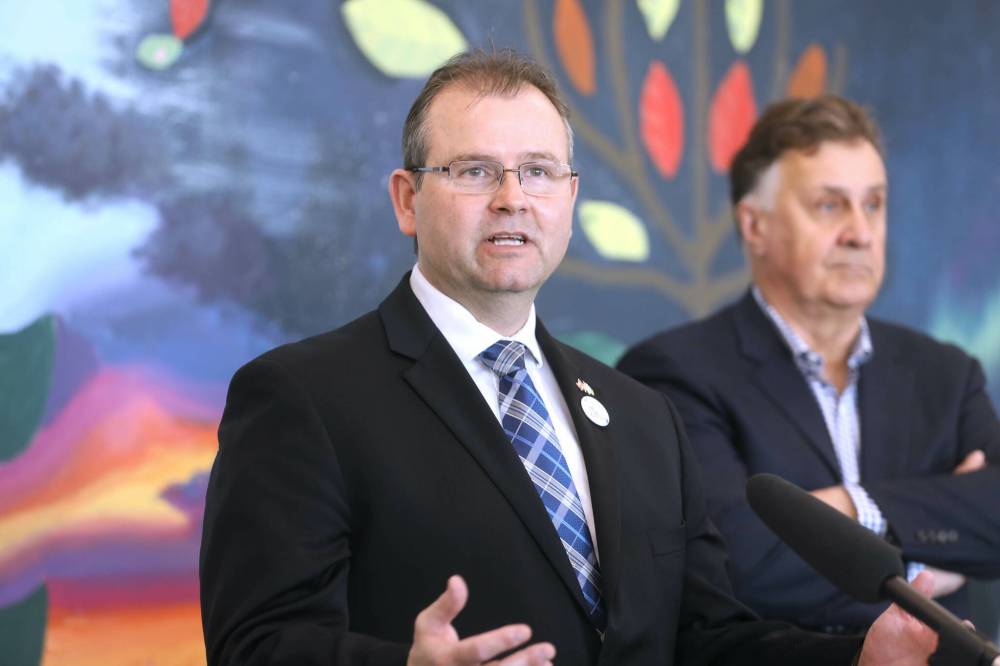
Education Minister Wayne Ewasko
It is a label normally used in heavy labour industries such as construction and manufacturing, not in schools.
According to records obtained by the Free Press under Manitoba’s access to information laws, more than 350 workplace and safety violations in schools were found by provincial officers between Sept. 1, 2022 and April 1, 2023.
Violations included shoddy electrical work, insufficient personal protective equipment, an absence of tool and machine safeguards and failure to prevent asbestos from becoming airborne.
The latter, found in two schools — Winnipeg-based College Beliveau and Nelson McIntyre Collegiate — may be among the most egregious, considering the lifelong risks associated with exposure to asbestos. Like many older buildings, some schools contain asbestos which, properly managed, usually poses little to no danger to people.
However, when safeguards are ignored and corners are cut, asbestos can become airborne, putting those exposed to it at risk of developing cancer in later years.
While the workplace safety and health findings focus primarily on schools as places of employment for teachers and support staff, they affect everyone who use the buildings and grounds, including students and community members.
Manitoba Education Minister Wayne Ewasko’s response to the findings last week was disappointing. Rather than launch a review of workplace safety and health for all schools to ensure they meet minimum standards, the minister’s office issued a statement reiterating government’s commitment to health and safety in schools.
Without an action plan, the minister’s statement was largely meaningless.

Mr. Ewasko also explained that health and safety issues in public schools are not all related to funding, although he used the opportunity to remind Manitobans that his government increased school funding this year by a record 6.1 per cent. The minister is correct that funding (or more precisely, a lack of funding in the case of the Progressive Conservative government over the past seven years) is not to blame for all safety and health issues in schools. Some are likely caused by weak or non-existent safety and health procedures that have little to do with budgets.
However, consecutive years of underfunding by the PC government, as well as provincially mandated limits on education property tax increases, have forced school divisions to delay building repairs and maintenance.
Per capita spending by school divisions was less than one per cent a year on average between 2016-17 and 2021-22. That is far below inflation and not nearly enough to keep pace with core operating costs. Building maintenance and repairs are often the first to fall by the wayside during budget cuts. One year of above-average funding by Mr. Ewasko in an election year will have little impact on that.
Ensuring public schools are safe and healthy places for students and staff requires an ongoing commitment by the provincial government.
That includes predictable and sustainable funding, something Manitobans have not seen in recent years.