

Rewriting history for political gain
Advertisement
Read this article for free:
or
Already have an account? Log in here »
To continue reading, please subscribe:

Digital Subscription
One year of digital access for only $205*
- Enjoy unlimited reading on winnipegfreepress.com
- Read the E-Edition, our digital replica newspaper
- Access News Break, our award-winning app
- Play interactive puzzles
*First annual payment billed as $205.00 + GST for one year. This annual subscription will automatically renew at $233.00 + GST every 52 weeks (10% off the regular annual price of $259.35). Offer available to new and qualified returning subscribers only. Cancel any time.
To continue reading, please subscribe:
Add Free Press access to your Brandon Sun subscription for only an additional
$1 for the first 4 weeks*
- Enjoy unlimited reading on winnipegfreepress.com
- Read the E-Edition, our digital replica newspaper
- Access News Break, our award-winning app
- Play interactive puzzles
*Your next Brandon Sun subscription payment will increase by $1.00 and you will be charged $17.95 plus GST for four weeks. After four weeks, your payment will increase to $24.95 plus GST every four weeks.
Read unlimited articles for free today:
or
Already have an account? Log in here »
Hey there, time traveller!
This article was published 04/08/2023 (1143 days ago), so information in it may no longer be current.
Terms such as “alternative facts” and “fake news” have become part of the political lexicon, proving weeds can take root in fertile soil as easily as crops do.
Former U.S. president Donald Trump and his spin doctors have used these tactics — telling a lie enough times that it’s perceived to be true — to score cheap political points, fire up adoring supporters and attack their enemies.
They can be a nuisance, like dandelions taking over the front lawn, such as when Trump’s spokespeople used “alternative facts” to dispute photographs of the small size of the crowd at his presidential inauguration in 2017.
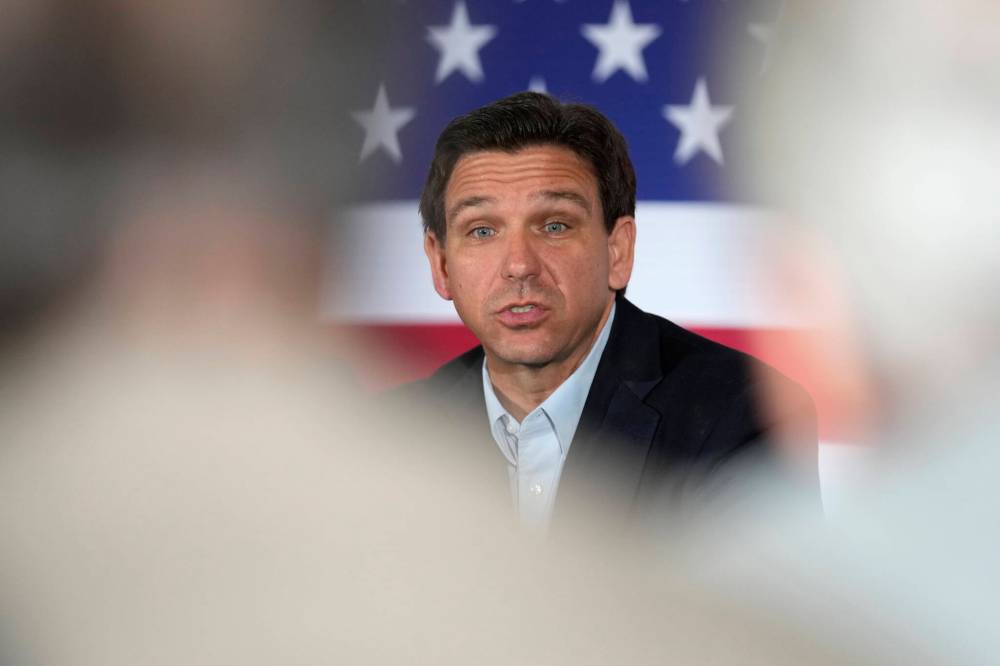
Robert F. Bukaty / Associated Press files
Florida Gov. Ron DeSantis wants students to learn a new interpretation of slavery.
They’re more noxious when political spin is presented as established history.
The latest preposterous example is from Florida, where the state’s board of education has included new curriculum that will teach children some Black people benefited from slavery by developing skills that could be used for their personal gain.
Florida Gov. Ron DeSantis, whose “war on wokeness” rhetoric is the centrepiece of his campaign for the 2024 Republican party’s presidential candidate in 2024, defended the new lessons.
“I think what they’re doing is they’re probably going to show some of the folks who eventually parlayed being a blacksmith into doing things later in life,” he said in a news conference when asked of the curriculum changes. “These were scholars who put that together. It was not anything that was done politically.”
DeSantis, whose candidacy is struggling in the polls, could use a refresher about slavery, whose effects from centuries ago continue to plague North America in 2023.
It was morally abhorrent when slave traders began kidnapping Africans in the 16th century to sell them to the highest bidder.
Slaves were physically and sexually assaulted by slavemasters, some of whom were British lords or American presidents. Those who tried to flee faced further tortures and indignities if they were captured.
It was a practice finally made illegal in the British Empire, including Canada, on Aug. 1, 1834.
It was just as vile in the United States, where enslaved families were split apart at the rap of an auctioneer’s gavel.
A constitutional amendment in 1865 abolished slavery, including in secessionist southern states, where the practice had become so entrenched it was a backbone of the economy.
Canada is no stranger to revisionist histories either, especially regarding the Indian residential school system, one of this country’s darkest chapters.
There are those who deny the deaths and minimize the physical and sexual abuses that took place at the residential schools, which were run by churches and established by the federal government in the 19th century.
The abuses were kept hidden for decades and only came to light after heart-rending testimony by residential school survivors at the Truth and Reconciliation Commission, which ran from 2008 to 2015.

Children were taken from their parents and transported to boarding schools, often hundreds of kilometres away. The children were not allowed to speak their languages or follow other aspects of their cultures.
A new round of realization and reconciliation occurred in 2021 when ground-penetrating radar discovered 215 anomalies believed to be graves of children buried near a former residential school in British Columbia.
Yet there remain denialists who have tried to dig up potential graves at the B.C. school in the middle of the night, says Kimberly Murray, Canada’s independent special interlocutor for missing children and the unmarked grave sites.
There’s no room for foolish “alternative facts.”
Those who care about passing on history to the next generation must match the vigilance of those who seek to spread their revised versions of the past.
Related Articles
Florida Gov. DeSantis suspends another Democratic prosecutor as he seeks GOP presidential nomination



Advertisement Advertise With Us
Advertisement Advertise With Us